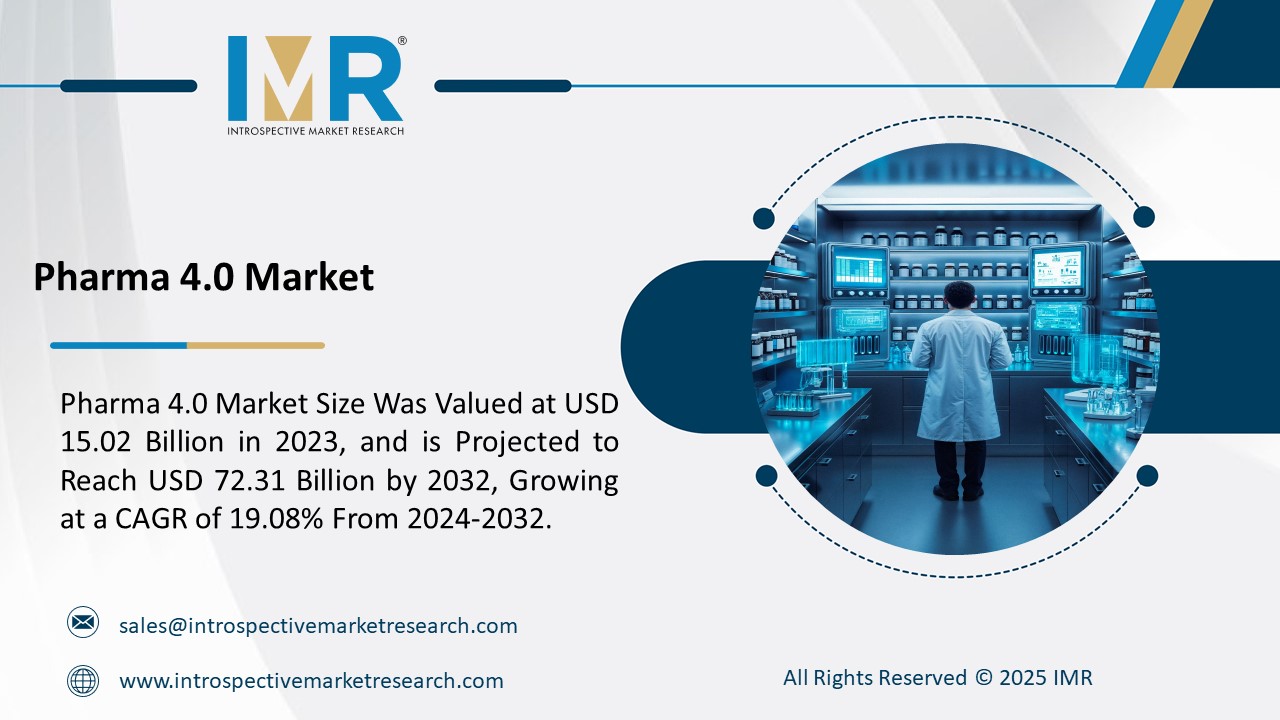
According to a new report published by Introspective Market Research, titled, Pharma 4.0 Market by Technology, Application, and End User, The Global Pharma 4.0 Market Size Was Valued at USD 15.02 Billion in 2023 and is Projected to Reach USD 72.31 Billion by 2032, Growing at a CAGR of 19.08%. Pharma 4.0 represents the next generation of digital transformation within the pharmaceutical industry, aligning with Industry 4.0 principles. It integrates advanced technologies such as artificial intelligence (AI), big data analytics, Internet of Things (IoT), robotics, and blockchain into pharmaceutical manufacturing, quality control, and supply chain management. This digital shift is enabling pharmaceutical companies to streamline operations, enhance drug development processes, and ensure higher levels of compliance and efficiency.
Unlike traditional pharmaceutical models, Pharma 4.0 provides real-time data insights, predictive analytics, and automated systems that minimize human error while increasing production efficiency. Its advantages include reduced operational costs, faster drug discovery, improved clinical trial management, and enhanced regulatory compliance. Major industries adopting Pharma 4.0 include biotechnology firms, pharmaceutical manufacturers, and contract development and manufacturing organizations (CDMOs), all of which are seeking to modernize processes and maintain competitiveness in a rapidly evolving healthcare landscape.
A key growth driver for the Pharma 4.0 market is the rising demand for digitalization and automation in pharmaceutical manufacturing. With increasing pressure to reduce time-to-market for new drugs and ensure regulatory compliance, pharmaceutical companies are rapidly adopting technologies like AI-driven predictive analytics and IoT-enabled smart factories. These technologies provide greater transparency, efficiency, and precision in operations, ultimately improving productivity and ensuring higher-quality drug output. The strong push from global regulatory bodies for digital compliance frameworks further accelerates Pharma 4.0 adoption worldwide.
One significant market opportunity lies in the integration of Pharma 4.0 with personalized medicine and precision healthcare. As demand for individualized therapies grows, companies are leveraging AI, machine learning, and advanced analytics to design tailored treatment pathways. Pharma 4.0 technologies enable rapid data processing, patient-centric manufacturing, and adaptive supply chain systems. Emerging markets, along with increased adoption of blockchain for secure clinical trial management, present lucrative opportunities for stakeholders to capitalize on this paradigm shift and establish leadership in the global pharmaceutical digital transformation.
Pharma 4.0 Market, Segmentation
Technology
-
The Technology segment is further classified into Artificial Intelligence, Big Data & Analytics, IoT, Cloud Computing, Blockchain, and Robotics. Among these, the Artificial Intelligence sub-segment accounted for the highest market share in 2023. AI enables predictive modeling, drug discovery acceleration, and optimization of manufacturing processes. Its application in reducing research timelines and increasing clinical trial efficiency has positioned AI as the most dominant technology driving Pharma 4.0 adoption globally.
Application
-
The Application segment is further classified into Drug Discovery, Manufacturing, Supply Chain Management, and Quality Control. Among these, the Manufacturing sub-segment accounted for the highest market share in 2023. Pharma 4.0 technologies such as IoT and robotics are revolutionizing pharmaceutical manufacturing by enabling real-time monitoring, smart batch production, and automation. These advancements significantly reduce costs, enhance compliance with global regulations, and improve scalability, making manufacturing the most impactful application of Pharma 4.0.
Some of The Leading/Active Market Players Are-
- Siemens Healthineers (Germany)
- Rockwell Automation (U.S.)
- Schneider Electric (France)
- Honeywell International Inc. (U.S.)
- SAP SE (Germany)
- Emerson Electric Co. (U.S.)
- Werum IT Solutions GmbH (Germany)
- Accenture plc (Ireland)
- Dassault Systèmes (France)
- Cognizant Technology Solutions (U.S.)
- IBM Corporation (U.S.)
- TATA Consultancy Services (India)
- Yokogawa Electric Corporation (Japan)
- Infosys Limited (India)
- PTC Inc. (U.S.)
- Other active players
Key Industry Developments
- In March 2024, Siemens Healthineers launched a next-generation Pharma 4.0 digital platform designed to optimize smart factory operations in pharmaceutical production.
The platform integrates AI-powered analytics and IoT connectivity, enabling real-time decision-making, predictive maintenance, and improved quality assurance in large-scale drug manufacturing facilities. - In July 2024, Rockwell Automation partnered with a global biopharmaceutical company to implement Pharma 4.0 solutions across multiple production plants.
The collaboration focuses on enhancing operational efficiency through robotics, cloud-based process monitoring, and blockchain-enabled supply chain traceability, significantly boosting manufacturing reliability and regulatory compliance.
Key Findings of the Study
- Artificial Intelligence and Manufacturing dominated the Pharma 4.0 market in 2023.
- North America and Europe lead in adoption, while Asia-Pacific shows the fastest growth.
- Rising digitalization and regulatory support are key market drivers.
- Integration of AI, IoT, and blockchain is shaping major trends in Pharma 4.0.