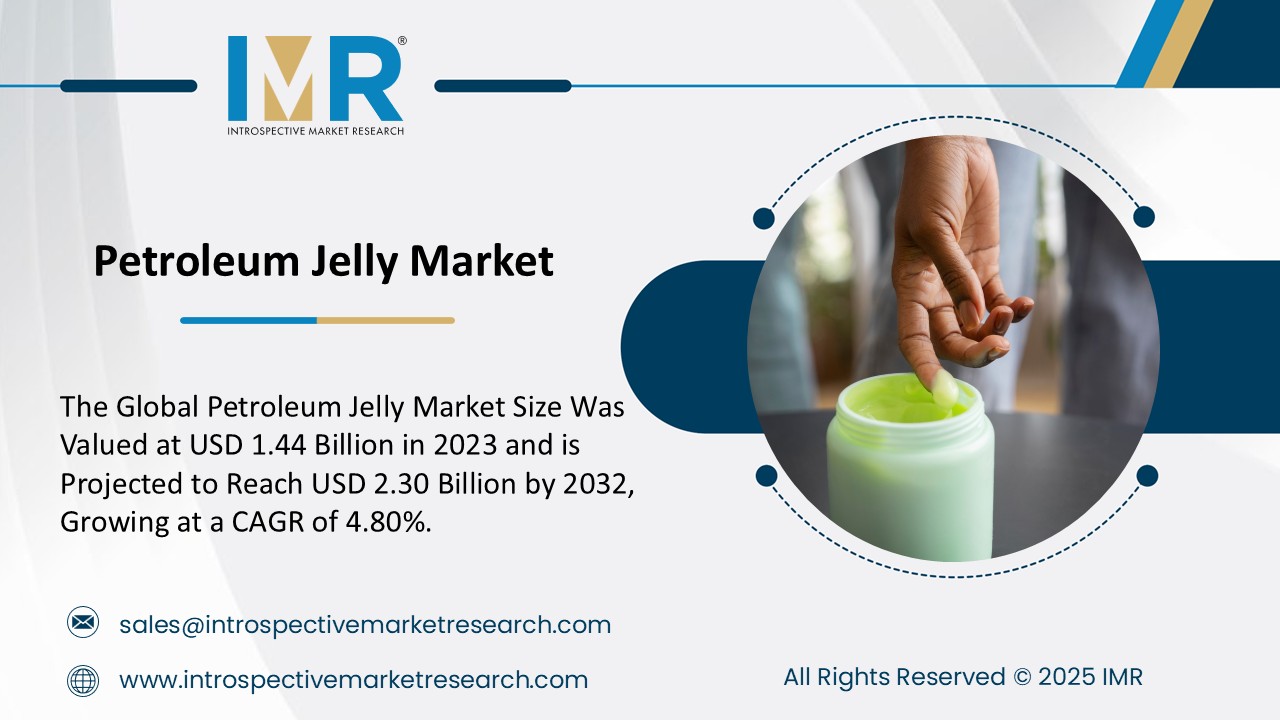
According to a new report published by Introspective Market Research, titled, Petroleum Jelly Market by Product Type, Application, and Region, The Global Petroleum Jelly Market Size Was Valued at USD 1.44 Billion in 2023 and is Projected to Reach USD 2.30 Billion by 2032, Growing at a CAGR of 4.80%. The petroleum jelly market comprises a versatile mixture of hydrocarbons primarily derived from petroleum refining processes. Its unique emollient and moisturizing properties make it widely used across pharmaceutical, cosmetic, and industrial sectors. Petroleum jelly offers advantages over traditional alternatives such as natural waxes due to its affordability, longer shelf life, and consistent quality.
This market is driven by increasing demand for skin care products, wound healing ointments, and lubricants. In pharmaceuticals, petroleum jelly is employed in topical treatments for burns and skin protection, while in cosmetics it serves as a base for moisturizers and lip care formulations. Industrially, it is used as a lubricant and protective coating, supporting growth across diverse applications.
The Petroleum Jelly Market is segmented into Product Type, Application, and Region. By Product Type, the market is categorized into White Petroleum Jelly, Yellow Petroleum Jelly, and Others. By Application, it is categorized into Personal Care, Pharmaceuticals, and Industrial Uses. By Region, the market is segmented into North America, Europe, Asia-Pacific, and Rest of the World.
One of the key growth drivers of the petroleum jelly market is the rising demand in the cosmetic and personal care industries. Increasing consumer awareness about skin hydration and protection has driven formulations incorporating petroleum jelly into lotions, creams, and lip balms. Its effectiveness and affordability support widespread adoption, accelerating market growth.
A significant market opportunity lies in expanding pharmaceutical applications as wound care and dermatological treatments advance. The need for effective topical agents in healing wounds, burns, and skin irritations is growing globally, offering manufacturers potential to develop high-grade, pharmaceutical-quality petroleum jelly products catering to healthcare demands.
Petroleum Jelly Market, Segmentation
The Petroleum Jelly Market is segmented on the basis of Product Type, Application, and Region.
Product Type
The White Petroleum Jelly sub-segment accounted for the highest market share in 2023. Known for its higher purity and refined quality, white petroleum jelly is preferred in pharmaceutical and personal care products. Its hypoallergenic nature and stability make it ideal for sensitive skin applications, driving its dominance in the market.
Application
The Personal Care segment held the largest share in 2023. Wide usage in skincare, lip care, and haircare products due to its moisturizing and protective characteristics fuels substantial demand. Consumer trends emphasizing skincare regimes and protection against harsh climates anchor this segment's leading position.
Some of The Leading/Active Market Players Are-
- ExxonMobil (USA)
- Unilever (UK)
- Sasol Limited (South Africa)
- Hindustan Unilever Limited (India)
- The Procter & Gamble Company (USA)
- Calumet Specialty Products Partners, L.P. (USA)
- Royal Dutch Shell plc (Netherlands)
- Savita Oil Technologies Limited (India)
- Petronas Chemicals Group Berhad (Malaysia)
- L'Oréal S.A. (France)
- and other active players.
Key Industry Developments
In August 2025, ExxonMobil launched a new pharmaceutical-grade petroleum jelly product line.
This move aims to meet stringent regulatory requirements and growing demand from healthcare industries, featuring enhanced purity and hypoallergenic properties specifically targeted at advanced wound care applications.
In June 2025, Unilever announced a sustainability initiative to develop eco-friendly petroleum jelly formulations.
The initiative includes sourcing renewable feedstocks and reducing carbon footprint in production processes, addressing growing consumer preference for sustainable personal care products.
Key Findings of the Study
- White Petroleum Jelly and Personal Care applications dominate the market.
- North America and Asia-Pacific are key regions leading market growth.
- Increasing demand in cosmetics and pharmaceuticals drives expansion.
- Sustainability and product innovation are emerging market trends.