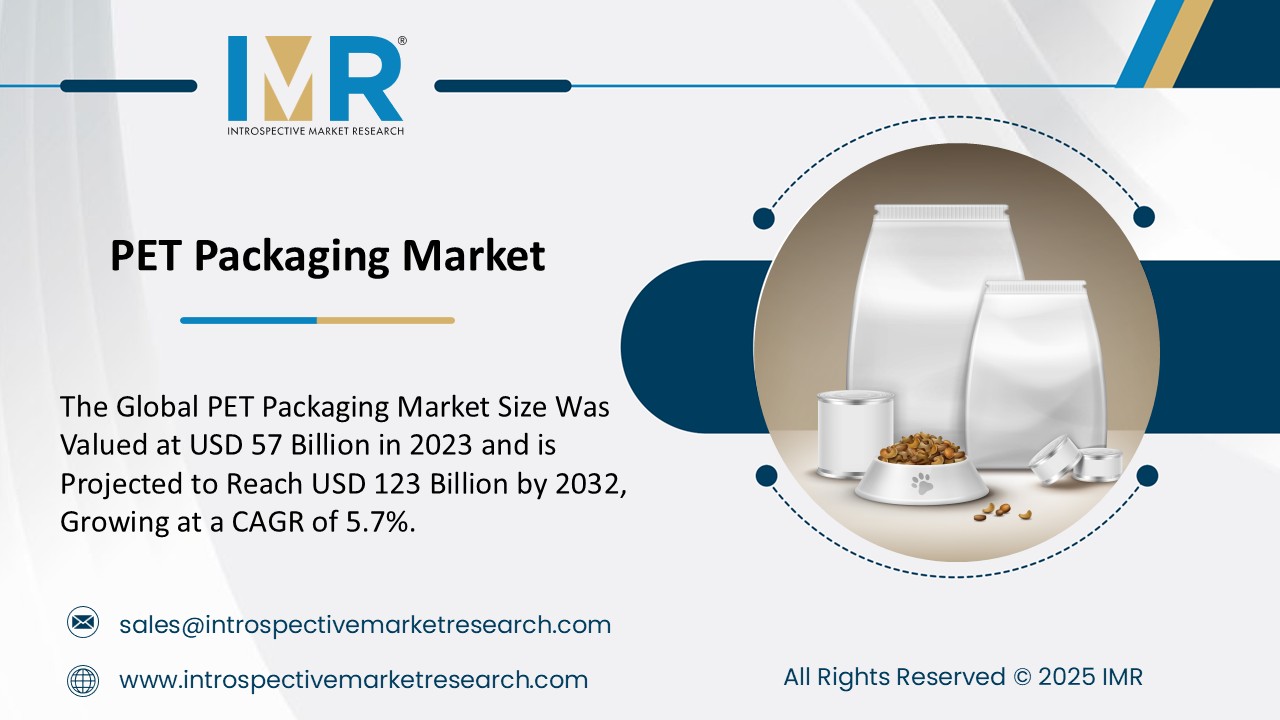
According to a new report published by Introspective Market Research, titled, “PET Packaging Market by Product Type, Packaging, and End-User Industry, The Global PET Packaging Market Size Was Valued at USD 57 Billion in 2023 and is Projected to Reach USD 123 Billion by 2032, Growing at a CAGR of 5.7%.”The PET Packaging Market comprises packaging solutions made from polyethylene terephthalate (PET), a versatile, lightweight, and recyclable plastic widely used in the food & beverage, pharmaceutical, and personal care sectors. PET packaging has rapidly replaced traditional materials such as glass and metal due to its durability, excellent barrier properties, and lower transportation costs. Its transparency and chemical resistance enhance product visibility and extend shelf life, making it highly attractive to brands and consumers alike.
Major industries benefit from PET packaging through reduced breakage risks, enhanced design flexibility, and compliance with stringent health and environmental standards. As global consumption of packaged goods rises—driven by lifestyle changes, urbanization, and demand for convenience—PET packaging is integral to addressing supply chain efficiency and evolving sustainability demands in both developed and emerging markets.
The PET Packaging Market is segmented into Product Type, Packaging, and End-User Industry.
By Product Type, the market is categorized into Bottles and Jars, Bags and Pouches, Trays, Lids/Caps and Closures, and Other Product Types.
By Packaging, it is categorized into Rigid and Flexible.
By End-User Industry, the market is categorized into Food and Beverage, Pharmaceuticals, Personal Care and Cosmetic Industry, Industrial Goods, Household Products, and Others.
A key growth driver for the PET Packaging Market is the global movement toward sustainable packaging. PET is favored for its recyclability, lightweight nature, and ability to reduce carbon emissions across the supply chain. Innovations in material science—including advanced rPET (recycled PET) and bio-based PET—are enabling manufacturers and consumer brands to meet eco-conscious regulatory mandates and increasing consumer demand for green packaging. These collective factors are propelling the rapid adoption of PET packaging across diverse applications worldwide.
A major opportunity lies in the integration of smart packaging technologies and enhanced recyclability. The emergence of interactive packaging solutions—incorporating QR codes and sensors—enables traceability, anti-counterfeit measures, and real-time communication with consumers. Meanwhile, growing government support for circular economy initiatives and investments in recycling infrastructure are opening new revenue streams for PET packaging firms capable of delivering innovative, sustainable, and value-added solutions.
PET Packaging Market, Segmentation
The PET Packaging Market is segmented on the basis of Product Type, Packaging, and End-User Industry.
Product Type
The Product Type segment is further classified into Bottles and Jars, Bags and Pouches, Trays, Lids/Caps and Closures, and Others. Among these, the Bottles and Jars sub-segment accounted for the highest market share in 2023. This dominance is due to high demand for PET bottles in food and beverages, particularly bottled water, soft drinks, and dairy. The segment benefits from PET’s lightweight, excellent barrier properties, and shatter-resistance, making it the preferred packaging format for major global brands and facilitating brand differentiation in crowded markets.
Packaging
The Packaging segment is further classified into Rigid and Flexible. In 2023, Rigid packaging—dominated by bottles and jars—held the largest share due to its strength, stability, and suitability for carbonated drinks, liquid food, and pharmaceuticals. PET’s rigidity ensures protection, product visibility, and compliance with international logistics standards, reinforcing its leadership over flexible alternatives.
Some of The Leading/Active Market Players Are-
- Amcor plc (Switzerland/Australia)
- Berry Global Group Inc. (U.S.)
- Gerresheimer AG (Germany)
- Silgan Holdings Inc. (U.S.)
- Tetra Laval International SA (Switzerland)
- Plastipak Holdings Inc. (U.S.)
- ALPLA Group (Austria)
- Constantia Flexibles Group GmbH (Austria)
- INOAC Corporation (Japan)
- LANINVER SHC SL (Spain)
- KP Holding GmbH & Co. KG (Germany)
- Retal Industries Ltd. (Cyprus)
- Resilux NV (Belgium)
- PET Power (Netherlands)
- Huhtamaki Oyj (Finland)
- Other active players.
Key Industry Developments
In August 2025, Amcor expanded its healthcare PET packaging network in Costa Rica, boosting its manufacturing footprint to meet growing demand across the pharmaceutical and medical devices industry. Through this capacity expansion, Amcor aims to further strengthen its market position in Latin America, providing sustainable and high-performance PET packaging solutions to healthcare customers.
In July 2025, the Pet Sustainability Coalition launched a global program to help brands transition to sustainable PET film and container solutions. The initiative encourages manufacturers to adopt rPET and bio-based PET, with a focus on reducing environmental impact, advancing recycling innovation, and promoting industry-wide adoption of circular economy standards.
Key Findings of the Study
- Bottles and jars remain the dominant product segment, led by food & beverage demand.
- Asia-Pacific is the fastest-growing and largest regional market for PET packaging.
- Sustainability, recyclability, and circular economy incentives are major growth drivers.
- Flexible packaging and smart solutions present high-growth opportunities.
- The market is shaped by continuous innovation, major expansions, and strong regulatory and consumer sustainability focus.