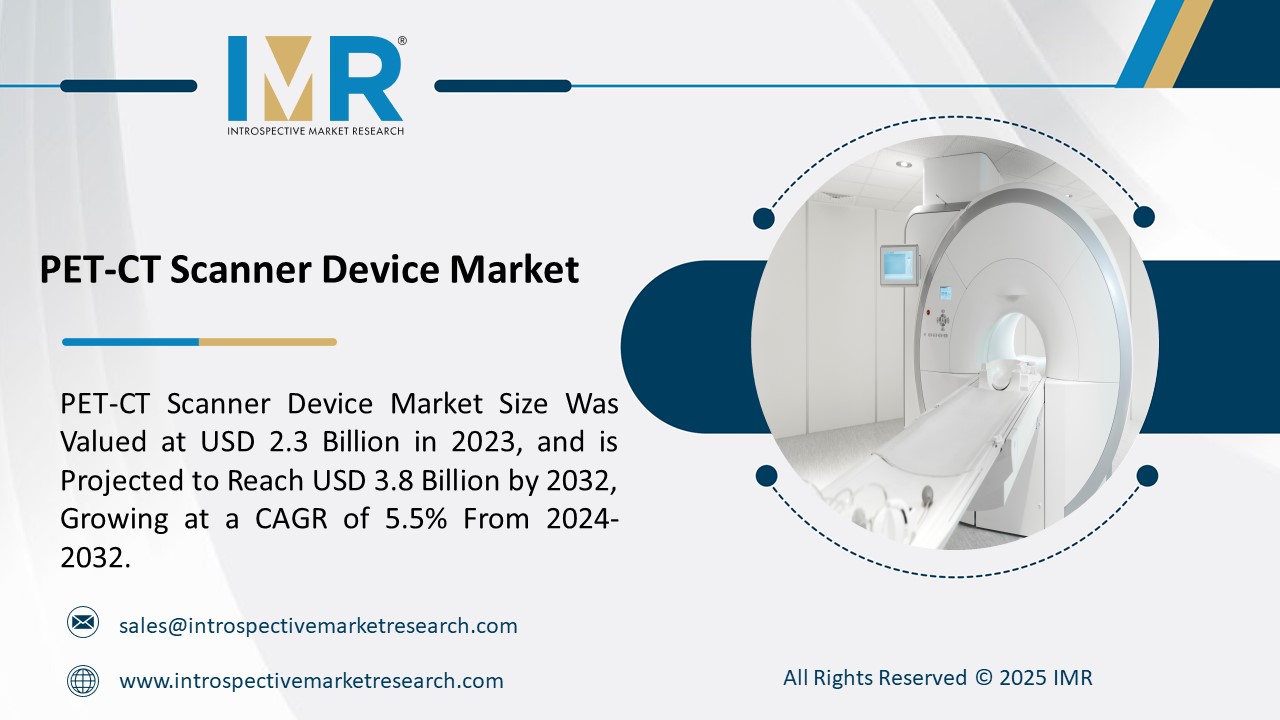
According to a new report published by Introspective Market Research, titled, “PET-CT Scanner Device Market by Type, Application, and End-User, The Global PET-CT Scanner Device Market Size Was Valued at USD 2.3 Billion in 2023 and is Projected to Reach USD 3.8 Billion by 2032, Growing at a CAGR of 5.5%. The global PET-CT Scanner Device Market is experiencing steady growth, driven by the increasing demand for accurate diagnostic imaging and the rising prevalence of chronic diseases such as cancer, cardiovascular disorders, and neurological conditions. PET-CT (Positron Emission Tomography–Computed Tomography) scanners combine the functional imaging of PET with the anatomical detail of CT, offering clinicians enhanced diagnostic capabilities in a single system.
Unlike traditional standalone imaging systems, PET-CT scanners provide real-time insights into metabolic activity and structural anatomy, enabling early disease detection and improved treatment planning. These devices are widely used in oncology for tumor localization, cardiology for myocardial viability assessment, and neurology for studying brain disorders such as Alzheimer’s disease.
Furthermore, advancements in detector technologies, growing adoption of hybrid imaging in hospitals, and the expansion of nuclear medicine infrastructure across emerging markets are significantly contributing to the market’s expansion. As healthcare providers shift toward value-based care and precision medicine, PET-CT scanners continue to play a vital role in delivering timely and accurate diagnostics.
A key growth driver for the PET-CT Scanner Device Market is the rising incidence of cancer and other chronic diseases globally. With the increasing need for early and accurate diagnosis, healthcare facilities are investing heavily in advanced imaging technologies. PET-CT scanners, which provide both functional and structural data, have become essential tools for oncologists to monitor tumor progression and evaluate treatment response. The ongoing shift toward precision diagnostics and personalized treatment further accelerates market demand.
The integration of AI and advanced image processing algorithms presents a significant market opportunity. AI-enabled PET-CT systems can automate image reconstruction, enhance image quality, and improve diagnostic accuracy by detecting subtle changes that may not be visible to the human eye. Additionally, cloud-based data sharing and remote interpretation are enabling faster decision-making and multidisciplinary collaboration, particularly beneficial in developing healthcare systems. These technological advancements are expected to create lucrative opportunities for market players over the coming years.
PET-CT Scanner Device Market, Segmentation
The PET-CT Scanner Device Market is segmented on the basis of Type, Application, and End-User.
Type
- The Type segment is further classified into Stationary Scanners and Portable Scanners. Among these, the Stationary Scanners sub-segment accounted for the highest market share in 2023.
- Stationary PET-CT scanners are preferred by large hospitals and diagnostic centers due to their superior imaging resolution, advanced detector systems, and integration with high-capacity imaging workflows. Their ability to handle a high volume of patient scans makes them ideal for comprehensive diagnostic and treatment planning applications, especially in oncology.
Application
- The Application segment is further classified into Oncology, Cardiology, and Neurology. Among these, the Oncology sub-segment accounted for the highest market share in 2023.
- The dominance of the oncology segment is attributed to the growing use of PET-CT scanners for cancer detection, staging, and treatment monitoring. These devices enable precise localization of tumors and assessment of therapeutic efficacy, leading to improved patient outcomes. The increasing global cancer burden continues to drive consistent demand for oncology-focused imaging solutions.
Some of The Leading/Active Market Players Are:
- Siemens Healthineers AG (Germany)
- GE HealthCare Technologies Inc. (U.S.)
- Canon Medical Systems Corporation (Japan)
- Philips Healthcare (Netherlands)
- United Imaging Healthcare Co., Ltd. (China)
- Positron Corporation (U.S.)
- Neusoft Medical Systems Co., Ltd. (China)
- Hitachi Ltd. (Japan)
- Spectrum Dynamics Medical (Israel)
- Mediso Ltd. (Hungary)
- Shimadzu Corporation (Japan)
- CMR Naviscan Corporation (U.S.)
- Kromek Group plc (U.K.)
- Trivitron Healthcare Pvt. Ltd. (India)
- And other active players.
Key Industry Developments
- In April 2024, GE HealthCare introduced its new Omni Legend digital PET-CT system, designed to enhance image clarity and reduce scan times. The system integrates advanced AI-assisted reconstruction technology, improving diagnostic precision for oncology and neurology applications.
- In July 2024, Siemens Healthineers launched the Biograph Vision Quadra PET-CT system, offering an extended axial field of view for whole-body imaging in a single scan. The device aims to advance clinical research and improve throughput for healthcare providers.
Key Findings of the Study
- Stationary PET-CT scanners dominated the market in 2023.
- The oncology segment held the largest share due to growing cancer screening programs.
- North America led the market owing to high adoption of advanced imaging systems.
- AI integration and digitalization are emerging as key market trends.
- Strategic collaborations among manufacturers are shaping technological innovation