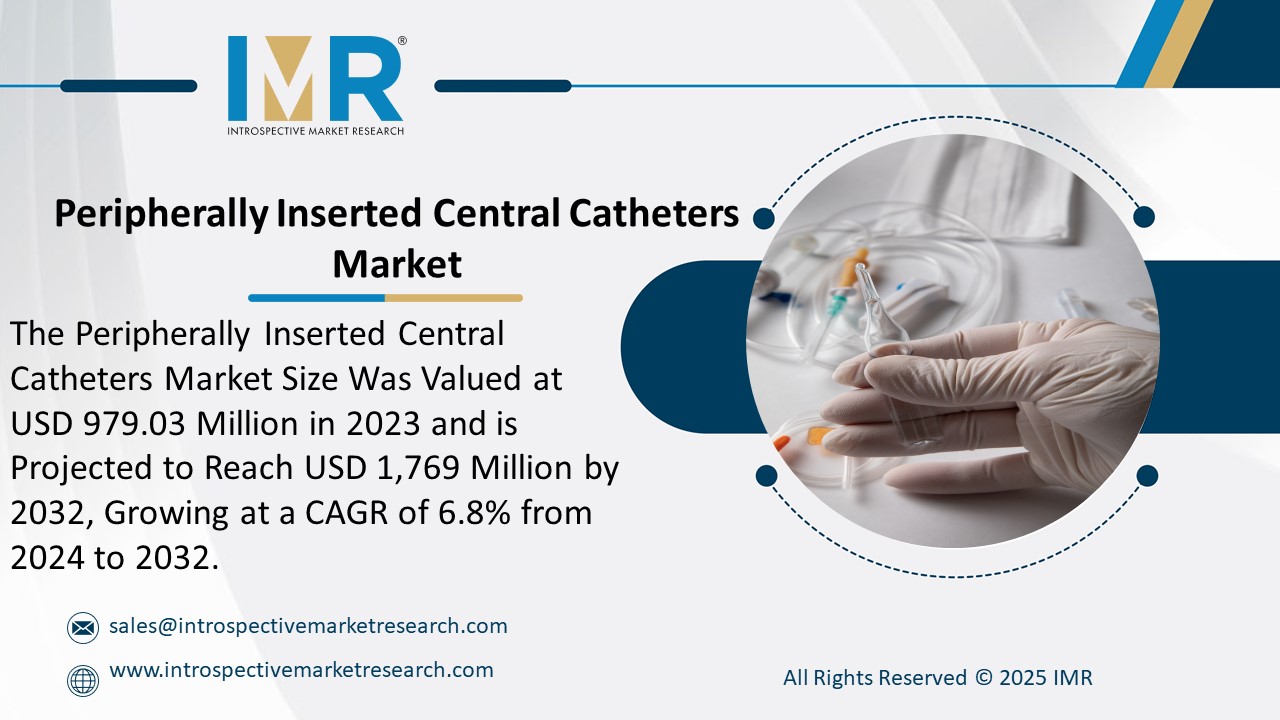
According to a new report published by Introspective Market Research, titled, Peripherally Inserted Central Catheters Market by Product Type, Application, and Region, The Global Peripherally Inserted Central Catheters Market Size Was Valued at USD 979.03 Million in 2023 and is Projected to Reach USD 1,769 Million by 2032, Growing at a CAGR of 6.8% from 2024 to 2032. Peripherally Inserted Central Catheters (PICCs) are long, thin, flexible tubes inserted into peripheral veins—commonly in the arm—and advanced to central veins near the heart. They provide extended vascular access for long-term therapies such as chemotherapy, parenteral nutrition, antibiotic administration, and frequent blood sampling. Compared to traditional central venous catheters inserted in the chest or neck, PICCs are less invasive, lower risk in placement, and suitable for outpatient care, making them a preferred choice in many clinical settings.
PICCs are constructed using medical-grade polymers (e.g. polyurethane, silicone) and may include antimicrobial coatings or multi-lumen designs to support different simultaneous therapies. They are especially valuable in oncology, critical care, and home infusion therapies where long-dwell vascular access is needed. The rising global burden of cancer, growth in ambulatory care, and shift toward home-based healthcare are major factors fueling PICC adoption.
The Peripherally Inserted Central Catheters Market is segmented into Product Type, Application, and Region. By Product Type, the market is categorized into (Single Lumen, Double Lumen, Triple or Multi-Lumen). By Application, the market is categorized into (Oncology / Chemotherapy, Parenteral Nutrition, Long-Term Antibiotic Therapy, Blood Sampling & Diagnostics, Others). By Region, the market is categorized into (North America, Europe, Asia-Pacific, Latin America, Middle East & Africa).
One of the foremost growth drivers in the PICC market is the increasing prevalence of cancer and chronic diseases globally. PICCs play a central role in chemotherapy delivery, long-term intravenous therapies, and supportive care—serving patients who require frequent infusions over weeks or months. As the incidence of cancer rises and treatment protocols intensify, the demand for reliable, long-dwell vascular access devices like PICCs escalates. Additionally, improvements in catheter materials, coating technologies (antimicrobial, antithrombogenic), and insertion techniques (ultrasound guidance) enhance safety and adoption, further driving market expansion.
A key opportunity in the PICC market lies in the growing shift toward outpatient and home infusion therapies. Healthcare systems globally are promoting home-based care to reduce hospital stays and costs. PICCs allow patients to receive therapies such as antibiotics, nutrition, or infusions at home with minimal intervention. Providers and device manufacturers that deliver patient-centric PICC systems—easy to manage, low complication rates, integration with remote monitoring, and training support—can capture this growing segment. This opportunity is particularly strong in regions where hospital infrastructure is constrained, and home care demand is rising.
Peripherally Inserted Central Catheters Market, Segmentation
The Peripherally Inserted Central Catheters Market is segmented on the basis of Product Type, Application, and Region.
Product Type
The Product Type segment is further classified into Single Lumen, Double Lumen, and Triple or Multi-Lumen. Among these, the Single Lumen sub-segment accounted for the highest market share in 2023. Single lumen PICCs are simpler, lower cost, and reduce complication risks associated with multiple lumens. They are sufficient for many chemotherapy and infusion protocols and thus remain dominant in clinical adoption, especially in resource-sensitive settings.
Application
The Application segment is further classified into Oncology / Chemotherapy, Parenteral Nutrition, Long-Term Antibiotic Therapy, Blood Sampling & Diagnostics, and Others. Among these, the Oncology / Chemotherapy sub-segment accounted for the highest market share in 2023. Given the high frequency and long-term nature of chemotherapy regimens, oncology patients rely heavily on PICCs for repeated intravenous access, thereby driving significant volume demand in this use case.
Some of The Leading/Active Market Players Are-
- Becton, Dickinson & Company (USA)
- AngioDynamics, Inc. (USA)
- Teleflex Incorporated (USA)
- Smiths Medical (UK)
- Medtronic plc (USA)
- C. R. Bard / BD (USA)
- Baxter International Inc. (USA)
- Cook Medical LLC (USA)
- Cardinal Health (USA)
- Johnson & Johnson (USA)
- other active players.
Key Industry Developments
-
In April 2025, Becton, Dickinson & Company launched a next-generation PICC line with integrated antimicrobial and thrombosis-resistant coating.
This advanced PICC model aims to reduce catheter-related bloodstream infections and clot formation by combining antimicrobial and antithrombotic surface technologies. The product is targeted at oncology and long-term infusion markets, offering enhanced patency, lower complication risks, and improved patient outcomes. BD’s decision reflects growing demand for safer, high-performance vascular access solutions and addresses hospital and regulatory pressures to lower infection rates. - In January 2025, AngioDynamics acquired a European PICC manufacturer to expand its chronic vascular access portfolio.
The acquisition broadens AngioDynamics’ geographic footprint and product range in PICC and vascular access devices across Europe and emerging markets. The acquired company brings specialized catheter designs and distribution networks in key countries. This strategic move strengthens AngioDynamics’ position in the global PICC market and supports supply chain localization, cost efficiencies, and faster market access in Europe and Asia.
Key Findings of the Study
- Single lumen PICCs lead by product type due to simplicity and safety.
- Oncology / chemotherapy is the largest application driving demand.
- North America and Europe dominate adoption because of advanced healthcare infrastructure.
- Growth is propelled by rising cancer incidence and home infusion trends.
- Advances in antimicrobial and antithrombotic catheter technologies are shaping future growth.