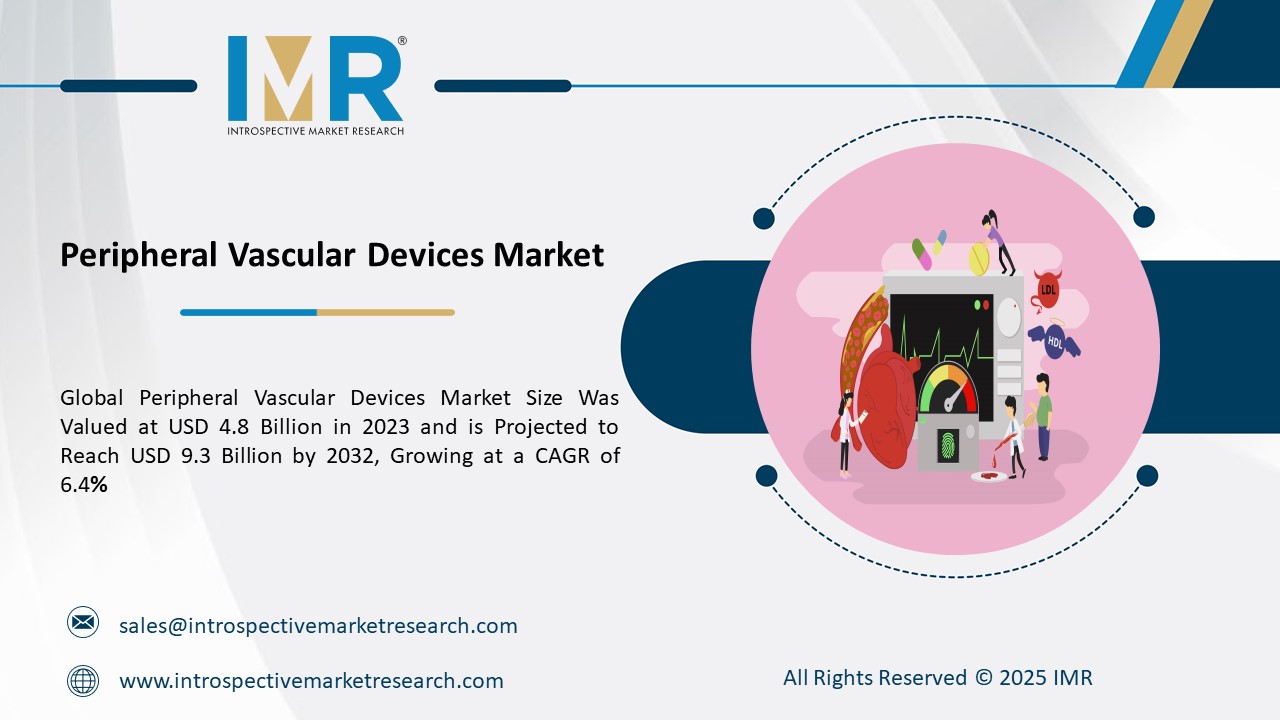
According to a new report published by Introspective Market Research, titled, Peripheral Vascular Devices Market by Product Type, Application, and End User, The Global Peripheral Vascular Devices Market Size Was Valued at USD 4.8 Billion in 2023 and is Projected to Reach USD 9.3 Billion by 2032, Growing at a CAGR of 6.4%.The global peripheral vascular devices market is witnessing steady growth, driven by the rising prevalence of peripheral artery disease (PAD), increasing geriatric population, and technological advancements in minimally invasive treatment options. Peripheral vascular devices are used to diagnose and treat disorders of the peripheral arteries and veins, such as blockages, aneurysms, and deep vein thrombosis. These devices include stents, catheters, angioplasty balloons, guidewires, and filters, which play a crucial role in restoring normal blood flow and preventing severe complications.
The growing adoption of endovascular procedures, supported by enhanced imaging technologies and advanced material design, has significantly improved patient outcomes and reduced recovery times. Moreover, the increasing healthcare expenditure and awareness regarding early diagnosis of vascular diseases are expected to fuel the demand for these devices across hospitals and specialty clinics worldwide.
The Peripheral Vascular Devices Market is segmented into Product Type, Application, and End User.
-
By Product Type: the market is categorized into Peripheral Stents, Angioplasty Balloons, Catheters, Guidewires, Inferior Vena Cava (IVC) Filters, and Others.
-
By Application: the market is categorized into Peripheral Artery Disease, Deep Vein Thrombosis, Pulmonary Embolism, and Others.
-
By End User: the market is categorized into Hospitals, Ambulatory Surgical Centers, and Specialty Clinics.
A key growth driver for the peripheral vascular devices market is the increasing incidence of peripheral artery disease and other vascular disorders globally. Sedentary lifestyles, obesity, diabetes, and smoking have all contributed to rising cases of vascular blockages. This trend, combined with an aging population more susceptible to such conditions, is boosting the demand for innovative and minimally invasive devices that provide faster recovery and reduced procedural risks.
A significant market opportunity lies in the development of next-generation bioresorbable and drug-eluting vascular devices. Manufacturers are focusing on creating products that combine mechanical support with drug delivery capabilities, enabling better healing and lower restenosis rates. Additionally, the expansion of healthcare infrastructure in emerging economies and increasing access to advanced interventional therapies are likely to create lucrative growth prospects in the coming years.
Peripheral Vascular Devices Market, Segmentation
The Peripheral Vascular Devices Market is segmented on the basis of Product Type, Application, and End User.
Product Type
The Product Type segment is further classified into Peripheral Stents, Angioplasty Balloons, Catheters, Guidewires, Inferior Vena Cava (IVC) Filters, and Others. Among these, the Peripheral Stents sub-segment accounted for the highest market share in 2023. Peripheral stents are widely used in endovascular treatments to restore blood flow and maintain vessel patency, especially in patients with PAD, making them a leading choice among healthcare providers.
Application
The Application segment is further classified into Peripheral Artery Disease, Deep Vein Thrombosis, Pulmonary Embolism, and Others. Among these, the Peripheral Artery Disease sub-segment accounted for the highest market share in 2023. The increasing global prevalence of PAD, coupled with a surge in endovascular interventions, continues to drive demand in this segment.
Some of The Leading/Active Market Players Are:
- Abbott Laboratories (USA)
- Medtronic plc (Ireland)
- Boston Scientific Corporation (USA)
- Terumo Corporation (Japan)
- Becton, Dickinson and Company (USA)
- Cook Medical (USA)
- Cardinal Health, Inc. (USA)
- B. Braun Melsungen AG (Germany)
- Koninklijke Philips N.V. (Netherlands)
- AngioDynamics, Inc. (USA)
- Cordis Corporation (USA)
- Penumbra, Inc. (USA)
- Teleflex Incorporated (USA)
- Gore Medical (USA)
- BIOTRONIK SE & Co. KG (Germany)
- other active players.
Key Industry Developments
- In March 2024, Medtronic launched its latest generation of drug-eluting stents designed specifically for the treatment of complex peripheral artery disease.
This product aims to improve vessel healing, reduce restenosis, and enhance long-term patient outcomes. - In August 2024, Boston Scientific acquired a minority stake in a vascular device startup focusing on bioresorbable scaffold technology.
The collaboration is expected to accelerate innovation in next-generation vascular implants and strengthen Boston Scientific’s peripheral intervention portfolio.
Key Findings of the Study
- Peripheral stents held the dominant market share in 2023.
- Peripheral artery disease remains the leading application segment.
- North America led the market, driven by high healthcare spending and advanced medical infrastructure.
- Growth driven by rising prevalence of vascular diseases and minimally invasive treatments.
- Technological innovation and emerging market expansion present significant future opportunities.