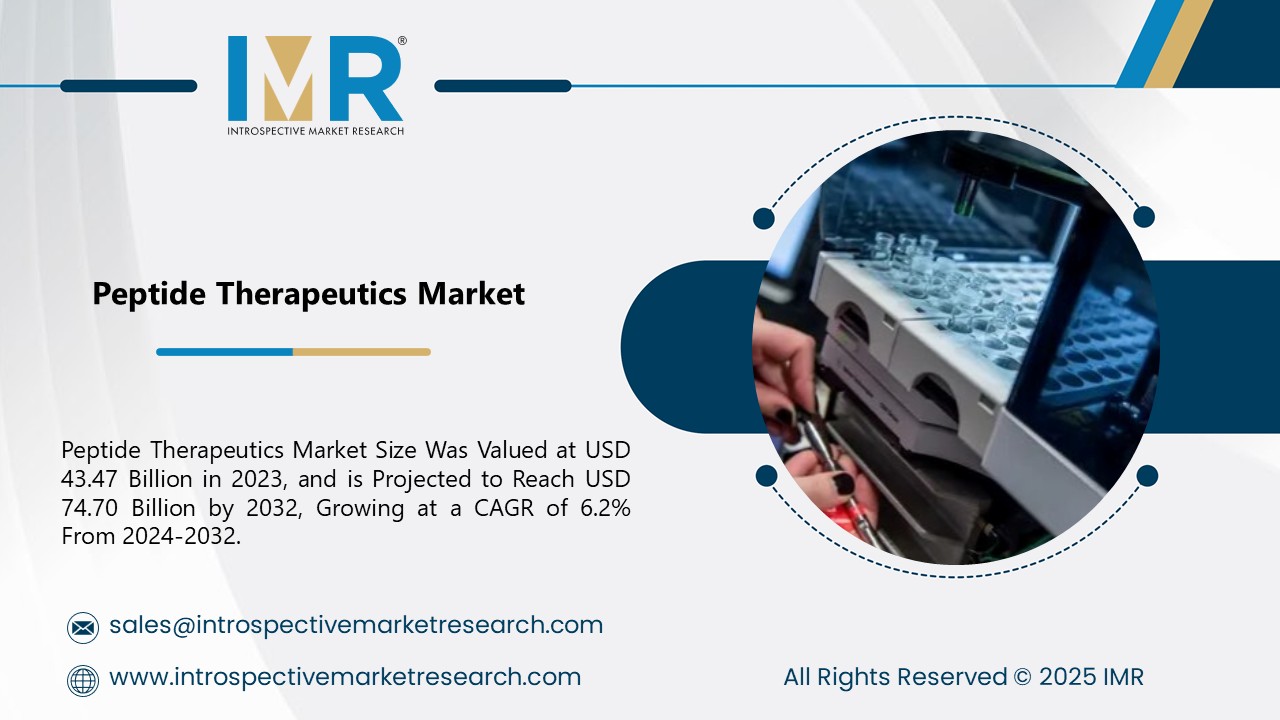
According to a new report published by Introspective Market Research, titled, Peptide Therapeutics Market by Type (Branded Peptides, Generic Peptides), by Application (Oncology, Metabolic Disorders, Cardiovascular Disorders, Central Nervous System Disorders, Gastrointestinal Disorders, Anti-infectives, Others), by Route of Administration (Parenteral, Oral, Others), by Synthesis Technology (Solid Phase Peptide Synthesis, Liquid Phase Peptide Synthesis, Hybrid Phase Peptide Synthesis), by End-User (Hospitals, Specialty Clinics, Academic & Research Institutes), The Global Peptide Therapeutics Market Size Was Valued at USD 43.47 Billion in 2023 and is Projected to Reach USD 74.70 Billion by 2032, Growing at a CAGR of 6.2%. The Peptide Therapeutics Market is experiencing significant expansion, driven by the increasing recognition of peptides as a distinct and highly effective class of pharmaceutical drugs. Peptides are short chains of amino acids that can selectively bind to specific receptors or targets in the body, offering high potency, specificity, and generally favorable safety profiles compared to traditional small molecule drugs or large biological proteins. This market encompasses a wide range of therapeutic applications, from oncology and metabolic disorders to cardiovascular and central nervous system conditions, leveraging their natural biological mechanisms.
These therapeutics offer several advantages over traditional alternatives, including lower toxicity, reduced immunogenicity, and targeted action, which minimizes off-target effects. Their main uses are prominent in major industries such as the pharmaceutical and biotechnology sectors for treating chronic diseases, rare disorders, and various types of cancer. Hospitals and specialty clinics are primary end-users, where these advanced treatments are administered to patients requiring innovative and precise therapeutic interventions. The ongoing research and development in peptide synthesis and delivery technologies further underscore the market's growth potential.
The Peptide Therapeutics Market is segmented into Type, Application, Route of Administration, Synthesis Technology, and End-User. By Type, the market is categorized into Branded Peptides and Generic Peptides. By Application, the market is categorized into Oncology, Metabolic Disorders, Cardiovascular Disorders, Central Nervous System Disorders, Gastrointestinal Disorders, Anti-infectives, and Others. By Route of Administration, the market is categorized into Parenteral, Oral, and Others. By Synthesis Technology, the market is categorized into Solid Phase Peptide Synthesis, Liquid Phase Peptide Synthesis, and Hybrid Phase Peptide Synthesis. By End-User, the market is categorized into Hospitals, Specialty Clinics, and Academic & Research Institutes.
key growth driver for the Peptide Therapeutics Market is the increasing prevalence of chronic and lifestyle-related diseases globally, such as diabetes, obesity, and various forms of cancer. Peptides offer highly targeted and often more tolerable treatment options for these complex conditions compared to traditional drugs. For instance, glucagon-like peptide-1 (GLP-1) receptor agonists have revolutionized the treatment of type 2 diabetes and obesity. As these diseases continue to rise, the demand for effective and safer therapeutic alternatives drives significant investment in peptide drug discovery and development, expanding the market. The high specificity and reduced off-target effects of peptide drugs make them attractive for managing long-term conditions.
A significant market opportunity in the Peptide Therapeutics Market lies in the advancement of novel peptide delivery systems, particularly those enabling oral administration. Currently, the majority of peptide drugs are administered via injection (parenteral route) due to their susceptibility to enzymatic degradation in the gastrointestinal tract and poor membrane permeability. Developing stable and bioavailable oral peptide formulations would revolutionize patient convenience, adherence, and market access, especially for chronic conditions requiring frequent dosing. Innovations in technologies like encapsulation, permeation enhancers, and prodrug strategies to overcome these bioavailability challenges represent a vast untapped potential, promising to significantly expand the market by broadening the applicability and patient acceptance of peptide therapeutics.
Peptide Therapeutics Market, Segmentation
The Peptide Therapeutics Market is segmented on the basis of Type, Application, Route of Administration, Synthesis Technology, and End-User.
Type
- The Type segment is further classified into Branded Peptides and Generic Peptides. Among these, the Branded Peptides sub-segment accounted for the highest market share in 2023. Branded peptides hold the largest market share primarily due to the significant investment required in research and development, clinical trials, and regulatory approvals for novel peptide drugs. These proprietary therapeutics are protected by patents, allowing pharmaceutical companies to maintain market exclusivity and premium pricing for a period. Their high efficacy, specific mechanisms of action, and established safety profiles in various therapeutic areas, such as oncology and metabolic disorders, further contribute to their dominant position. The introduction of innovative branded peptides continues to drive the market, reflecting their strong clinical value and commercial success.
Application
- The Application segment is further classified into Oncology, Metabolic Disorders, Cardiovascular Disorders, Central Nervous System Disorders, Gastrointestinal Disorders, Anti-infectives, and Others. Among these, the Metabolic Disorders sub-segment accounted for the highest market share in 2023. The metabolic disorders segment dominates the peptide therapeutics market, primarily driven by the widespread use and success of GLP-1 receptor agonists for the treatment of type 2 diabetes and obesity. Drugs like semaglutide and liraglutide have revolutionized the management of these chronic conditions, offering significant benefits in blood glucose control, weight loss, and cardiovascular risk reduction. The global epidemic of diabetes and obesity, coupled with the proven efficacy and relatively favorable safety profiles of these peptide-based therapies, ensures sustained high demand and makes metabolic disorders the leading application area in the market.
Some of The Leading/Active Market Players Are-
- Novo Nordisk A/S (Denmark)
- Eli Lilly and Company (US)
- Takeda Pharmaceutical Company Limited (Japan)
- Amgen Inc. (US)
- Bristol Myers Squibb Company (US)
- Pfizer Inc. (US)
- Sanofi S.A. (France)
- Merck & Co., Inc. (US)
- AstraZeneca Plc (UK)
- Novartis AG (Switzerland)
- Teva Pharmaceutical Industries Ltd. (Israel)
- Bachem Holding AG (Switzerland)
- PolyPeptide Group AG (Switzerland)
- Ipsen S.A. (France)
- Ferring Pharmaceuticals (Switzerland)
Key Industry Developments
- In October 2023, Novo Nordisk announced positive results from its FLOW clinical trial, demonstrating that semaglutide (Wegovy/Ozempic) significantly reduced the risk of kidney disease events in people with type 2 diabetes and chronic kidney disease.
This finding expands the therapeutic potential of GLP-1 receptor agonists beyond glucose control and weight management, highlighting their broad benefits for metabolic and cardiovascular health. It reinforces semaglutide's value, potentially leading to broader indications and increased usage in managing complex comorbidities. - In September 2023, Eli Lilly and Company presented new data at the European Association for the Study of Diabetes (EASD) showing that its dual GIP/GLP-1 receptor agonist, tirzepatide (Mounjaro), provided superior glycemic control and weight loss compared to insulin glargine in type 2 diabetes patients.
This reinforces tirzepatide's strong clinical profile as a highly effective treatment for type 2 diabetes, offering significant advantages in both glycemic management and weight reduction. The data further solidifies its competitive position in the metabolic disorders segment, driving its adoption in clinical practice.
Key Findings of the Study
- Branded peptides dominate, driven by R&D investment and patent protection.
- Metabolic disorders hold the largest application share, led by GLP-1 agonists for diabetes/obesity.
- North America maintains its lead due to advanced R&D infrastructure and high healthcare expenditure.
- Increasing prevalence of chronic diseases is a primary growth driver.
- The market trend is towards novel delivery systems, especially oral formulations, to enhance patient convenience.