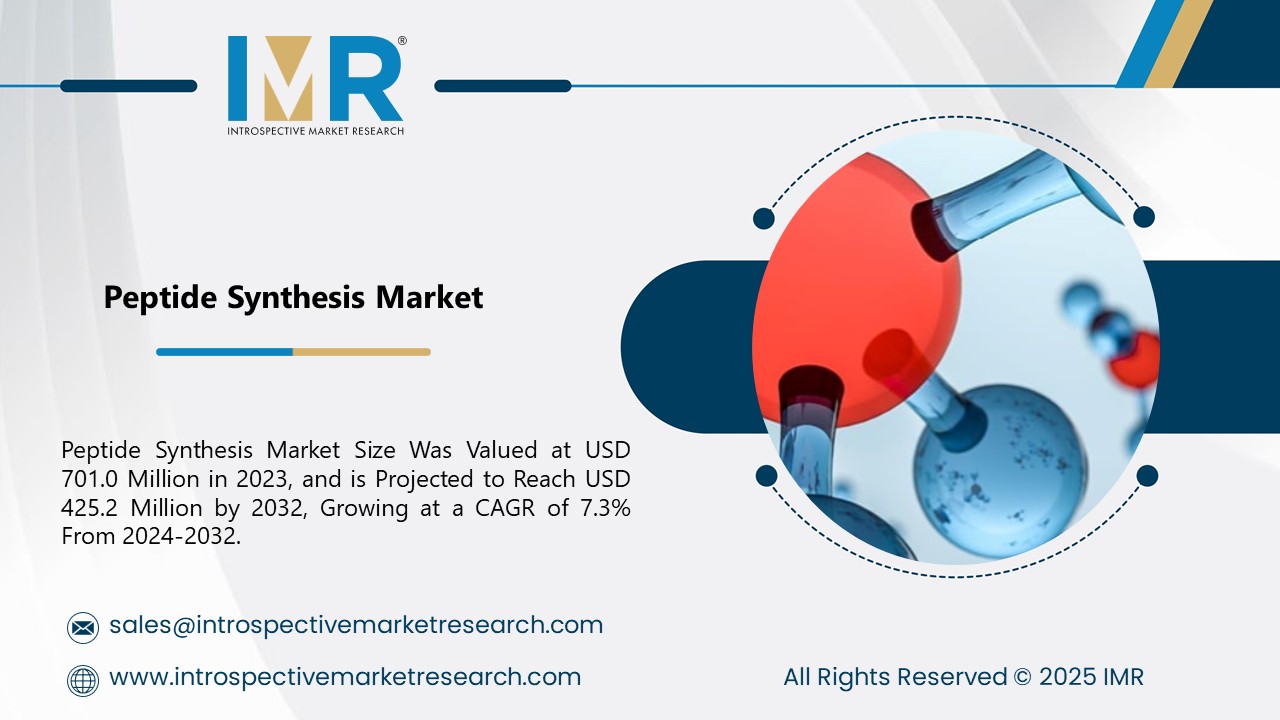
According to a new report published by Introspective Market Research, titled, Peptide Synthesis Market by Product (Reagents & Consumables, Equipment, Services), by Technology (Solid Phase Peptide Synthesis, Liquid Phase Peptide Synthesis, Hybrid Phase Peptide Synthesis), by Application (Therapeutics, Diagnostics, Research), by End-User (Pharmaceutical & Biotechnology Companies, Contract Research Organizations, Academic & Research Institutes), The Global Peptide Synthesis Market Size Was Valued at USD 701.0 Million in 2023 and is Projected to Reach USD 425.2 Million by 2032, Growing at a CAGR of 7.3%. The Peptide Synthesis Market is a crucial segment within the broader biotechnology and pharmaceutical industries, providing essential tools and services for the creation of peptides. Peptides are short chains of amino acids that serve as building blocks for proteins and act as key biological messengers, making them invaluable in drug discovery, diagnostics, and fundamental research. This market encompasses reagents, equipment, and services used to synthesize custom peptides, both for therapeutic applications and academic studies. These advanced synthesis methods offer significant advantages over extracting peptides from natural sources, providing higher purity, scalability, and the ability to create novel peptide sequences.
The primary product and service offerings in this market include automated peptide synthesizers, a wide array of amino acids and coupling reagents, and contract synthesis services. Its main uses span major industries such as pharmaceutical and biotechnology companies, which utilize synthetic peptides for drug development, clinical trials, and manufacturing of peptide therapeutics. Contract Research Organizations (CROs) leverage these capabilities for outsourced research, while academic and research institutes rely on them for various biological studies, contributing to the understanding of disease mechanisms and the development of new diagnostic tools.
The Peptide Synthesis Market is segmented into Product, Technology, Application, and End-User. By Product, the market is categorized into Reagents & Consumables, Equipment, and Services. By Technology, the market is categorized into Solid Phase Peptide Synthesis, Liquid Phase Peptide Synthesis, and Hybrid Phase Peptide Synthesis. By Application, the market is categorized into Therapeutics, Diagnostics, and Research. By End-User, the market is categorized into Pharmaceutical & Biotechnology Companies, Contract Research Organizations, and Academic & Research Institutes.
A key growth driver for the Peptide Synthesis Market is the increasing demand for peptide-based therapeutics and diagnostics. Peptides are gaining prominence as a versatile class of drugs due to their high specificity, low toxicity, and ability to modulate biological processes effectively. The rising prevalence of chronic diseases such as cancer, diabetes, and autoimmune disorders fuels the research and development of novel peptide drugs. This surge in therapeutic and diagnostic applications directly translates to a higher demand for synthetic peptides for preclinical and clinical studies, as well as for commercial production, thereby significantly expanding the peptide synthesis market.
A significant market opportunity in the Peptide Synthesis Market lies in the growing adoption of automated and high-throughput peptide synthesizers, particularly in drug discovery and development. These advanced instruments offer increased efficiency, reproducibility, and speed, enabling researchers to synthesize a large number of diverse peptide libraries in a shorter timeframe. As pharmaceutical and biotechnology companies increasingly focus on accelerating their drug discovery pipelines and exploring novel peptide candidates, the demand for sophisticated automation solutions will surge. This presents a substantial opportunity for manufacturers of peptide synthesis equipment to develop and market more advanced, user-friendly, and scalable automated systems that cater to the evolving needs of high-volume research and therapeutic development.
Peptide Synthesis Market, Segmentation
The Peptide Synthesis Market is segmented on the basis of Product, Technology, Application, and End-User.
Product
- The Product segment is further classified into Reagents & Consumables, Equipment, and Services. Among these, the Reagents & Consumables sub-segment accounted for the highest market share in 2023. The dominance of the Reagents & Consumables segment is attributed to their continuous demand in every step of peptide synthesis, regardless of the technology or scale. This includes a vast array of specialty amino acids, coupling reagents, resins, solvents, and purification media, which are essential for both manual and automated synthesis processes. As research and development activities in peptide therapeutics and diagnostics escalate, so does the recurring need for these fundamental components. The high frequency of purchase and the diversity of specialized reagents required for complex peptide sequences ensure this segment maintains the largest market share.
Technology
- The Technology segment is further classified into Solid Phase Peptide Synthesis, Liquid Phase Peptide Synthesis, and Hybrid Phase Peptide Synthesis. Among these, the Solid Phase Peptide Synthesis sub-segment accounted for the highest market share in 2023. Solid Phase Peptide Synthesis (SPPS) has been the cornerstone of peptide synthesis for decades due to its relative simplicity, efficiency, and amenability to automation. The technique involves anchoring the growing peptide chain to an insoluble resin, allowing for easy removal of excess reagents and byproducts through washing steps. This significantly streamlines the purification process compared to liquid-phase methods. Its robust nature, capacity for synthesizing complex peptide sequences, and widespread adoption in both academic research and industrial production of therapeutic peptides have firmly established SPPS as the leading technology in the market.
Some of The Leading/Active Market Players Are-
- Thermo Fisher Scientific Inc. (US)
- Merck KGaA (Germany)
- Lonza Group AG (Switzerland)
- GenScript Biotech Corporation (US)
- AnaSpec, Inc. (US)
- Sartorius AG (Germany)
- CEM Corporation (US)
- Activotec GmbH (Germany)
- Bachem Holding AG (Switzerland)
- PolyPeptide Group AG (Switzerland)
- CSBio (US)
- Pepscan (Netherlands)
- JPT Peptide Technologies GmbH (Germany)
- Creative Peptides (US)
- Peptide Institute, Inc. (Japan)
Key Industry Developments
In September 2023, GenScript Biotech Corporation announced the launch of its new ultra-high-throughput peptide synthesis platform, aimed at accelerating drug discovery efforts. This platform significantly reduces synthesis time and increases the yield of complex peptides.
This development addresses the critical need for faster and more efficient peptide synthesis in pharmaceutical research, enabling scientists to screen a wider range of peptide candidates for potential therapeutic applications. It underscores the ongoing innovation in automated synthesis to meet increasing demands in drug discovery pipelines.
In August 2023, Thermo Fisher Scientific expanded its portfolio of peptide synthesis reagents, introducing new high-purity, environmentally friendly amino acid derivatives and coupling reagents. These products are designed to improve synthesis efficiency and reduce waste.
This initiative supports the growing industry focus on sustainable practices in chemical synthesis. The introduction of greener reagents not only enhances the efficiency and purity of peptide production but also aligns with the broader environmental goals of pharmaceutical and biotechnology companies, offering tangible benefits for researchers and manufacturers.
Key Findings of the Study
- Reagents & Consumables hold the largest product share due to continuous demand.
- Solid Phase Peptide Synthesis (SPPS) is the dominant technology, valued for its efficiency and automation compatibility.
- North America leads the market, driven by robust pharmaceutical R&D and academic research.
- Increasing demand for peptide therapeutics and diagnostics is a primary growth driver.
- The market trend is towards automation and high-throughput systems for accelerated drug discovery.