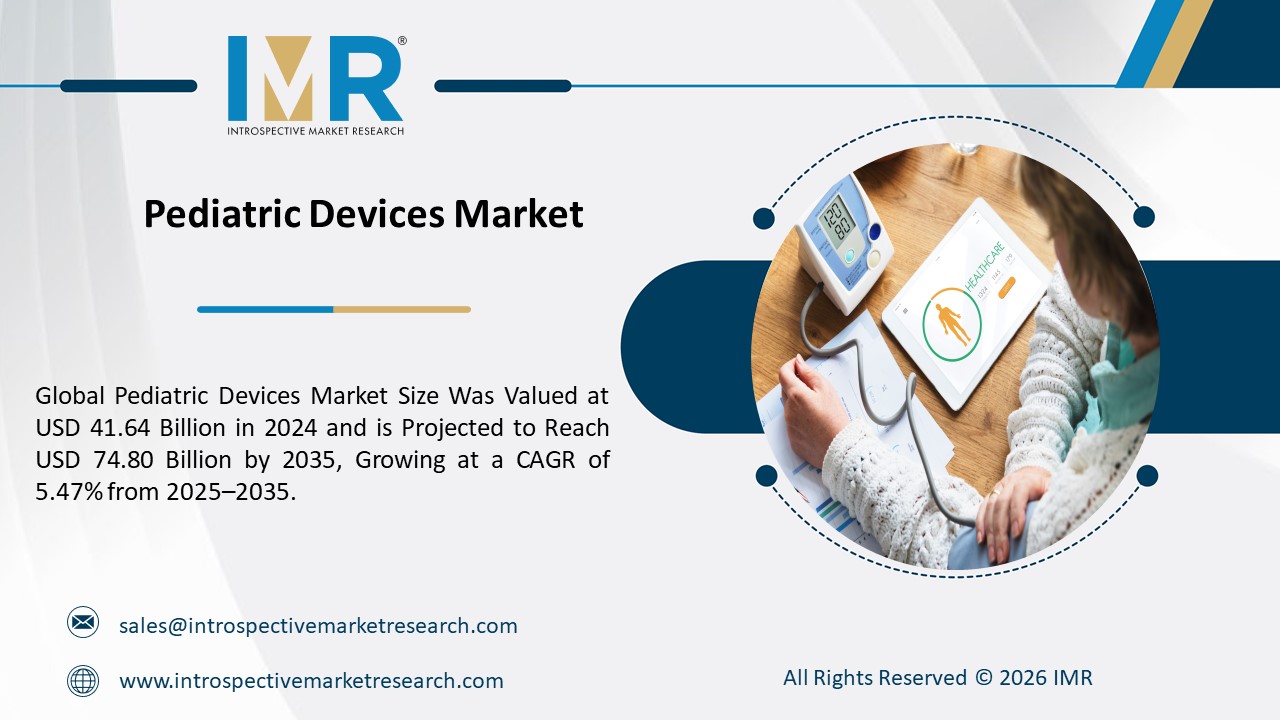
“According to a new report published by Introspective Market Research, titled, Pediatric Devices Market by Product Type, Application, and End User, The Global Pediatric Devices Market Size Was Valued at USD 41.64 Billion in 2024 and is Projected to Reach USD 74.80 Billion by 2035, Growing at a CAGR of 5.47% from 2025–2035.”
The pediatric devices market comprises a wide range of medical devices specifically designed to diagnose, monitor, and treat health conditions in infants, children, and adolescents. These devices include neonatal monitoring systems, pediatric ventilators, infusion pumps, orthopedic implants, and diagnostic imaging equipment tailored to pediatric anatomy and physiology. Compared to conventional adult medical devices, pediatric devices offer enhanced safety, precision, and age-appropriate functionality, ensuring improved clinical outcomes and reduced risk of complications.
The market is witnessing steady growth due to rising pediatric population, increasing prevalence of congenital disorders, respiratory diseases, and chronic conditions among children, and growing demand for advanced neonatal and pediatric care. Technological advancements such as miniaturization of devices, integration of digital health solutions, and development of child-friendly designs are further strengthening market adoption.
Additionally, increasing healthcare expenditure, expansion of pediatric hospitals and neonatal intensive care units (NICUs), and supportive government initiatives aimed at improving child healthcare infrastructure are significantly contributing to the growth of the pediatric devices market across developed and emerging economies.
Market Segmentation
The Pediatric Devices Market is segmented into Product Type, Application, and End User.
- By Product Type, the market is categorized into (Diagnostic Devices, Therapeutic Devices, Monitoring Devices).
- By Application, the market is categorized into (Neonatology, Cardiology, Orthopedics, Respiratory Care, Others).
- By End User, the market is categorized into (Hospitals, Pediatric Clinics, Home Care Settings).
Growth Driver
One of the primary growth drivers of the pediatric devices market is the increasing prevalence of pediatric diseases and premature births worldwide. Rising cases of neonatal respiratory distress, congenital heart defects, and orthopedic abnormalities have increased the demand for specialized pediatric medical devices. Furthermore, advancements in neonatal care and improved survival rates of preterm infants are driving the adoption of sophisticated monitoring and therapeutic devices. Growing awareness among healthcare professionals and parents regarding early diagnosis and timely intervention is also fueling market growth.
Market Opportunity
A key market opportunity lies in the rapid adoption of technologically advanced and minimally invasive pediatric devices in emerging economies. Increasing investments in healthcare infrastructure, expansion of pediatric specialty hospitals, and growing access to advanced medical technologies in regions such as Asia-Pacific and Latin America present significant growth potential. Moreover, the integration of digital health technologies, remote monitoring solutions, and AI-based diagnostics in pediatric care is expected to create new revenue streams and enhance patient outcomes over the forecast period.
Detailed Segmentation
Pediatric Devices Market, Segmentation
The Pediatric Devices Market is segmented on the basis of Product Type, Application, and End User.
Product Type
The Product Type segment is further classified into Diagnostic Devices, Therapeutic Devices, and Monitoring Devices. Among these, the Monitoring Devices sub-segment accounted for the highest market share in 2024. This dominance is attributed to the widespread use of neonatal monitors, pulse oximeters, and vital sign monitoring systems in NICUs and pediatric wards. Continuous monitoring is critical for early detection of complications in infants and children, driving consistent demand for these devices across healthcare settings.
Application
The Application segment is further classified into Neonatology, Cardiology, Orthopedics, Respiratory Care, and Others. Among these, the Neonatology sub-segment accounted for the highest market share in 2024. The high share is driven by the increasing number of preterm births and the growing need for advanced neonatal care equipment such as incubators, ventilators, and monitoring systems to support infant survival and development.
Some of The Leading/Active Market Players Are-
• Medtronic plc (Ireland)
• GE HealthCare Technologies Inc. (USA)
• Koninklijke Philips N.V. (Netherlands)
• Siemens Healthineers AG (Germany)
• Johnson & Johnson (USA)
• Baxter International Inc. (USA)
• Boston Scientific Corporation (USA)
• Stryker Corporation (USA)
• Getinge AB (Sweden)
• Fisher & Paykel Healthcare (New Zealand)
• Natus Medical Incorporated (USA)
• Drägerwerk AG & Co. KGaA (Germany)
• Smiths Medical (UK)
• Masimo Corporation (USA)
• Cook Medical (USA)
and other active players.
Key Industry Developments
In March 2024, a leading medical device manufacturer launched an advanced neonatal monitoring system designed to improve real-time tracking of vital parameters in preterm infants.
The new system integrates AI-based analytics to enhance early detection of complications, supporting improved clinical decision-making and patient outcomes in NICUs.
In September 2024, a global healthcare company expanded its pediatric device portfolio through a strategic acquisition aimed at strengthening its presence in emerging markets.
This development is expected to enhance product accessibility, expand distribution networks, and accelerate innovation in pediatric care technologies.
Key Findings of the Study
• Monitoring devices dominated the product segment due to high usage in NICUs
• Neonatology emerged as the leading application segment
• North America held a significant market share driven by advanced healthcare infrastructure
• Rising pediatric disease prevalence is a key growth driver
• Technological innovation is a major market trend