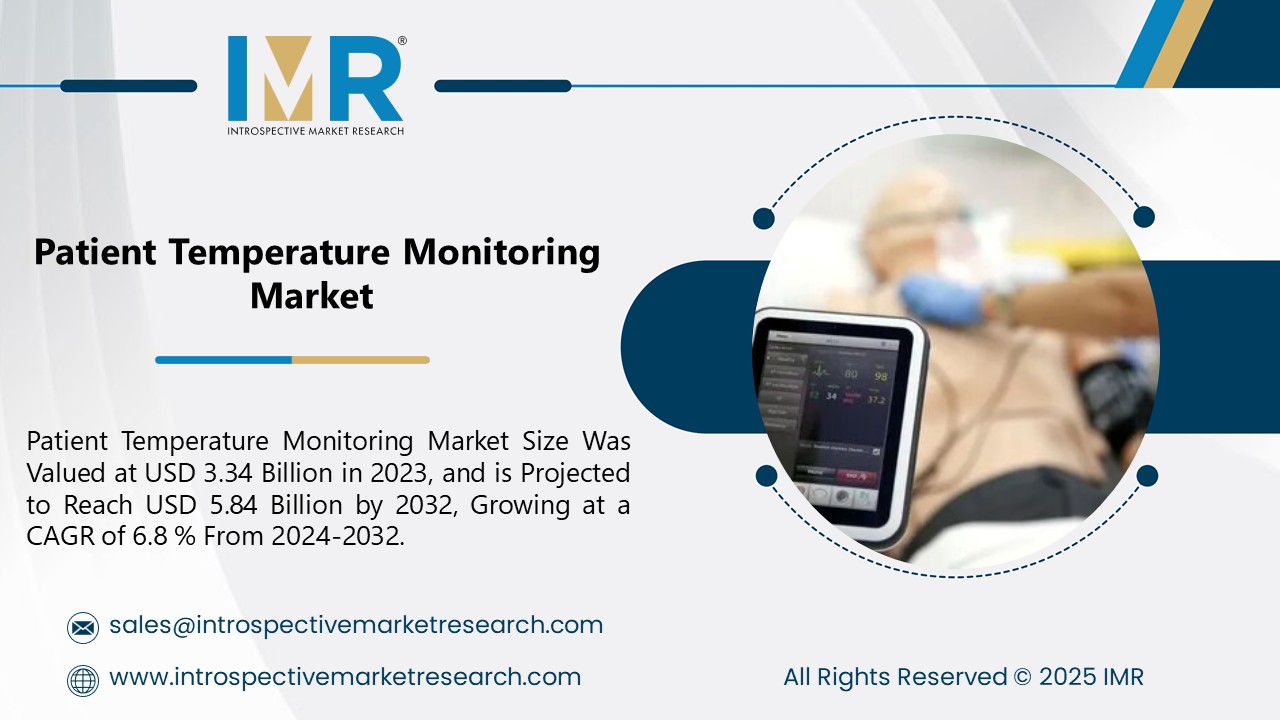
According to a new report published by Introspective Market Research, titled, Patient Temperature Monitoring Market by Product Type, Application, and End-Use, The Global Patient Temperature Monitoring Market Size Was Valued at USD 3.34 Billion in 2023 and is Projected to Reach USD 5.84 Billion by 2032, Growing at a CAGR of 6.8% from 2024 to 2032. The Patient Temperature Monitoring Market is witnessing robust growth, driven by the rising prevalence of chronic illnesses, infectious diseases, and the growing importance of continuous health monitoring in clinical as well as home-care settings. Patient temperature monitoring systems provide critical real-time data that help in early diagnosis, treatment planning, and effective patient management.
Unlike traditional thermometers, modern patient temperature monitoring devices are integrated with IoT, wireless connectivity, and smart sensors, allowing seamless data sharing with healthcare professionals and electronic health record (EHR) systems. Their adoption is rising in hospitals, ambulatory care, and home healthcare, especially due to the demand for remote monitoring solutions and improved patient safety.
One of the key growth drivers of the Patient Temperature Monitoring Market is the increasing adoption of remote patient monitoring solutions. The COVID-19 pandemic accelerated the shift towards telehealth and contactless monitoring, with healthcare providers and patients relying on wireless thermometers and continuous wearable devices to track vital signs. This trend continues to expand as healthcare systems integrate advanced monitoring technologies to enhance patient safety, reduce hospital readmissions, and improve treatment efficiency.
The growing integration of AI-powered predictive analytics in temperature monitoring devices presents a major market opportunity. Smart systems that analyze patient data in real time can predict complications such as infection onset or post-surgical fever, enabling preventive interventions. Furthermore, emerging markets in Asia-Pacific and Latin America are expected to offer significant opportunities due to expanding healthcare infrastructure, increasing medical device adoption, and government investments in digital healthcare technologies.
Patient Temperature Monitoring Market, Segmentation
The Patient Temperature Monitoring Market is segmented on the basis of Product Type, Application, and End-Use.
Segment A: Product Type
- The Product Type segment is further classified into Wearable Continuous Monitoring Devices, Non-Invasive Thermometers, and Smart Temperature Monitoring Patches. Among these, the Wearable Continuous Monitoring Devices sub-segment accounted for the highest market share in 2023, owing to their ability to provide real-time continuous temperature data, integration with mobile health applications, and increased use in critical care and home settings. The growing adoption of connected health devices and patient preference for non-invasive monitoring further fuel its dominance.
Segment B: Application
- The Application segment is further classified into Fever Management, Hypothermia Management, Anesthesia & Surgery, and Others. Among these, the Fever Management sub-segment accounted for the highest market share in 2023, as fever remains a common clinical symptom requiring frequent monitoring. With rising incidences of infectious diseases such as influenza and COVID-19, healthcare providers prioritize accurate temperature monitoring, driving demand in this sub-segment.
Some of The Leading/Active Market Players Are-
- 3M Company (USA)
- Koninklijke Philips N.V. (Netherlands)
- Hill-Rom Holdings, Inc. (USA)
- Masimo Corporation (USA)
- Terumo Corporation (Japan)
- Cardinal Health, Inc. (USA)
- Drägerwerk AG & Co. KGaA (Germany)
- Microlife Corporation (Taiwan)
- Welch Allyn (USA)
- Omron Healthcare (Japan)
- Braun Healthcare (Germany)
- American Diagnostic Corporation (USA)
- Cosinuss GmbH (Germany)
- Exergen Corporation (USA)
- Medtronic plc (Ireland)
…and other active players.
Key Industry Developments
- April 2024: Masimo launched a new wearable continuous temperature monitoring device designed for post-surgical recovery and home monitoring. The device enables remote data transmission to physicians, improving patient follow-ups and reducing readmissions.
This innovation highlights the industry’s growing shift toward remote, AI-enabled monitoring solutions. - January 2023: Philips introduced an AI-integrated patient monitoring system that combines temperature tracking with other vital signs. The solution is designed to support ICUs and emergency care units, enhancing predictive analytics and early warning systems.
This development underscores the industry’s focus on smart, integrated healthcare platforms.
Key Findings of the Study
- Wearable Continuous Monitoring Devices dominate the product type segment.
- Fever Management leads the application segment.
- North America holds the largest market share, while Asia-Pacific is the fastest-growing region.
- Rising demand for remote patient monitoring is a major growth driver.
- Integration of AI and IoT in medical devices is shaping future market trends.