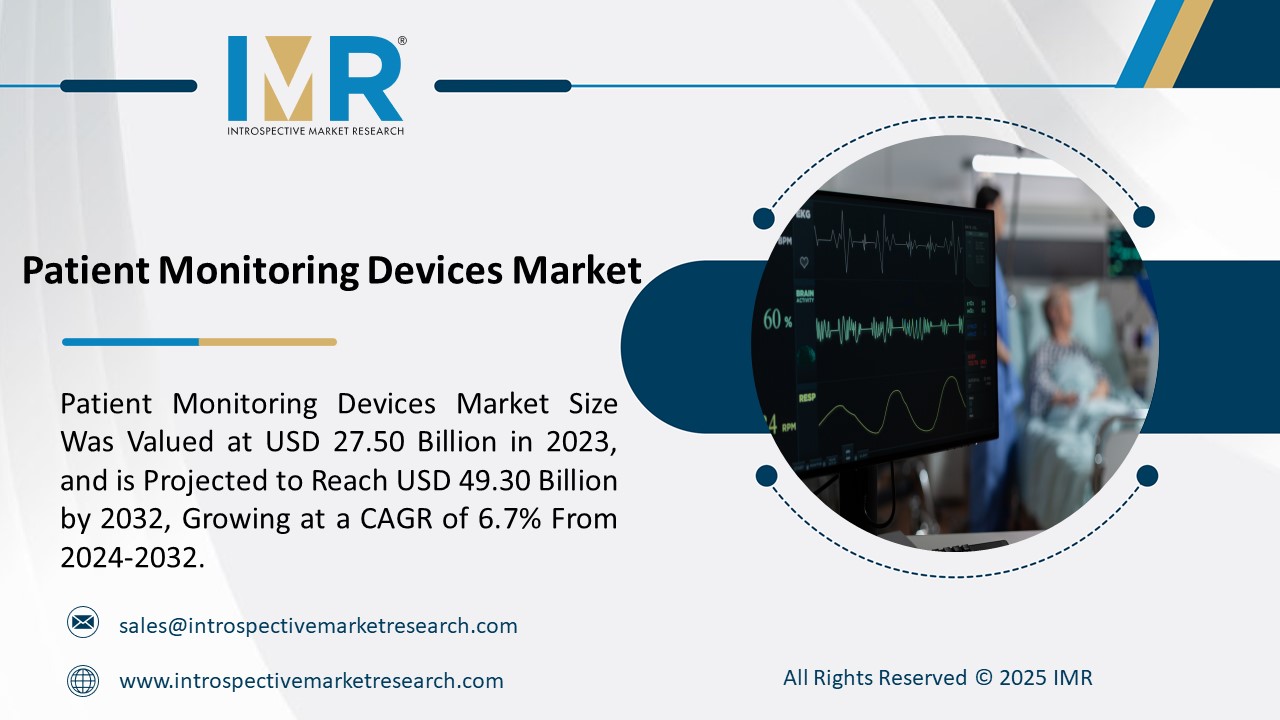
According to a new report published by Introspective Market Research, titled, Global Patient Monitoring Devices Market by Key Segments, The Global Patient Monitoring Devices Market Size Was Valued at USD 27.50 Billion in 2023 and is Projected to Reach USD 49.30 Billion by 2032, Growing at a CAGR of 6.7%. The Global Patient Monitoring Devices Market is poised for significant growth as healthcare providers increasingly adopt advanced technologies to enhance patient care. These devices, which include vital sign monitors, cardiac monitors, and wearable health trackers, enable continuous monitoring of patients' health status, facilitating timely interventions and improving clinical outcomes. The advantages of these devices over traditional monitoring methods include real-time data collection, remote monitoring capabilities, and enhanced patient engagement.
As the demand for personalized and efficient healthcare solutions rises, patient monitoring devices are becoming integral to various healthcare settings, including hospitals, outpatient clinics, and home care environments. The increasing prevalence of chronic diseases and the aging population further drive the need for effective monitoring solutions, making this market a critical component of modern healthcare systems.
A key growth driver for the Patient Monitoring Devices Market is the increasing prevalence of chronic diseases such as diabetes, cardiovascular disorders, and respiratory conditions. As these diseases require continuous monitoring for effective management, healthcare providers are increasingly investing in advanced monitoring devices. This trend is further supported by the growing emphasis on preventive healthcare, which encourages early detection and management of health issues, ultimately driving market growth.
One significant market opportunity lies in the integration of telehealth services with patient monitoring devices. The rise of telemedicine, accelerated by the COVID-19 pandemic, has created a demand for remote monitoring solutions that allow healthcare providers to track patients' health from a distance. By leveraging telehealth technologies, companies can enhance their product offerings and cater to a broader audience, thus expanding their market reach.
Global Patient Monitoring Devices Market, Segmentation
The Patient Monitoring Devices Market is segmented on the basis of Device Type, Application, and End-User.
Device Type
-
The Device Type segment is further classified into Vital Sign Monitors, Cardiac Monitors, and Neuromonitoring Devices. Among these, the Vital Sign Monitors sub-segment accounted for the highest market share in 2023. Vital sign monitors are essential for tracking critical health parameters such as heart rate, blood pressure, and oxygen saturation, making them indispensable in both hospital and home care settings.
Application
-
The Application segment is further classified into Cardiology, Respiratory, and Neurology. Among these, the Cardiology sub-segment accounted for the highest market share in 2023. Cardiology monitoring devices are crucial for managing heart-related conditions, providing healthcare professionals with real-time data to make informed decisions regarding patient care.
Some of The Leading/Active Market Players Are
-
Philips Healthcare (Netherlands)
- Medtronic plc (Ireland)
- GE Healthcare (USA)
- Siemens Healthineers (Germany)
- Abbott Laboratories (USA)
- Honeywell International Inc. (USA)
- Nihon Kohden Corporation (Japan)
- Boston Scientific Corporation (USA)
- Biotronik SE & Co. KG (Germany)
- Zoll Medical Corporation (USA)
- and other active players.
Key Industry Developments
-
In March 2023, Medtronic announced the launch of a new remote patient monitoring system designed to enhance chronic disease management. This innovative system integrates advanced analytics to provide healthcare providers with actionable insights for better patient outcomes.
- In June 2023, Philips Healthcare unveiled a next-generation wearable health monitor that tracks multiple vital signs in real-time. This device aims to empower patients to take control of their health while providing healthcare professionals with critical data for timely interventions.
Key Findings of the Study
-
Dominant segments include Device Type and Application.
- Leading regions are North America and Europe.
- Key growth drivers include the prevalence of chronic diseases and the shift towards preventive healthcare.
- Market trends indicate a rise in telehealth integration and remote monitoring solutions.
- The market is projected to grow significantly, reaching USD 49.30 Billion by 2032.