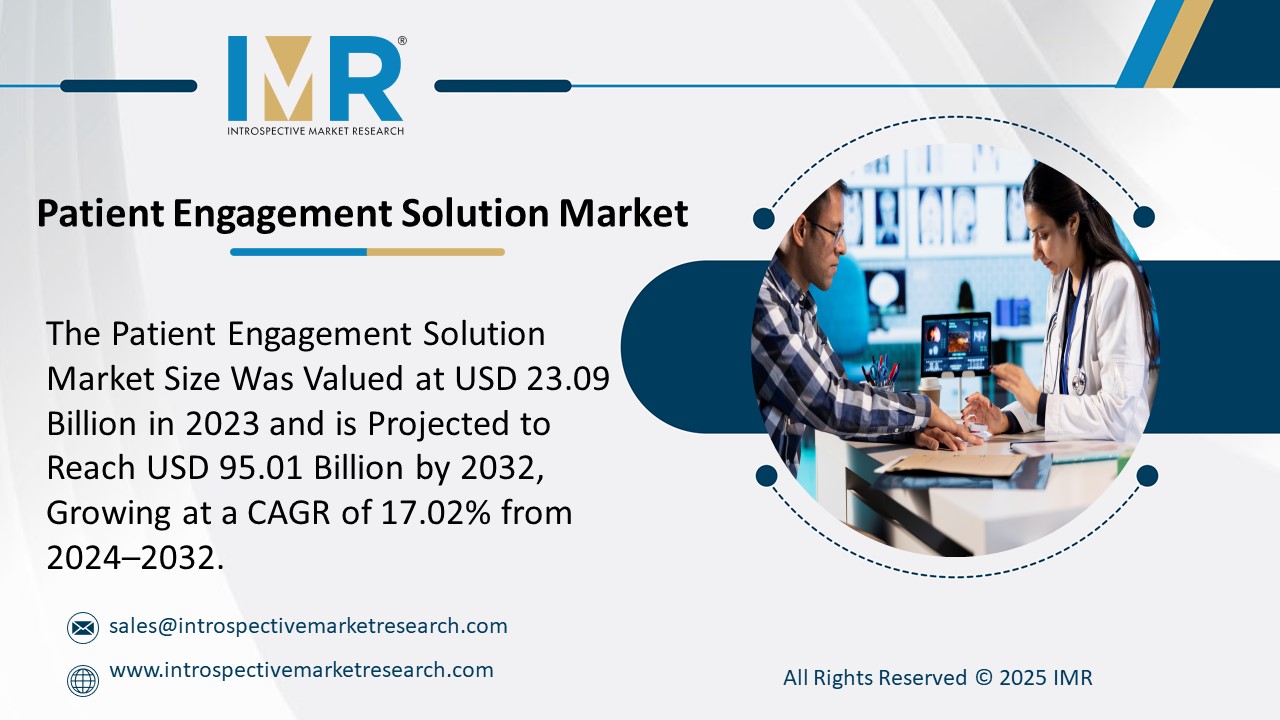
According to a new report published by Introspective Market Research, titled, Patient Engagement Solution Market by Component, Delivery Mode, and Application, The Global Patient Engagement Solution Market Size Was Valued at USD 23.09 Billion in 2023 and is Projected to Reach USD 95.01 Billion by 2032, Growing at a CAGR of 17.02% from 2024–2032. The patient engagement solution market is rapidly transforming the healthcare ecosystem by empowering patients to take an active role in managing their health. These solutions include digital platforms, mobile apps, and integrated care tools designed to improve communication between patients and healthcare providers. They enable better treatment adherence, efficient management of chronic diseases, and improved clinical outcomes.
The shift toward value-based care, coupled with rising healthcare digitization, is significantly driving demand for patient engagement platforms. Patients are increasingly looking for accessible, personalized, and convenient healthcare services, while providers aim to enhance efficiency and reduce costs. The solutions also offer analytics-driven insights that help in preventive care and improved resource allocation.
With strong government support for digital health, growing adoption of telehealth, and the rise of consumer-centric healthcare models, patient engagement solutions are set to become indispensable in modern medical practices worldwide.
The Patient Engagement Solution Market is segmented into Component, Delivery Mode, and Application. By Component, the market is categorized into Software, Hardware, and Services. By Delivery Mode, the market is categorized into On-Premise, Cloud-Based, and Web-Based. By Application, the market is categorized into Health Management, Social and Behavioral Management, Home Health Management, and Financial Health Management.
One of the primary drivers of the Patient Engagement Solution Market is the increasing adoption of telehealth and remote patient monitoring. With the global rise in chronic illnesses, healthcare providers are embracing digital engagement platforms to monitor patients outside hospital settings. These tools ensure timely intervention, medication adherence, and reduced hospital readmissions. Patients benefit from real-time connectivity with physicians and caregivers, improving satisfaction and outcomes. The integration of AI, predictive analytics, and wearable devices is further enhancing engagement levels, fostering a shift from reactive to proactive healthcare delivery. This driver is expected to significantly accelerate market growth.
A significant opportunity in the market lies in the integration of patient engagement solutions with AI and personalized healthcare. As patients demand more tailored experiences, AI-driven platforms can provide predictive care, personalized treatment plans, and interactive health education tools. This personalization enhances patient trust and compliance, reducing healthcare costs in the long term. Moreover, emerging markets with rapidly expanding digital infrastructure present a strong growth avenue. Governments and private players are investing heavily in eHealth initiatives, creating opportunities for global companies to expand into new geographies. This convergence of personalization and digital expansion offers immense potential.
Patient Engagement Solution Market, Segmentation
The Patient Engagement Solution Market is segmented on the basis of Component, Delivery Mode, and Application.
Component
The Component segment is further classified into Software, Hardware, and Services. Among these, the Software sub-segment accounted for the highest market share in 2023. Software solutions, such as mobile health apps, patient portals, and electronic health record (EHR) integration tools, form the backbone of patient engagement strategies. They allow seamless communication, appointment scheduling, and health data access, enabling patients to make informed decisions. As cloud adoption and digital literacy rise, software continues to dominate due to its scalability, customization, and ability to integrate with telehealth platforms.
Delivery Mode
The Delivery Mode segment is further classified into On-Premise, Cloud-Based, and Web-Based. Among these, the Cloud-Based sub-segment accounted for the highest market share in 2023. Cloud deployment is increasingly favored for its flexibility, lower upfront costs, and scalability, especially for healthcare organizations with large patient data volumes. It facilitates remote access, interoperability, and secure data sharing across providers and patients. With the growing need for seamless care delivery across multiple touchpoints, cloud solutions are proving vital in enabling real-time engagement and supporting advanced analytics that enhance patient experience.
Some of The Leading/Active Market Players Are-
- Allscripts Healthcare Solutions (United States)
- Cerner Corporation (United States)
- Epic Systems Corporation (United States)
- McKesson Corporation (United States)
- Orion Health (New Zealand)
- Medecision (United States)
- GetWellNetwork (United States)
- IBM Watson Health (United States)
- Lincor Solutions (Ireland)
- Wolters Kluwer Health (Netherlands)
- Athenahealth (United States)
- Salesforce Health Cloud (United States)
- Elsevier (Netherlands)
- CureMD Healthcare (United States)
- eClinicalWorks (United States)
- and other active players.
Key Industry Developments
- In June 2024, Cerner Corporation announced the launch of an AI-powered patient engagement platform to enhance patient communication and chronic care management.
This solution integrates predictive analytics to identify high-risk patients and provides personalized alerts and reminders, helping reduce hospital readmissions. The move highlights Cerner’s strategy to integrate AI and data-driven insights into its product portfolio, further strengthening its leadership in digital healthcare transformation. - In March 2024, Epic Systems partnered with Microsoft to expand its cloud-based patient engagement solutions.
Through this collaboration, Epic aims to leverage Microsoft Azure’s scalability and security to enhance patient data access, telehealth integration, and interoperability. The partnership demonstrates the increasing trend of healthcare providers moving to cloud ecosystems for improved engagement and efficiency in managing vast amounts of patient data
Key Findings of the Study
- Software and cloud-based solutions dominated the market in 2023.
- North America leads due to strong digital health adoption and supportive regulations.
- Rising telehealth adoption is a key growth driver.
- AI-driven personalization offers significant market opportunities.
- Industry players are focusing on partnerships and innovation in cloud and AI technologies.