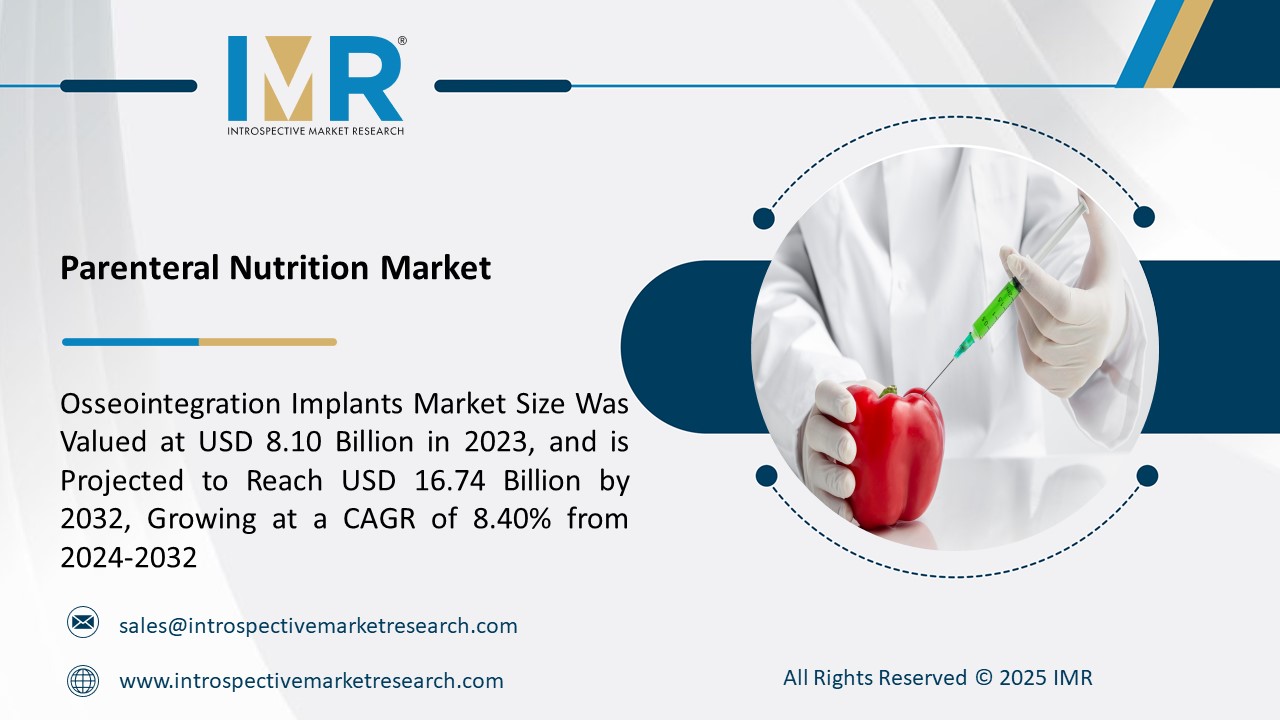
According to a new report published by Introspective Market Research, titled, Parenteral Nutrition Market by Nutrient Type, Patient Type, and End-User, The Global Parenteral Nutrition Market Size Was Valued at USD 8.54 Billion in 2023 and is Projected to Reach USD 14.48 Billion by 2032, Growing at a CAGR of 6.04% from 2025 to 2032.
The Global Parenteral Nutrition Market is witnessing steady expansion as the prevalence of chronic diseases, gastrointestinal disorders, and malnutrition continues to rise globally. Parenteral nutrition refers to the intravenous administration of nutrients such as carbohydrates, proteins, fats, vitamins, and minerals for patients unable to absorb adequate nutrition through oral or enteral routes. It plays a critical role in sustaining patients with severe digestive impairments, cancer, preterm birth complications, and post-surgical recovery. Compared to traditional oral or enteral feeding methods, parenteral nutrition provides direct nutrient delivery into the bloodstream, ensuring faster absorption and immediate energy supply. Its advantages include precision in nutritional formulation, life-saving support for critically ill patients, and customization to specific patient needs. Healthcare providers increasingly rely on advanced parenteral nutrition formulations to improve patient outcomes and reduce hospital stays.
The demand for parenteral nutrition is also supported by advancements in compounding technologies, rising adoption in neonatal care, and the increasing aging population worldwide. With greater focus on personalized medicine and patient-centric healthcare, the parenteral nutrition market is expected to remain a vital part of global clinical nutrition. The Parenteral Nutrition Market is segmented into Nutrient Type, Patient Type, and End-User. By Nutrient Type, the market is categorized into (Carbohydrates, Lipids, Amino Acids, Electrolytes, Minerals, Vitamins, and Others). By Patient Type, the market is categorized into (Pediatric, Adult, and Geriatric). By End-User, the market is categorized into (Hospitals, Clinics, and Home Healthcare).
One of the key growth drivers of the Parenteral Nutrition Market is the increasing prevalence of chronic illnesses and gastrointestinal disorders. Patients suffering from conditions such as Crohn’s disease, cancer, and severe gastrointestinal dysfunctions often cannot meet their nutritional needs orally. Parenteral nutrition offers an effective solution by providing tailored nutrition directly into the bloodstream, improving survival rates, enhancing recovery, and reducing complications associated with malnutrition. Rising awareness and improved access to healthcare services have significantly accelerated market adoption.
A major opportunity in the Parenteral Nutrition Market lies in the growing demand for personalized and home-based parenteral nutrition. With advancements in healthcare infrastructure and infusion pump technologies, patients are increasingly receiving parenteral nutrition in home settings, reducing hospitalization costs and improving quality of life. Furthermore, the demand for specialized formulations tailored to pediatric and geriatric patients is opening new avenues for manufacturers, as personalized therapies gain traction in the global healthcare system.
Parenteral Nutrition Market, Segmentation
The Parenteral Nutrition Market is segmented on the basis of Nutrient Type, Patient Type, and End-User.
Nutrient Type: The Nutrient Type segment is further classified into Carbohydrates, Lipids, Amino Acids, Electrolytes, Minerals, Vitamins, and Others. Among these, the Amino Acids sub-segment accounted for the highest market share in 2024. Amino acids are critical for protein synthesis, muscle maintenance, and metabolic support, making them essential for patients undergoing surgery, chemotherapy, or suffering from severe malnutrition. Their role in improving recovery rates and enhancing patient outcomes has made them a cornerstone in parenteral nutrition therapy.
Patient Type: The Patient Type segment is further classified into Pediatric, Adult, and Geriatric. Among these, the Pediatric sub-segment accounted for the highest market share in 2024. Premature infants and neonates often face underdeveloped digestive systems, requiring parenteral nutrition for survival and proper growth. With increasing preterm birth rates and improved neonatal intensive care unit (NICU) facilities, demand for specialized pediatric parenteral nutrition solutions has grown rapidly, supporting strong adoption in hospitals worldwide.
Some of The Leading/Active Market Players Are
- Baxter International Inc. (USA)
- Fresenius Kabi AG (Germany)
- B. Braun Melsungen AG (Germany)
- Grifols, S.A. (Spain)
- Pfizer Inc. (USA)
- Otsuka Pharmaceutical Co., Ltd. (Japan)
- Sichuan Kelun Pharmaceutical Co., Ltd. (China)
- ICU Medical, Inc. (USA)
- Hospira Inc. (USA)
- Vifor Pharma (Switzerland) and other active players.
Key Industry Developments
-
In March 2024, Baxter International introduced a new lipid injectable emulsion designed to enhance safety and efficacy in adult and pediatric parenteral nutrition. The product offers improved tolerance and optimized nutrient absorption, addressing critical needs in hospital and home care settings. With this launch, Baxter strengthens its portfolio while aligning with global demand for advanced intravenous nutrition therapies.
-
In September 2024, Fresenius Kabi expanded its parenteral nutrition production facility in Germany to increase capacity and meet rising global demand. The expansion includes state-of-the-art compounding technologies and quality control systems to ensure safer and more efficient parenteral nutrition formulations. This move enhances Fresenius Kabi’s ability to serve diverse markets while supporting its leadership in clinical nutrition.
Key Findings of the Study
- Amino acids dominate the nutrient type segment due to critical therapeutic applications.
- Pediatric patients represent the largest user group, driven by rising preterm birth rates.
- Hospitals remain the primary end-users, though home healthcare adoption is rising.
- Europe and North America lead the market, with Asia-Pacific showing rapid growth.
- Personalized and home-based therapies present significant opportunities.