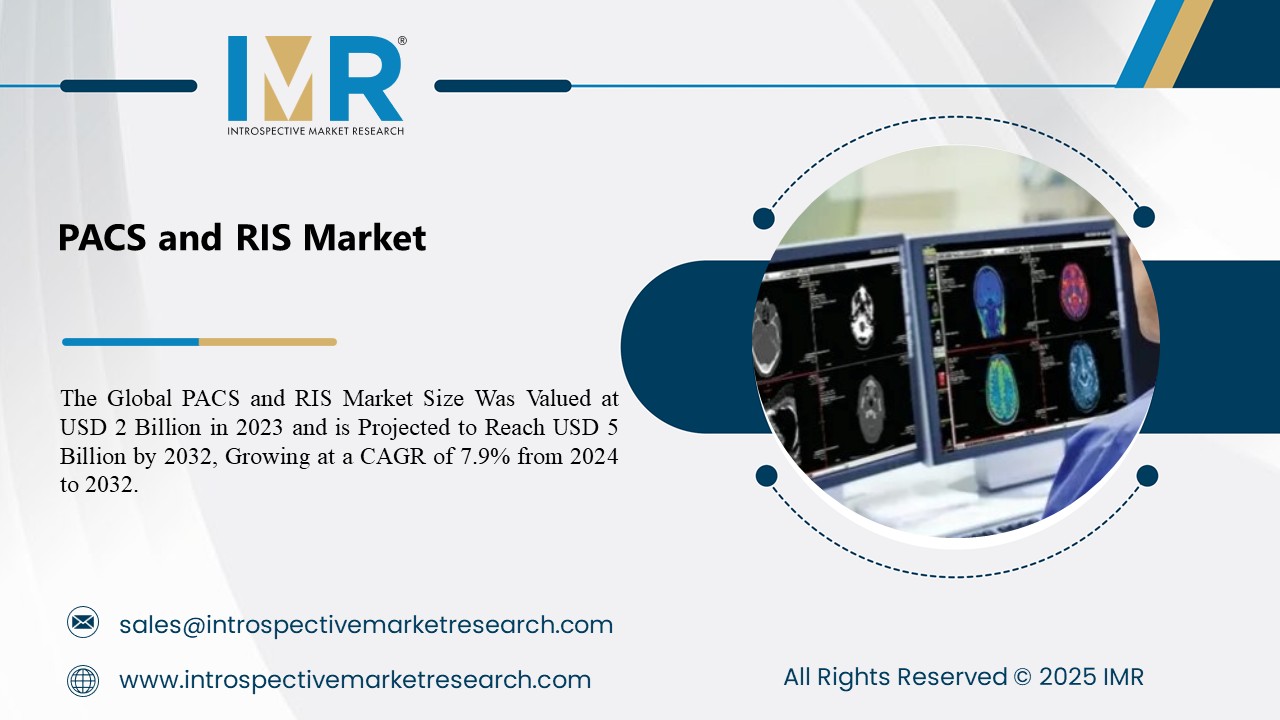
According to a new report published by Introspective Market Research, titled, PACS and RIS Market by Component, Deployment Mode, End-User, and Region, The Global PACS and RIS Market Size Was Valued at USD 2 Billion in 2023 and is Projected to Reach USD 5 Billion by 2032, Growing at a CAGR of 7.9% from 2024 to 2032. The Global Picture Archiving and Communication System (PACS) and Radiology Information System (RIS) Market is a vital segment of the healthcare IT industry, enabling the efficient storage, retrieval, distribution, and management of medical imaging data. PACS allows seamless digital image archiving and sharing, while RIS supports radiology workflow management, scheduling, and reporting. Together, these systems form the backbone of diagnostic imaging services.
Compared to traditional film-based imaging, PACS and RIS offer faster image processing, reduced operational costs, improved accuracy, and enhanced accessibility. These solutions integrate with hospital information systems (HIS) and electronic health records (EHR), ensuring real-time access to imaging data and reports across multiple care facilities.
The adoption of PACS and RIS is expanding across hospitals, diagnostic centers, and research institutions. Rising demand for advanced imaging, tele-radiology, and AI-powered diagnostic tools is further propelling the growth of this market globally.
The Global PACS and RIS Market is segmented into Component, Deployment Mode, and End-User. By Component, the market is categorized into (PACS, RIS, Services). By Deployment Mode, the market is categorized into (On-Premise, Cloud-Based, Hybrid). By End-User, the market is categorized into (Hospitals, Diagnostic Centers, Research & Academic Institutes).
One of the key drivers for the PACS and RIS Market is the increasing adoption of digital healthcare infrastructure worldwide. Healthcare providers are shifting from analog and paper-based systems to integrated digital platforms that improve efficiency and accuracy. PACS and RIS streamline radiology workflows, reduce diagnostic errors, and facilitate real-time data sharing among clinicians, ultimately improving patient care. Additionally, government initiatives promoting digitization in healthcare and investments in tele-radiology services are fueling rapid market expansion.
A significant opportunity lies in the integration of artificial intelligence (AI) and machine learning (ML) within PACS and RIS platforms. AI algorithms can enhance image analysis, automate reporting, and identify anomalies with greater precision. Cloud-based PACS and RIS systems also offer scalable and cost-efficient solutions, especially for small and medium healthcare providers. As healthcare organizations increasingly demand AI-driven, interoperable platforms, vendors have opportunities to differentiate their offerings through innovation and partnerships with AI technology providers.
PACS and RIS Market, Segmentation
The PACS and RIS Market is segmented on the basis of Component, Deployment Mode, and End-User.
Component
The Component segment is further classified into PACS, RIS, and Services. Among these, the PACS sub-segment accounted for the highest market share in 2024. PACS solutions are widely adopted due to their ability to streamline imaging workflows, eliminate film-based inefficiencies, and support multi-site access. They serve as a core technology in diagnostic imaging, with increasing integration into hospital information systems and cloud platforms, ensuring rapid image sharing and long-term archiving.
Deployment Mode
The Deployment Mode segment is further classified into On-Premise, Cloud-Based, and Hybrid. Among these, the Cloud-Based sub-segment accounted for the highest market share in 2024. Cloud PACS and RIS offer scalability, cost efficiency, and remote accessibility, making them particularly attractive for healthcare systems with multiple facilities and growing imaging volumes. The shift towards cloud adoption is driven by reduced IT infrastructure costs, faster implementation, and support for tele-radiology services.
Some of The Leading/Active Market Players Are-
- GE HealthCare (USA)
- Siemens Healthineers (Germany)
- Philips Healthcare (Netherlands)
- Fujifilm Holdings Corporation (Japan)
- Agfa-Gevaert Group (Belgium)
- IBM Watson Health (USA)
- Novarad Corporation (USA)
- Carestream Health (USA)
- Sectra AB (Sweden)
- Infinitt Healthcare (South Korea)
…and other active players.
Key Industry Developments
- In June 2024, Siemens Healthineers launched its next-generation cloud-based PACS solution to support global healthcare networks.
The solution is designed to integrate seamlessly with AI-powered diagnostic tools, offering healthcare providers faster, more accurate imaging workflows. This launch emphasizes Siemens’ focus on cloud adoption and interoperability to address the growing need for scalable imaging solutions in both developed and emerging markets. - In February 2024, GE HealthCare partnered with a leading AI startup to enhance RIS functionality with predictive analytics.
This collaboration aims to embed AI into radiology reporting and scheduling modules, enabling hospitals to improve workflow efficiency, reduce patient wait times, and achieve higher diagnostic accuracy. The partnership reflects the industry’s strong push toward digital transformation and AI integration in medical imaging solutions.
Key Findings of the Study
- PACS dominates the market due to widespread adoption in diagnostic imaging.
- Cloud-based deployment leads growth, driven by cost savings and scalability.
- Hospitals remain the primary end-users of PACS and RIS solutions.
- AI integration and tele-radiology are emerging as key growth opportunities.
- North America and Europe remain leading regions due to advanced healthcare infrastructure.