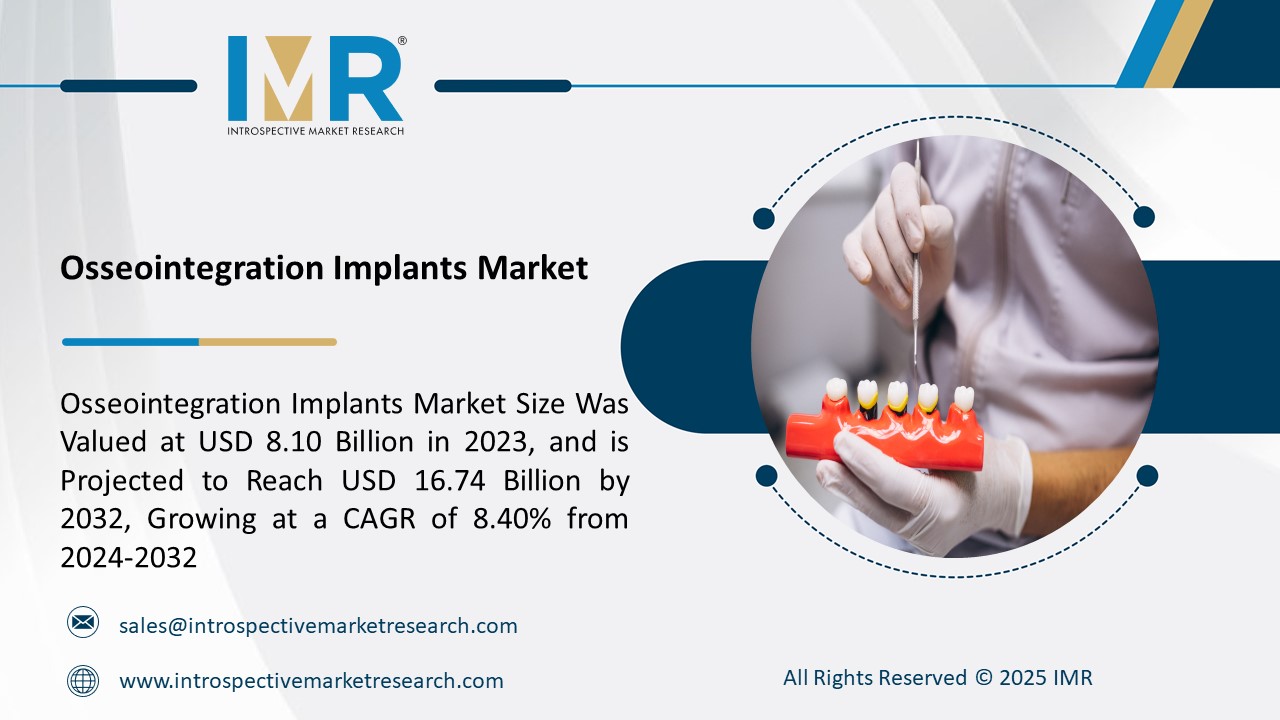
According to a new report published by Introspective Market Research, titled, “Osseointegration Implants Market by Product, Material, and End-User,” The Global Osseointegration Implants Market Size Was Valued at USD 8.10 Billion in 2023 and is Projected to Reach USD 16.74 Billion by 2032, Growing at a CAGR of 8.40%.
The osseointegration implants market is witnessing strong growth, driven by advancements in orthopedic and dental procedures where permanent anchorage is essential. Osseointegration technology refers to the direct structural and functional connection between living bone and the surface of a load-bearing implant. These implants provide a highly stable and durable solution compared to traditional prosthetics, reducing discomfort and increasing long-term reliability. The advantages of osseointegration implants over conventional alternatives include enhanced comfort, improved sensory feedback, reduced risk of pressure sores, and higher mobility for patients with limb loss. In addition, dental osseointegration implants are increasingly being adopted as a reliable alternative to removable dentures. Growing awareness of minimally invasive surgeries, rising cases of orthopedic injuries, and an aging population suffering from bone disorders have been significant contributors to the adoption of osseointegration implants across major healthcare markets.
One of the primary growth drivers of the osseointegration implants market is the rising prevalence of orthopedic injuries and amputations due to trauma, accidents, and chronic conditions such as diabetes. According to global health statistics, millions of people undergo amputations annually, creating a high demand for advanced prosthetic solutions. Osseointegration implants provide superior comfort, reduced reliance on external support, and greater long-term stability compared to traditional prosthetic sockets. As healthcare providers focus on improving quality of life and patient outcomes, the growing adoption of these advanced implants is expected to significantly accelerate market expansion worldwide.
A major opportunity for the osseointegration implants market lies in the increasing adoption of advanced dental implants worldwide. The global burden of dental disorders, tooth loss, and periodontal diseases is rising sharply, particularly among the elderly. With growing patient preference for aesthetic and functional dental restoration, osseointegration-based dental implants are gaining momentum due to their superior durability and natural feel. In addition, technological innovations such as customized 3D-printed implants and surface modifications that accelerate bone healing are expanding their applications. This emerging trend offers strong potential for manufacturers and healthcare providers to capture new patient segments across both developed and emerging economies.
Osseointegration Implants Market, Segmentation
The Osseointegration Implants Market is segmented on the basis of Product, Material, and End-User.
Product: The product segment is further classified into Dental Implants, Bone-Anchored Prosthetics, and Others. Among these, the Dental Implants sub-segment accounted for the highest market share in 2023. The demand for dental implants is growing rapidly due to increasing cases of tooth loss, rising cosmetic dentistry trends, and patient preference for permanent solutions. Unlike removable dentures, osseointegration dental implants mimic natural teeth and provide long-term stability, reducing jawbone loss. This segment has also benefited from technological improvements in implant surfaces that speed up bone integration, along with increased affordability and access to dental care globally.
Material: The material segment is further classified into Titanium Implants, Zirconia Implants, and Others. Among these, the Titanium Implants sub-segment accounted for the highest market share in 2023. Titanium implants are widely recognized as the gold standard due to their exceptional biocompatibility, mechanical strength, and long history of successful clinical use. The material’s ability to form a natural bond with bone tissue ensures long-term stability and high success rates in both dental and orthopedic applications. Additionally, titanium’s durability and corrosion resistance make it highly suitable for load-bearing implants, thereby maintaining its dominance in the global osseointegration implants market.
Some of The Leading/Active Market Players Are
- Straumann Group (Switzerland)
- Zimmer Biomet (United States)
- Smith & Nephew (United Kingdom)
- Integrum AB (Sweden)
- Dentsply Sirona (United States)
- Nobel Biocare Services AG (Switzerland)
- Medtronic (United States)
- Johnson & Johnson (United States)
- Osstem Implant Co., Ltd. (South Korea)
- B. Braun Melsungen AG (Germany)
- Stryker Corporation (United States)
- BioHorizons (United States)
- Anthogyr SAS (France)
- NEOSS Limited (United Kingdom)
- MegaGen Implant Co. (South Korea)
- and other active players.
Key Industry Developments
- In April 2024, Straumann Group launched a next-generation line of digital dental implant solutions integrating 3D printing and AI-driven surgical planning. This development is expected to enhance precision in dental implant placement and accelerate treatment time. By combining digital workflows with osseointegration technology, Straumann aims to strengthen its leadership in the dental implants market, targeting both premium and emerging economies with advanced, patient-specific solutions.
- In January 2024, Integrum AB received FDA approval for its OPRA Implant System for above-knee amputees in the United States.This regulatory milestone marks a significant step for patients requiring advanced prosthetics, offering improved mobility, reduced skin complications, and enhanced quality of life. The approval is expected to boost demand for osseointegration implants in the U.S. market while strengthening Integrum AB’s competitive position in orthopedic implant solutions.
Key Findings of the Study
- Dental Implants and Titanium Implants remain dominant segments in 2023.
- North America and Europe lead the global osseointegration implants market.
- Rising orthopedic injuries and dental disorders drive market expansion.
- Technological innovations such as 3D printing and FDA approvals fuel growth.