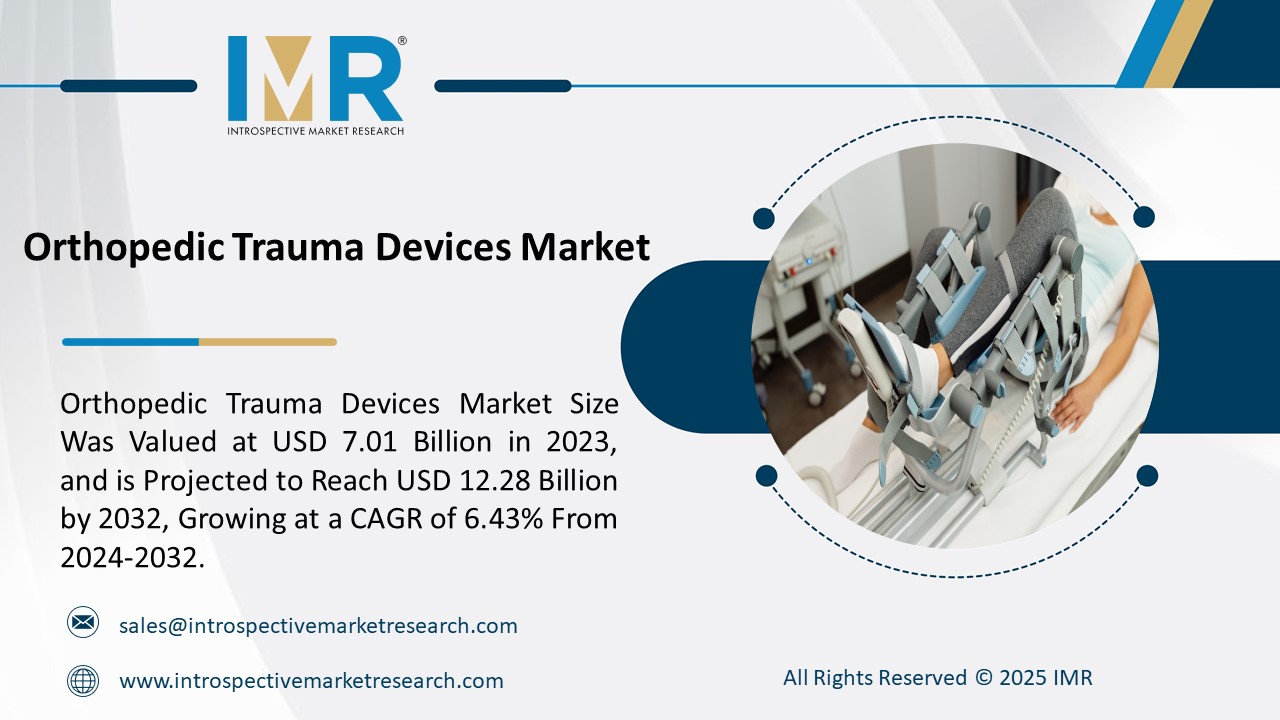
According to a new report published by Introspective Market Research, titled, Global Orthopedic Trauma Devices Market by Key Segments, The Global Orthopedic Trauma Devices Market Size Was Valued at USD 7.01 Billion in 2023 and is Projected to Reach USD 12.28 Billion by 2032, Growing at a CAGR of 6.43%. The Global Orthopedic Trauma Devices Market is experiencing steady growth as the incidence of orthopedic injuries rises globally. These devices, which include plates, screws, nails, and external fixators, are essential for the effective treatment of fractures and other traumatic injuries. The advantages of orthopedic trauma devices over traditional treatment methods include improved stabilization, faster recovery times, and enhanced patient outcomes, making them a critical component in modern orthopedic surgery.
As the global population ages and the prevalence of sports-related injuries increases, the demand for orthopedic trauma devices is expected to rise. Additionally, advancements in technology, such as the development of bio-compatible materials and minimally invasive surgical techniques, are further driving the market. This growth is supported by an increasing focus on patient safety and the effectiveness of orthopedic interventions.
A key growth driver for the Orthopedic Trauma Devices Market is the rising incidence of road accidents and sports injuries. As these injuries become more common, the need for effective orthopedic trauma solutions increases. Healthcare providers are investing in advanced trauma devices to ensure better patient care and faster recovery, thus propelling market growth. The increasing awareness of the importance of timely and effective treatment for orthopedic injuries further supports this trend.
One significant market opportunity lies in the development of innovative orthopedic trauma devices that incorporate smart technology. The integration of sensors and data analytics into these devices can provide real-time monitoring of patient recovery and device performance. This innovation not only enhances patient outcomes but also offers healthcare providers valuable insights, creating a competitive edge for companies that invest in smart orthopedic solutions.
Global Orthopedic Trauma Devices Market, Segmentation
The Orthopedic Trauma Devices Market is segmented on the basis of Device Type, Material, and End-User.
Device Type
-
The Device Type segment is further classified into Internal Fixation Devices, External Fixation Devices, and Bone Grafts. Among these, the Internal Fixation Devices sub-segment accounted for the highest market share in 2023. Internal fixation devices, such as plates and screws, provide stable support for fractured bones, facilitating optimal healing and recovery.
Material
-
The Material segment is further classified into Metal, Polymer, and Composite. Among these, the Metal sub-segment accounted for the highest market share in 2023. Metal devices, particularly those made from titanium and stainless steel, are favored for their strength and durability, making them ideal for load-bearing applications in orthopedic trauma.
Some of The Leading/Active Market Players Are
-
Johnson & Johnson (USA)
- Stryker Corporation (USA)
- Medtronic plc (Ireland)
- Zimmer Biomet Holdings, Inc. (USA)
- Smith & Nephew plc (UK)
- DePuy Synthes (USA)
- NuVasive, Inc. (USA)
- Orthofix Medical Inc. (USA)
- Aesculap, Inc. (Germany)
- B. Braun Melsungen AG (Germany)
- and other active players.
Key Industry Developments
-
In January 2023, Stryker Corporation launched a new line of advanced internal fixation devices designed to enhance surgical efficiency and patient outcomes. These devices feature innovative locking mechanisms that improve stability and reduce the risk of complications.
- In March 2023, Johnson & Johnson announced a partnership with a technology firm to develop smart orthopedic devices that monitor patient recovery in real-time. This collaboration aims to integrate data analytics into orthopedic trauma solutions, enhancing treatment effectiveness.
Key Findings of the Study
-
Dominant segments include Device Type and Material.
- Leading regions are North America and Europe.
- Key growth drivers include the rise in road accidents and sports injuries.
- Market trends indicate a shift towards smart orthopedic devices.
- The market is projected to grow significantly, reaching USD 12.28 Billion by 2032.