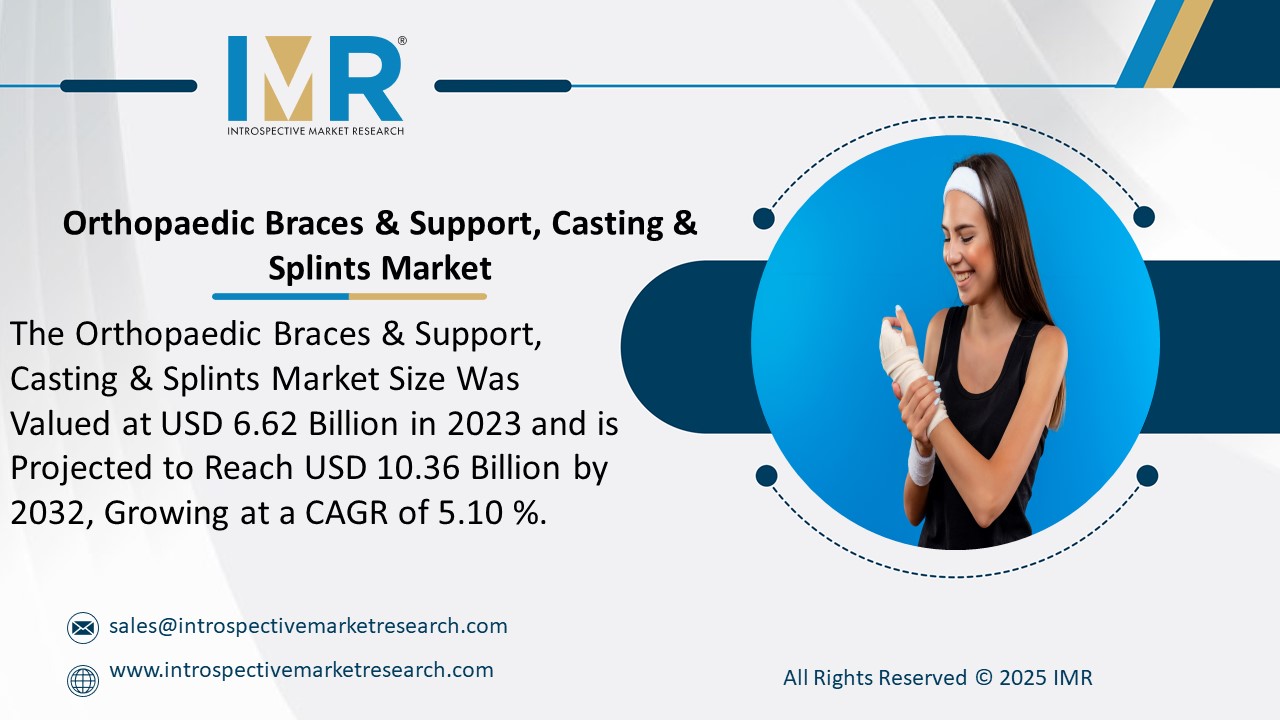
According to a new report published by Introspective Market Research, titled, Orthopaedic Braces & Support, Casting & Splints Market by Product Type, Application, End-User and Region, The Global Orthopaedic Braces & Support, Casting & Splints Market Size Was Valued at USD 6.62 Billion in 2023 and is Projected to Reach USD 10.36 Billion by 2032, Growing at a CAGR of 5.10 %. The global orthopaedic braces, supports, casting and splints market is experiencing steady growth as the incidence of musculoskeletal conditions, fractures and injuries continues to increase worldwide. These devices—such as joint braces, support systems, cast materials and splints—play a vital role in immobilising, stabilising and supporting injured, weakened or post-surgery joints and bones. Compared with traditional approaches such as full surgical fixes or long-term bed rest, braces and splints offer less invasive options, faster mobilization and rehabilitation, and often cost-effective alternatives in outpatient or home-care settings.
Today’s orthopaedic support products also incorporate advanced materials, ergonomic designs and improved comfort features, making them far more user-friendly than older rigid cast systems. They are widely used across various settings including hospitals, ambulatory surgical centres, physical therapy units and home care, for applications ranging from post-operative recovery and immobilisation to preventive support for sport injuries and age-related joint degeneration.
The Orthopaedic Braces & Support, Casting & Splints Market is segmented into Product Type, Application, and End-User. By Product Type, the market is categorized into (Braces & Supports, Casting Supplies & Equipment, Splints & Splinting Supplies). By Application, the market is categorized into (Fracture Management, Post-Surgical Recovery, Preventive Care & Rehabilitation). By End-User, the market is categorized into (Hospitals, Orthopaedic Clinics, Home Care / Ambulatory Centres).
One of the key growth drivers for the orthopaedic braces & support, casting & splints market is the rising prevalence of musculoskeletal disorders and the increasing geriatric population. As populations age, conditions such as osteoarthritis, osteoporosis and joint degeneration become more common, leading to greater demand for support products that aid joint stability and mobility. Concurrently, higher incidence of fractures, sports injuries and road accidents in both developed and emerging markets is pushing the uptake of braces, casts and splints as part of acute care and rehabilitation pathways.
A significant market opportunity lies in the development and adoption of advanced materials and technologies in brace and support systems—such as 3D-printed custom orthoses, lightweight composite splints, and “smart” braces incorporating sensors and connectivity. These innovations allow manufacturers to differentiate their offerings, serve premium segments, and address unmet patient needs (for comfort, custom fit and mobility). Emerging markets with growing healthcare infrastructure and rising awareness also present scalable opportunities for regional expansion and product diversification.
Orthopaedic Braces & Support, Casting & Splints Market, Segmentation
The Orthopaedic Braces & Support, Casting & Splints Market is segmented on the basis of Product Type, Application, and End-User.
Product Type
The Product Type segment is further classified into Braces & Supports, Casting Supplies & Equipment, and Splints & Splinting Supplies. Among these, the Braces & Supports sub-segment accounted for the highest market share in 2023. Braces & supports dominate because they cater to a broad range of conditions—from ligament injuries and joint instability to preventive support for athletes and elderly patients—and they offer flexible, reusable formats compared to one-time cast applications.
Application
The Application segment is further classified into Fracture Management, Post-Surgical Recovery, and Preventive Care & Rehabilitation. Among these, the Fracture Management sub-segment accounted for the highest market share in 2023. This is due to the consistent global incidence of bone fractures, the need for immobilisation and support during healing, and the volume of cases managed in hospitals and orthopaedic centres which drives demand for both casting & splinting supplies and associated support systems.
Some of The Leading/Active Market Players Are-
- 3M Company (USA)
- Össur Hf (Iceland)
- DJO Global, Inc. (USA)
- Stryker Corporation (USA)
- Zimmer Biomet Holdings (USA)
- Breg, Inc. (USA)
- DeRoyal Industries, Inc. (USA)
- Medi GmbH & Co. KG (Germany)
- Ottobock SE & Co. KGaA (Germany)
- Bauerfeind AG (Germany)
- other active players.
Key Industry Developments
-
In January 2025, a major orthopaedic device manufacturer launched a next-generation 3D-printed custom brace system designed for post-operative joint recovery.
The new system integrates lightweight composite materials with customized scanning and manufacturing, enabling patients to obtain highly tailored orthoses that conform to their anatomy, reduce pressure points, improve comfort and accelerate mobility. The launch reflects the industry shift from one-size-fits-all braces toward bespoke solutions and opens new premium product lines. Hospitals and rehabilitation centres are expected to adopt the technology first, followed by home-care and outpatient segments, thus broadening the addressable market for advanced support devices. - In March 2025, a global orthopaedic supply company announced a strategic partnership with a major healthcare provider in Asia Pacific to expand its splinting and casting supplies distribution across emerging markets.
The partnership will leverage the healthcare provider’s extensive network in India and Southeast Asia to introduce ready-to-use fiberglass casting kits and off-the-shelf splints in hospitals and trauma centres. The move is aimed at tapping into the high-growth potential of emerging regions where rising incomes, expanding hospital infrastructure and increasing awareness of orthopaedic care are creating strong demand. The partnership also includes training programmes for clinics and an e-commerce logistics component, highlighting how distribution and service models are evolving alongside the product base.
Key Findings of the Study
- Braces & Supports are the dominant product type due to broad application and reuse potential.
- Fracture Management leads in application, driven by steady volume of bone injuries and cast/splint use.
- North America retains a leading regional share, though Asia-Pacific is rising rapidly on infrastructure growth.
- Growth is fueled by ageing populations, higher sports/trauma incidents and demand for non-invasive support solutions.
- Innovation in customised orthoses and expansion into emerging markets offer key growth opportunities.