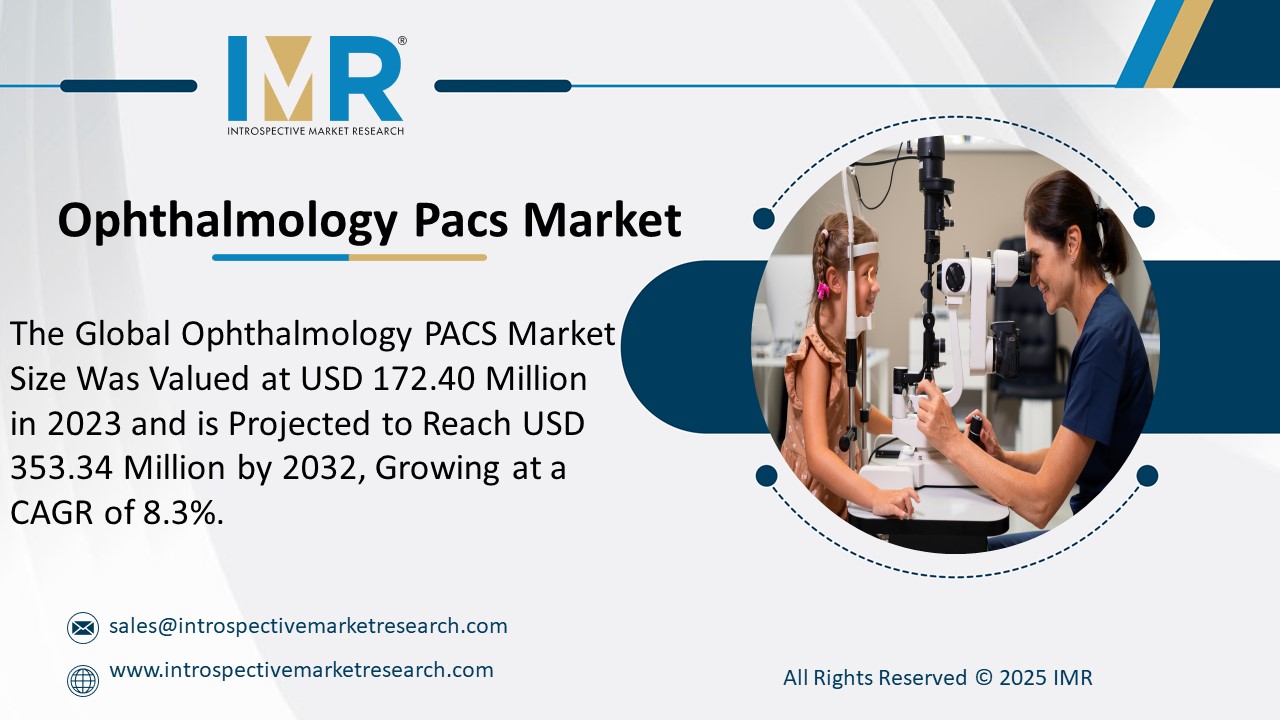
According to a new report published by Introspective Market Research, titled, Ophthalmology PACS Market by Type, Delivery Mode, and End User, The Global Ophthalmology PACS Market Size Was Valued at USD 172.40 Million in 2023 and is Projected to Reach USD 353.34 Million by 2032, Growing at a CAGR of 8.3%. The global Ophthalmology Picture Archiving and Communication System (PACS) market focuses on the digital storage, management, and retrieval of ophthalmic images, including optical coherence tomography (OCT), fundus photography, and visual field tests. The technology helps streamline clinical workflows, reduce manual errors, and enhance diagnostic efficiency.
The increasing prevalence of eye disorders such as glaucoma, diabetic retinopathy, and macular degeneration is driving adoption of ophthalmology PACS across hospitals, clinics, and eye-care centers. These systems enable remote image sharing, facilitate teleophthalmology, and integrate seamlessly with electronic health records (EHRs), enhancing patient management and care coordination.
Moreover, cloud-based PACS platforms are gaining traction due to their scalability, cost efficiency, and remote accessibility — particularly beneficial for multi-location healthcare providers. As the global healthcare sector continues to digitalize, demand for advanced ophthalmic imaging solutions is expected to rise significantly over the forecast period.
The Ophthalmology PACS Market is segmented into Type, Delivery Mode, and End User. By Type, the market is categorized into (Standalone PACS, Integrated PACS). By Delivery Mode, the market is categorized into (On-Premise, Cloud-Based, Web-Based). By End User, the market is categorized into (Hospitals, Specialty Clinics, Diagnostic Imaging Centers, Others).
A major growth driver for the ophthalmology PACS market is the increasing adoption of digital healthcare and telemedicine technologies. Rising cases of chronic eye conditions, coupled with the growing need for centralized image management and real-time collaboration among ophthalmologists, are accelerating PACS implementation. Additionally, government initiatives supporting healthcare IT infrastructure further enhance market expansion.
The shift toward AI-integrated ophthalmic imaging presents a substantial opportunity. Artificial intelligence and deep learning algorithms are increasingly being used for automated image analysis, early disease detection, and treatment planning. Vendors that combine PACS with AI-enabled diagnostic capabilities and cloud integration stand to gain a competitive edge in the coming years.
Ophthalmology PACS Market, Segmentation
The Ophthalmology PACS Market is segmented on the basis of Type, Delivery Mode, and End User.
Type
The Type segment is further classified into Standalone PACS and Integrated PACS. Among these, the Integrated PACS sub-segment accounted for the highest market share in 2023. Integrated systems enable seamless connectivity with EHRs, streamline diagnostic workflows, and reduce data redundancy, improving overall operational efficiency. Hospitals increasingly prefer integrated PACS for real-time access and interoperability across departments.
Delivery Mode
The Delivery Mode segment is further classified into On-Premise, Cloud-Based, and Web-Based. Among these, the Cloud-Based sub-segment accounted for the highest market share in 2023. Cloud solutions are preferred for their cost efficiency, scalability, and remote access capabilities. They also facilitate easy data backup, disaster recovery, and secure multi-location collaboration, making them ideal for large ophthalmology networks and telehealth setups.
Some of The Leading/Active Market Players Are-
- Carl Zeiss Meditec AG (Germany)
- Heidelberg Engineering GmbH (Germany)
- Topcon Corporation (Japan)
- Canon Medical Systems Corporation (Japan)
- IBM Corporation (USA)
- Visbion Ltd. (UK)
- Agfa-Gevaert Group (Belgium)
- EyePACS, LLC (USA)
- ScImage, Inc. (USA)
- Merge Healthcare Inc. (USA)
- INFINITT Healthcare (South Korea)
- Sonomed Escalon (USA)
- Medtronic PLC (Ireland)
- Other active players.
Key Industry Developments
-
In January 2025, Topcon Healthcare launched its next-generation cloud-based imaging platform, Harmony 3.0, designed to integrate ophthalmic images and patient data from multiple devices into a single, accessible interface.
This innovation enhances diagnostic collaboration, simplifies data management, and strengthens Topcon’s foothold in ophthalmology imaging informatics. - In June 2025, Heidelberg Engineering announced the integration of its Spectralis imaging platform with AI-powered diagnostic tools to improve early detection of retinal diseases.
This advancement reflects the growing trend of AI-enabled ophthalmic solutions, offering clinicians faster, more accurate analysis within PACS environments.
Key Findings of the Study
- Integrated PACS systems dominate the market due to workflow efficiency.
- Cloud-based delivery mode leads with remote accessibility advantages.
- Growing digital healthcare adoption drives market expansion.
- AI integration and teleophthalmology trends are shaping innovation.
- North America and Europe remain key revenue-generating regions.