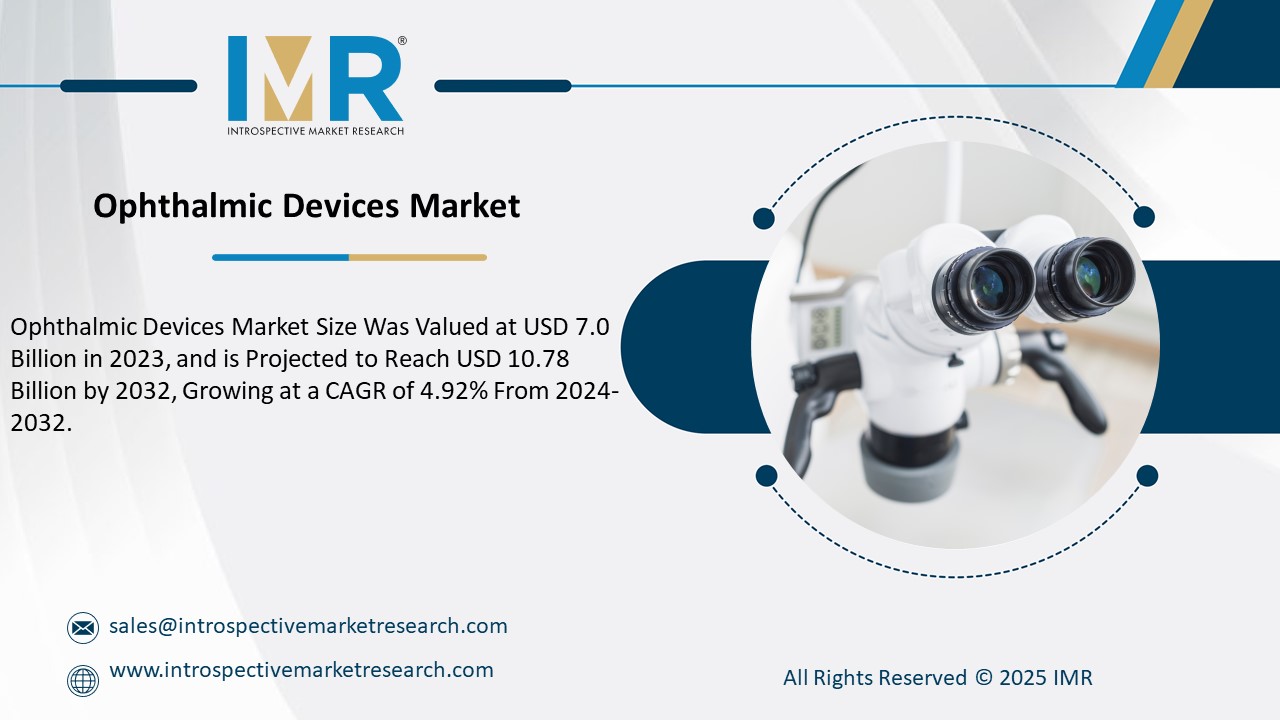
According to a new report published by Introspective Market Research, titled, Ophthalmic Devices Market by Product, Application, and End User, The Global Ophthalmic Devices Market Size Was Valued at USD 7.0 Billion in 2023 and is Projected to Reach USD 10.78 Billion by 2032, Growing at a CAGR of 4.92%. The global Ophthalmic Devices Market is witnessing significant growth due to rising eye disorders, increasing geriatric populations, and advancements in medical technology. Ophthalmic devices, including diagnostic instruments, surgical equipment, and therapeutic devices, are essential for the detection, treatment, and management of various eye conditions. Compared to traditional treatment methods, these devices provide improved precision, minimally invasive procedures, and enhanced patient outcomes.
Ophthalmic devices are extensively used across hospitals, clinics, and specialized eye care centers. They find applications in treating cataracts, glaucoma, retinal disorders, and refractive errors, among other conditions. The adoption of technologically advanced solutions, such as laser-assisted surgical tools and digital imaging devices, is driving market expansion across major regions. Additionally, the growing awareness about eye health, coupled with the rise in vision-related disorders globally, has led to an increasing demand for ophthalmic devices in both developed and emerging markets. Companies are investing in research and development to introduce innovative, patient-friendly products to meet this demand.
Market Segmentation
The Ophthalmic Devices Market is segmented into Product, Application, and End User. By Product, the market is categorized into Diagnostic Devices, Surgical Devices, and Therapeutic Devices. By Application, the market is categorized into Cataract, Glaucoma, Retinal Disorders, and Refractive Errors. By End User, the market is categorized into Hospitals, Clinics, and Eye Care Centers.
Growth Driver
The primary growth driver for the ophthalmic devices market is the increasing prevalence of eye disorders worldwide. Factors such as aging populations, rising diabetes rates, and extended screen exposure have led to a surge in vision-related problems. This has created a substantial demand for both diagnostic and therapeutic ophthalmic devices. Technological advancements, such as minimally invasive surgical instruments and AI-enabled diagnostic systems, further enhance treatment accuracy and patient outcomes, fueling market expansion across global regions.
Market Opportunity
One of the key market opportunities lies in the development of advanced surgical and diagnostic ophthalmic devices. Innovations such as robotic-assisted surgery, smart contact lenses, and portable imaging solutions offer improved precision, patient comfort, and accessibility. Emerging markets, particularly in Asia-Pacific and Latin America, present significant growth potential due to increasing healthcare expenditure, expanding healthcare infrastructure, and rising awareness about eye care. Companies investing in product innovation and strategic collaborations can capitalize on these opportunities to strengthen their market presence.
Detailed Segmentation
Ophthalmic Devices Market, Segmentation
Product
- The Product segment is further classified into Diagnostic Devices, Surgical Devices, and Therapeutic Devices. Among these, the Diagnostic Devices sub-segment accounted for the highest market share in 2023. Diagnostic devices, such as optical coherence tomography (OCT) systems, fundus cameras, and slit lamps, are essential for early detection of eye disorders, enabling timely intervention and reducing the risk of vision loss. Their precision, ease of use, and integration with digital platforms drive widespread adoption across healthcare facilities.
Application
- The Application segment is further classified into Cataract, Glaucoma, Retinal Disorders, and Refractive Errors. Among these, the Cataract sub-segment accounted for the highest market share in 2023. Cataract surgeries are among the most commonly performed ophthalmic procedures globally. The rising incidence of age-related cataracts, coupled with advancements in intraocular lenses and minimally invasive surgical techniques, is boosting the demand for cataract-related devices. Hospitals and specialized eye centers continue to invest in modern surgical tools to enhance patient outcomes.
Some of The Leading/Active Market Players Are-
- Alcon (Switzerland)
- Bausch + Lomb (USA)
- Carl Zeiss Meditec (Germany)
- EssilorLuxottica (France)
- Topcon Corporation (Japan)
- Hoya Corporation (Japan)
- Nidek Co., Ltd. (Japan)
- Johnson & Johnson Vision (USA)
- Canon Inc. (Japan)
- HOYA Surgical Optics (Japan)
- Rayner Intraocular Lenses (UK)
- Lumenis Ltd. (Israel)
- Alimera Sciences (USA)
- and other active players.
Key Industry Developments
- In March 2024, Alcon launched an AI-enabled surgical system for cataract procedures.The system integrates advanced imaging and automated guidance to assist ophthalmic surgeons, enhancing precision and reducing operation time. Early clinical studies indicate improved patient outcomes and faster recovery periods.
- In July 2023, Bausch + Lomb expanded its ophthalmic device portfolio in Asia-Pacific. This expansion included diagnostic and therapeutic devices, aimed at addressing the growing prevalence of glaucoma and retinal disorders in emerging markets. Strategic partnerships with local healthcare providers supported rapid adoption.
Key Findings of the Study
- Diagnostic Devices and Cataract applications dominate the market.
- North America and Europe lead in market adoption, with growing demand in Asia-Pacific.
- Aging population and rising vision-related disorders drive growth.
- Technological advancements and AI integration trend across surgical and diagnostic devices.