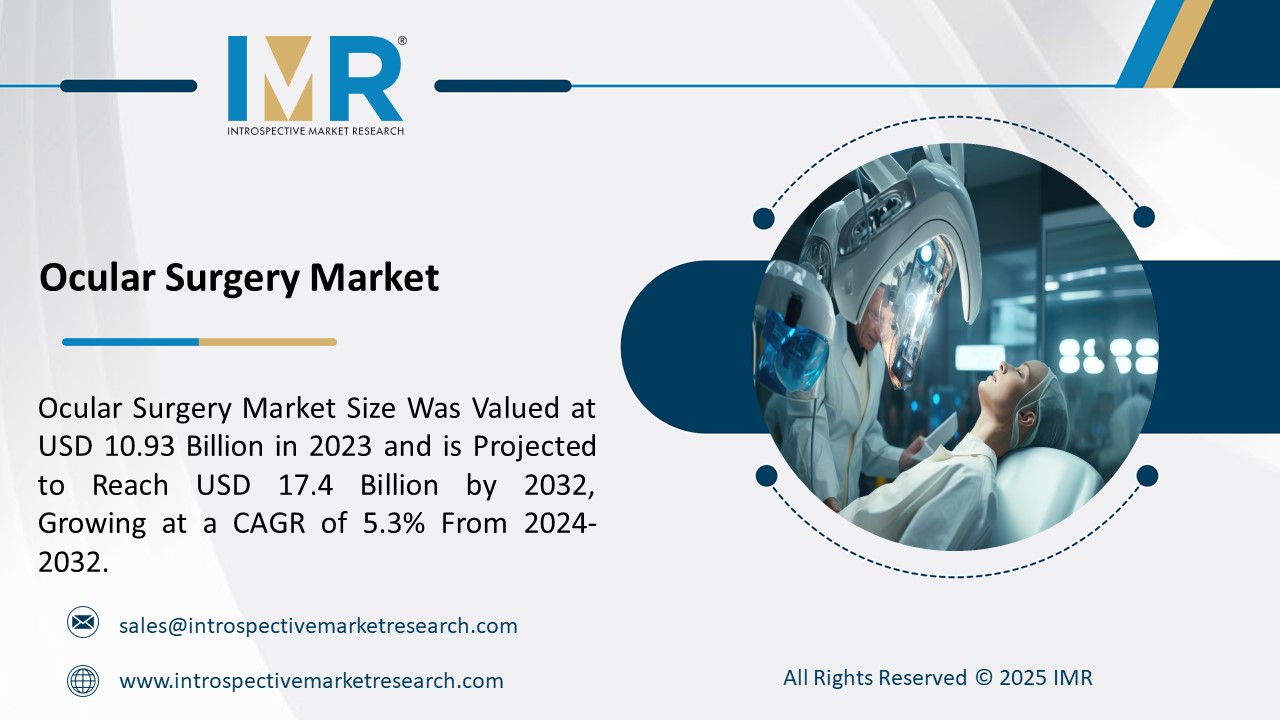
According to a new report published by Introspective Market Research, titled, "Ocular Surgery Market by Procedure Type (Cataract Surgery, Refractive Surgery, Glaucoma Surgery, Vitreoretinal Surgery, Oculoplasty, and Others), by Product (Ophthalmic Surgical Devices, Ophthalmic Viscosurgical Devices, and Ophthalmic Solutions), and by End-User (Hospitals, Ophthalmic Clinics, Ambulatory Surgical Centers, and Others), The Global Ocular Surgery Market Size Was Valued at USD 10.93 Billion in 2023 and is Projected to Reach USD 17.4 Billion by 2032, Growing at a CAGR of 5.3%. The Ocular Surgery Market is experiencing steady growth, driven by the increasing global prevalence of eye disorders, an aging population, and advancements in ophthalmic surgical technologies. Ocular surgery encompasses a range of medical procedures performed on the eye or its adnexa to treat conditions such as cataracts, glaucoma, refractive errors, retinal diseases, and other structural or functional abnormalities. These procedures aim to restore or improve vision, alleviate discomfort, and prevent further deterioration of eye health, significantly enhancing patients' quality of life.
The market benefits from the continuous innovation in surgical instruments, diagnostic equipment, and intraocular lenses (IOLs), which offer higher precision, better outcomes, and faster recovery times compared to traditional methods. Furthermore, increased awareness about eye health, coupled with improved access to healthcare facilities and skilled ophthalmologists in developing regions, contributes to the expanding adoption of ocular surgical interventions. These factors collectively underscore the vital role of the ocular surgery market in addressing global vision impairment.
A key growth driver for the Ocular Surgery Market is the rising global prevalence of age-related eye diseases, particularly cataracts and glaucoma, coupled with the increasing aging population worldwide. As individuals age, they become more susceptible to these conditions, which often necessitate surgical intervention to restore or preserve vision. The demographic shift towards an older global population directly translates into a larger patient pool requiring ocular surgeries. This demographic trend, combined with greater access to eye care, acts as a sustained impetus for market expansion, driving demand for advanced surgical procedures and related products.
A significant market opportunity in the Ocular Surgery Market lies in the advancements in minimally invasive surgical techniques and the development of new-generation ophthalmic devices. Innovations such as femtosecond laser-assisted cataract surgery, micro-invasive glaucoma surgery (MIGS), and advanced phacoemulsification systems offer enhanced precision, reduced recovery times, and improved safety profiles. These technological breakthroughs attract a broader patient demographic, including those who may have previously hesitated due to concerns about conventional surgery. Continued research and development in these areas promise to unlock new treatment modalities and expand the scope of treatable eye conditions, fostering significant market growth.
Ocular Surgery Market, Segmentation
Procedure Type
-
The Procedure Type segment is further classified into Cataract Surgery, Refractive Surgery, Glaucoma Surgery, Vitreoretinal Surgery, Oculoplasty, and Others. Among these, the Cataract Surgery sub-segment accounted for the highest market share in 2023. Cataract surgery remains the most frequently performed ophthalmic procedure globally, primarily due to the high prevalence of cataracts among the aging population and its effectiveness in restoring vision. The procedure involves removing the clouded natural lens and replacing it with an artificial intraocular lens (IOL), and advancements in IOL technology and surgical techniques continue to drive its market dominance.
Product
-
The Product segment is further classified into Ophthalmic Surgical Devices, Ophthalmic Viscosurgical Devices, and Ophthalmic Solutions. Among these, the Ophthalmic Surgical Devices sub-segment accounted for the highest market share in 2023. This dominance is attributed to the critical role these devices play in a wide array of ocular surgeries, including phacoemulsification systems, femtosecond lasers, vitreoretinal surgical systems, and diagnostic imaging equipment. Continuous technological advancements in these devices, focusing on precision, safety, and efficiency, ensure their indispensable position in modern ophthalmology, making them the largest revenue-generating product category.
Some of The Leading/Active Market Players Are-
- Alcon (Switzerland)
- Johnson & Johnson Vision (US)
- Carl Zeiss Meditec AG (Germany)
- Bausch + Lomb (US)
- Hoya Corporation (Japan)
- EssilorLuxottica (France/Italy)
- Topcon Corporation (Japan)
- Glaukos Corporation (US)
- STAAR Surgical Company (US)
- NIDEK CO., LTD. (Japan)
- Ziemer Ophthalmic Systems AG (Switzerland)
- Haag-Streit Holding AG (Switzerland)
- Rayner Intraocular Lenses Limited (UK)
- SurgiCube International B.V. (Netherlands)
- Light Adjustable Lens (RxSight, Inc.) (US)
- other active players.
Key Industry Developments
- In October 2023, Alcon received FDA approval for its new extended depth of focus (EDOF) intraocular lens (IOL) for cataract patients. This brief summary highlights an advancement in IOL technology by a major player. This new IOL aims to provide a continuous range of vision from near to far, reducing the need for glasses after cataract surgery. Alcon's innovation addresses a significant patient need for improved visual outcomes, demonstrating the ongoing evolution in cataract treatment and the drive for enhanced quality of life post-procedure.
- In July 2023, Johnson & Johnson Vision announced the acquisition of a leading developer of micro-invasive glaucoma surgery (MIGS) devices. This brief summary indicates a strategic move to expand offerings in glaucoma treatment. This acquisition strengthens J&J Vision's portfolio in the rapidly growing MIGS segment, providing innovative solutions for patients with early to moderate glaucoma. The move reflects the industry's focus on less invasive and more effective treatments for chronic eye conditions, aiming to improve patient compliance and reduce surgical risks.
Key Findings of the Study
- Cataract surgery dominates the market due to its high prevalence among the aging population.
- Ophthalmic surgical devices represent the largest product segment, driven by continuous technological innovation.
- Hospitals and Ophthalmic Clinics are the primary end-users for ocular surgical procedures.
- The rising global aging population and increasing prevalence of eye diseases are key market drivers.
- Advancements in minimally invasive techniques and new device development offer significant growth opportunities.