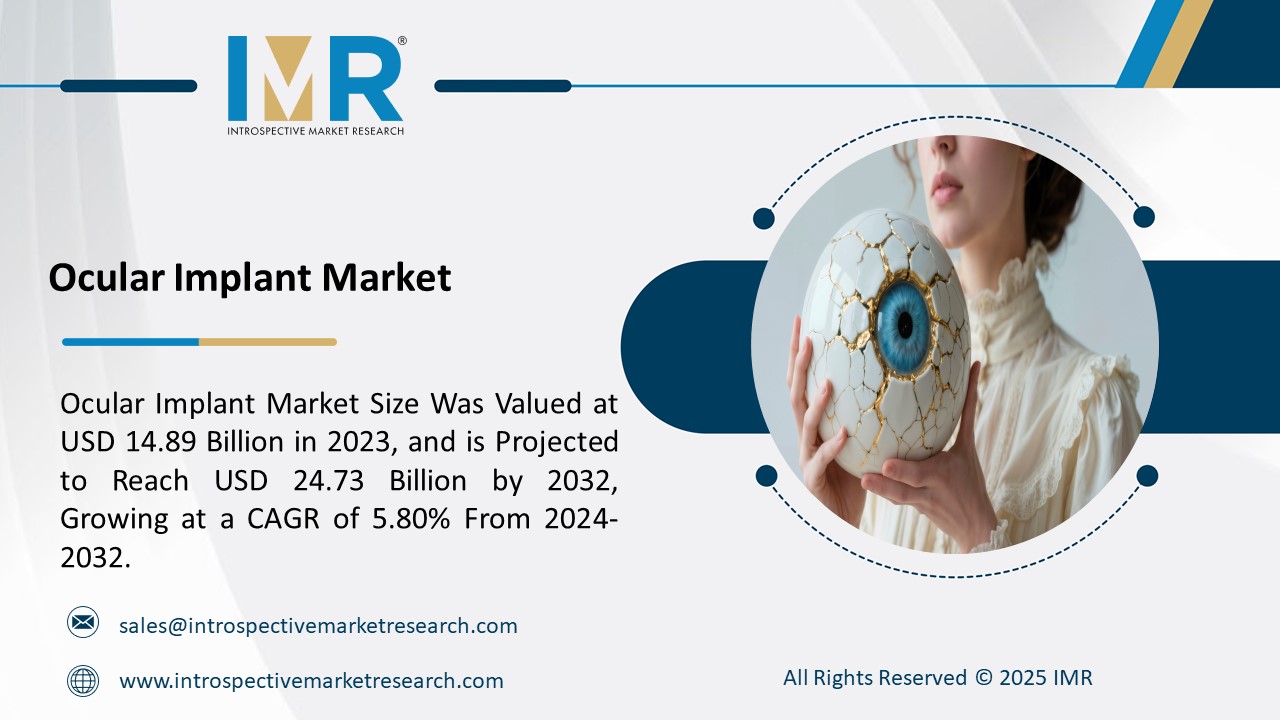
According to a new report published by Introspective Market Research, titled, Ocular Implant Market by Type, Material, and End-User, The Global Ocular Implant Market Size Was Valued at USD 14.89 Billion in 2023 and is Projected to Reach USD 24.73 Billion by 2032, Growing at a CAGR of 5.80%. The global ocular implant market is witnessing steady expansion, driven by the increasing prevalence of ophthalmic disorders, rising demand for advanced eye care solutions, and a growing aging population. Ocular implants are medical devices used to replace, support, or enhance the function of ocular tissues. They are commonly used in treating conditions such as cataracts, glaucoma, retinal disorders, and vision impairment.
Compared to traditional corrective methods like spectacles and contact lenses, ocular implants provide a long-term and often more effective solution for patients. The surge in lifestyle-related eye conditions, coupled with rising healthcare expenditures and accessibility to advanced surgical procedures, is significantly boosting demand. Additionally, innovations in materials such as biocompatible polymers and advanced intraocular lenses (IOLs) have enhanced patient comfort, reduced post-surgical complications, and increased adoption worldwide.
One of the key growth drivers for the ocular implant market is the rising global burden of cataracts and glaucoma. Cataracts are the leading cause of blindness worldwide, and surgical intervention with intraocular lenses has become the standard treatment. Similarly, glaucoma management increasingly involves implants to regulate intraocular pressure. With growing awareness, improved access to ophthalmic surgeries, and advancements in implant design, the demand for ocular implants is expected to rise sharply. Government and non-governmental health initiatives promoting early eye disease detection are further fueling this market’s expansion.
The ocular implant market presents a strong opportunity in the development of next-generation smart and customized implants. Advances in material science, 3D printing, and digital customization are enabling manufacturers to design implants tailored to individual patient needs, ensuring higher precision and comfort. Additionally, the growing adoption of premium intraocular lenses (such as multifocal and toric lenses) offers a lucrative avenue for expansion. Emerging economies, with their expanding healthcare infrastructure and rising disposable incomes, also represent untapped potential where manufacturers can cater to a large base of untreated eye disorder cases.
Ocular Implant Market, Segmentation
The Ocular Implant Market is segmented on the basis of Type, Material, and End-User.
Type
- The Type segment is further classified into Intraocular Lenses (IOLs), Orbital Implants, Glaucoma Implants, Ocular Prosthesis, and Others. Among these, the Intraocular Lenses (IOLs) sub-segment accounted for the highest market share in 2023. IOLs are widely used in cataract surgeries, which represent one of the most frequently performed medical procedures globally. The rising prevalence of cataracts in aging populations and the demand for premium IOLs, including multifocal and toric variants, are driving growth. Continuous innovations in lens design, biocompatibility, and surgical techniques are further enhancing outcomes, making IOLs the dominant choice in the ocular implant space.
Material
-
The Material segment is further classified into Polymers, Metals, Ceramics, and Others. Among these, the Polymers sub-segment accounted for the highest market share in 2023. Polymers are extensively used in ocular implants due to their biocompatibility, flexibility, and durability. They are especially preferred in the production of intraocular lenses and glaucoma implants. Advancements in polymer science have enabled the development of foldable and injectable IOLs, which have simplified surgical procedures and reduced patient recovery time. The increasing shift toward advanced polymer-based implants is expected to sustain this segment’s dominance.
Some of The Leading/Active Market Players Are-
-
Alcon Inc. (Switzerland)
- Johnson & Johnson Vision Care, Inc. (United States)
- Bausch & Lomb Incorporated (United States)
- Carl Zeiss Meditec AG (Germany)
- Hoya Corporation (Japan)
- STAAR Surgical Company (United States)
- Morcher GmbH (Germany)
- Rayner Intraocular Lenses Limited (United Kingdom)
- Ophtec BV (Netherlands)
- Aurolab (India)
- Hanita Lenses (Israel)
- Oculentis BV (Netherlands)
- Care Group India (India)
- EyeKon Medical, Inc. (United States)
- Savir GmbH (Germany)
and other active players.
Key Industry Developments
-
In April 2024, Alcon announced the launch of its new range of advanced multifocal intraocular lenses designed to provide superior vision correction for cataract patients.
This innovation is expected to enhance patient satisfaction and strengthen Alcon’s leadership in the global IOL segment by addressing growing demand for premium implants. - In August 2024, Johnson & Johnson Vision received FDA approval for its next-generation glaucoma implant system.
This approval marks a significant milestone for the company, offering ophthalmologists an advanced solution to better manage intraocular pressure in glaucoma patients and expanding Johnson & Johnson’s footprint in the ocular implant market.
Key Findings of the Study
-
Intraocular Lenses (IOLs) dominated the Type segment in 2023.
- Polymer-based implants led the Material segment due to biocompatibility and flexibility.
- North America and Europe remain key regions with strong adoption of advanced ocular technologies.
- Rising cataract prevalence and glaucoma burden are primary growth drivers.
- Premium and customized implants represent a major growth opportunity.