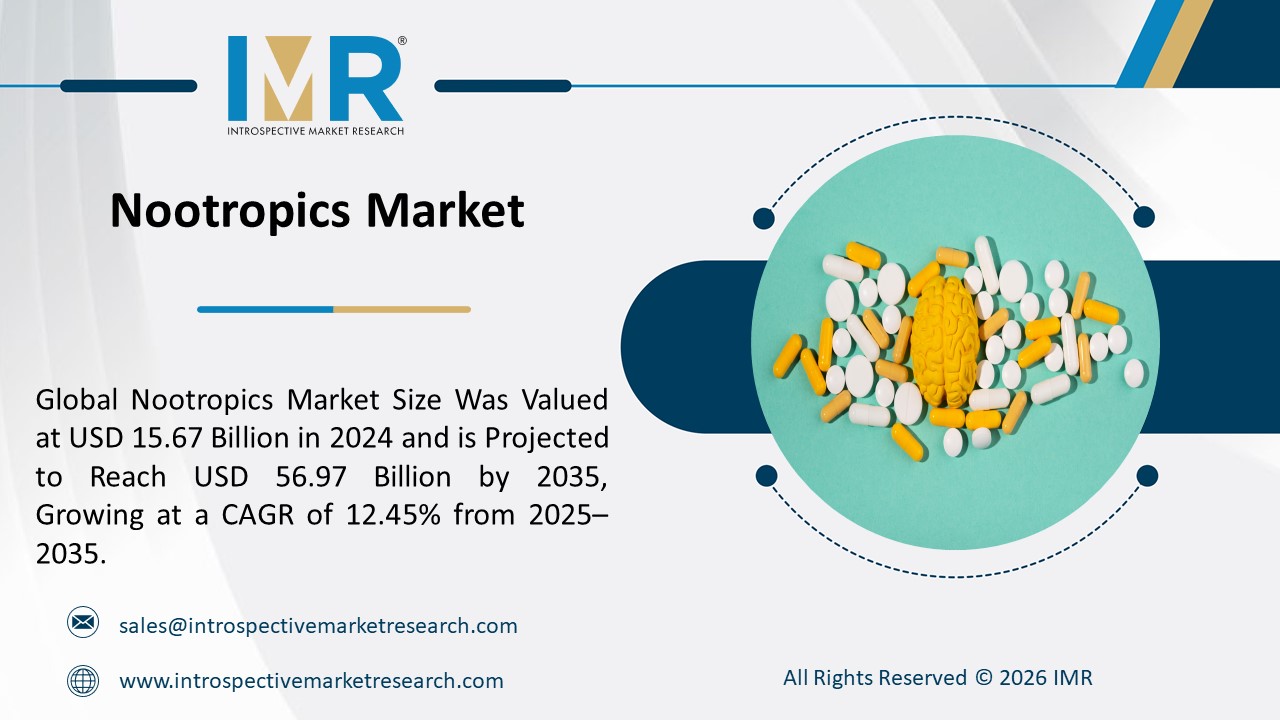
“According to a new report published by Introspective Market Research, titled, Nootropics Market by Product Type, Application, and Distribution Channel, The Global Nootropics Market Size Was Valued at USD 15.67 Billion in 2024 and is Projected to Reach USD 56.97 Billion by 2035, Growing at a CAGR of 12.45% from 2025–2035.”
The global nootropics market is witnessing robust growth, driven by increasing consumer awareness regarding cognitive health and mental performance. Nootropics, commonly referred to as “smart drugs,” are substances that enhance brain functions such as memory, creativity, focus, motivation, and overall cognitive ability. These products include natural compounds, synthetic formulations, and dietary supplements designed to support neurological health without causing significant adverse effects.
Compared to traditional stimulants, nootropics offer targeted cognitive enhancement with reduced dependency risks, making them increasingly popular among students, working professionals, and aging populations. The market has seen strong adoption across industries such as pharmaceuticals, nutraceuticals, dietary supplements, and functional foods. Growing stress levels, competitive work environments, and rising interest in preventive healthcare continue to position nootropics as a key component of modern cognitive wellness solutions.
Market Segmentation
The Nootropics Market is segmented into Product Type, Application, and Distribution Channel.
- By Product Type, the market is categorized into Natural Nootropics, Synthetic Nootropics, and Dietary Supplements.
- By Application, the market is categorized into Memory Enhancement, Attention & Focus, Mood & Depression, and Sleep & Anxiety Management.
- By Distribution Channel, the market is categorized into Online Retail, Pharmacies, and Specialty Stores.
Growth Driver
The primary growth driver of the nootropics market is the rising prevalence of cognitive disorders and increasing demand for mental performance enhancement. Factors such as aging populations, academic pressure, workplace competitiveness, and lifestyle-induced stress are accelerating the adoption of cognitive-enhancing products. Additionally, the growing acceptance of mental wellness as an integral part of overall health, supported by social media awareness and influencer marketing, is expanding the consumer base. Continuous innovation in formulations and clean-label ingredients further supports sustained market growth.
Market Opportunity
An emerging opportunity in the nootropics market lies in the increasing demand for natural and plant-based cognitive enhancers. Consumers are shifting toward herbal, organic, and clinically backed ingredients due to safety concerns associated with synthetic compounds. Expanding e-commerce platforms and direct-to-consumer models are also creating new revenue channels, especially in emerging economies. Furthermore, rising investments in research and personalized nutrition solutions are expected to unlock long-term growth opportunities for market players.
Detailed Segmentation
Nootropics Market, Segmentation
The Nootropics Market is segmented on the basis of Product Type, Application, and Distribution Channel.
Product Type
The Product Type segment is further classified into Natural Nootropics, Synthetic Nootropics, and Dietary Supplements. Among these, the Natural Nootropics sub-segment accounted for the highest market share in 2024. Natural nootropics, derived from herbs, vitamins, and plant extracts, are widely preferred due to their perceived safety, minimal side effects, and long-term cognitive benefits. Growing consumer inclination toward clean-label and organic products has significantly boosted the demand for this segment.
Application
The Application segment is further classified into Memory Enhancement, Attention & Focus, Mood & Depression, and Sleep & Anxiety Management. Among these, the Memory Enhancement sub-segment accounted for the highest market share in 2024. This dominance is attributed to rising concerns related to age-associated memory decline, increasing diagnosis of neurological conditions, and growing usage of nootropics among students and professionals seeking improved learning and retention capabilities.
Some of The Leading/Active Market Players Are –
• Pfizer Inc. (U.S.)
• Teva Pharmaceutical Industries Ltd. (Israel)
• Novartis AG (Switzerland)
• Reckitt Benckiser Group plc (UK)
• Onnit Labs Inc. (U.S.)
• Neurohacker Collective (U.S.)
• HVMN Inc. (U.S.)
• Mind Lab Pro (UK)
• AlternaScript (U.S.)
• TruBrain Inc. (U.S.)
• Purelife Bioscience Co. Ltd. (China)
• Nootrobox Inc. (U.S.)
• Kimera Koffee (U.S.)
• Peak Nootropics (U.S.)
and other active players.
Key Industry Developments
In March 2024, leading nootropics manufacturers increased investments in clinical research to validate the efficacy of natural cognitive enhancers.
This initiative aims to strengthen regulatory approvals, improve consumer trust, and expand the adoption of evidence-based nootropic products across global markets.
In October 2024, several market players expanded their online retail presence through direct-to-consumer platforms.
This strategic move enhanced product accessibility, improved brand visibility, and supported market penetration in emerging regions with growing digital adoption.
Key Findings of the Study
• Natural nootropics dominate the market due to safety and clean-label preferences
• Memory enhancement is the leading application segment
• North America holds the largest market share, while Asia-Pacific shows fastest growth
• Rising mental health awareness and lifestyle stress drive market expansion
• E-commerce and personalized nutrition trends shape future opportunities