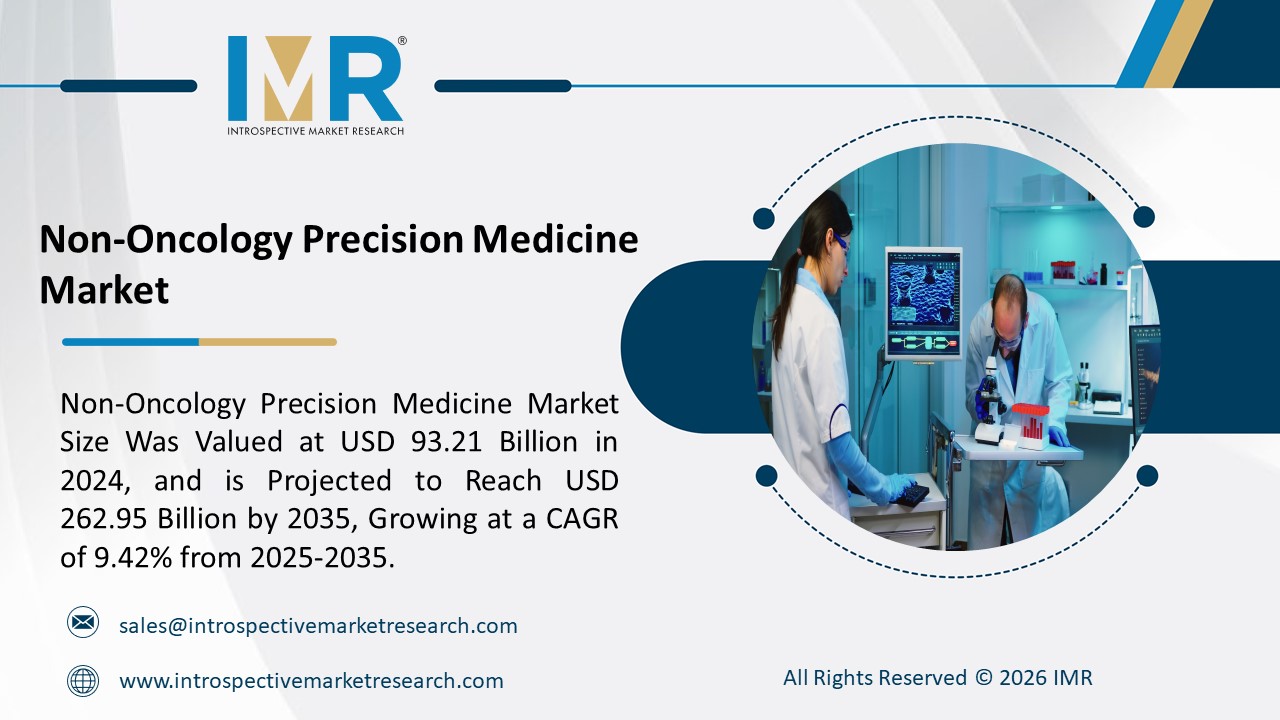
According to a new report published by Introspective Market Research, titled, “Non-Oncology Precision Medicine Market by Therapeutic Area, Technology, and End User,” The Global Non-Oncology Precision Medicine Market Size Was Valued at USD 93.21 Billion in 2024 and is Projected to Reach USD 262.95 Billion by 2035, Growing at a CAGR of 9.42%.
The non-oncology precision medicine market encompasses diagnostic tests, targeted therapies, and digital health tools designed to prevent, diagnose, and treat diseases outside of cancer based on an individual's genetic makeup, lifestyle, and environment. This approach moves beyond the traditional "one-size-fits-all" model to deliver customized healthcare. Its primary advantage is the ability to identify patient subgroups most likely to respond to a specific treatment, thereby enhancing therapeutic efficacy, reducing adverse drug reactions, and avoiding costly, ineffective interventions. This leads to improved patient outcomes and more efficient healthcare spending.
The primary growth driver for the non-oncology precision medicine market is the dramatic reduction in genomic sequencing costs coupled with significant advancements in big data analytics and artificial intelligence. The ability to sequence an entire human genome rapidly and affordably has democratized access to genetic information, the foundational layer of personalized care. Concurrently, AI and machine learning algorithms can now integrate and interpret massive, complex datasets from genomics, electronic health records, and wearable devices to uncover novel biomarkers and disease pathways. This powerful synergy enables the identification of precise molecular targets for drug development and allows clinicians to stratify patients with common diseases like diabetes or Alzheimer's into distinct subgroups, paving the way for targeted interventions and driving widespread adoption across healthcare systems.
A vast market opportunity exists in the expansion of precision medicine into mainstream chronic disease management, particularly for cardiometabolic and neurological conditions. While oncology has led the field, diseases like heart failure, type 2 diabetes, and Alzheimer's affect hundreds of millions globally and represent a largely untapped frontier. The opportunity lies in developing validated biomarker panels for early detection, progression monitoring, and therapy selection for these complex disorders. Furthermore, integrating continuous data from digital health tools (wearables, sensors) with traditional biomarkers creates a dynamic "digital phenotype," enabling real-time, personalized health management and preventative interventions, opening a new paradigm for value-based, chronic care.
Non-Oncology Precision Medicine Market, Segmentation
The Non-Oncology Precision Medicine Market is segmented on the basis of Therapeutic Area, Technology, and End User.
Therapeutic Area
The Therapeutic Area segment is further classified into Cardiovascular Diseases, Infectious Diseases, Neurological Disorders, Metabolic/Endocrine Disorders, and Others. Among these, the Cardiovascular Diseases sub-segment accounted for the highest market share in 2024. This dominance is driven by the high global prevalence of CVD, the clear clinical utility of genetic testing for conditions like familial hypercholesterolemia, and the established use of pharmacogenomics to guide anticoagulant (e.g., warfarin) and antiplatelet therapy. Precision approaches in cardiology directly impact drug selection and dosing, improving safety and efficacy, which has accelerated their integration into standard clinical guidelines and practice.
Technology
The Technology segment is further classified into Genomic Sequencing, Pharmacogenomics, Molecular Diagnostics, and Big Data & Analytics. Among these, the Genomic Sequencing sub-segment accounted for the highest market share in 2024. Genomic sequencing is the foundational technology enabling nearly all precision medicine applications. The widespread adoption of next-generation sequencing (NGS) panels for diagnosing rare diseases, profiling infectious pathogens, and identifying inherited risk factors has made it the largest revenue-generating segment. Its continuous evolution towards faster, cheaper, and more comprehensive sequencing solidifies its central role in the market's ecosystem.
Some of The Leading/Active Market Players Are-
- Illumina, Inc. (USA)
- Thermo Fisher Scientific Inc. (USA)
- F. Hoffmann-La Roche Ltd. (Switzerland)
- Quest Diagnostics Incorporated (USA)
- Laboratory Corporation of America Holdings (USA)
- Qiagen N.V. (Netherlands)
- Bio-Rad Laboratories, Inc. (USA)
- Myriad Genetics, Inc. (USA)
- Pacific Biosciences of California, Inc. (USA)
- Oxford Nanopore Technologies plc (UK)
- Sophia Genetics (Switzerland)
- Invitae Corporation (USA)
- BGI Group (China)
- Agilent Technologies, Inc. (USA)
- PerkinElmer, Inc. (USA)
and other active players.
Key Industry Developments
In February 2024, Roche and Illumina announced a strategic collaboration to develop and distribute new next-generation sequencing (NGS)-based diagnostic tests for hereditary diseases, focusing on cardiology and neurology, in the U.S. and Europe.
This partnership between a diagnostics powerhouse and a sequencing leader aims to accelerate the clinical adoption of standardized, regulated NGS tests in non-oncology areas, bridging the gap between complex genomic data and actionable clinical decision-making for common complex diseases.
In January 2024, the U.S. National Institutes of Health (NIH) launched a major new research initiative, "Precision Nutrition: The Nutrition for Precision Health Study," aiming to use AI and multi-omics to develop personalized diet recommendations.
This large-scale public sector investment underscores the expanding scope of precision medicine beyond pharmaceuticals into lifestyle interventions, validating the market's potential to revolutionize preventative care and chronic disease management through highly personalized dietary and health plans.
Key Findings of the Study
- Cardiovascular Diseases represent the largest therapeutic application area.
- Genomic Sequencing technology is the dominant and foundational segment.
- Market growth is propelled by plummeting sequencing costs and advances in AI-driven data integration.
- North America holds the leading market share, with the Asia-Pacific region exhibiting the highest growth potential.
- Expansion into chronic disease management and digital health integration are the key future trends.