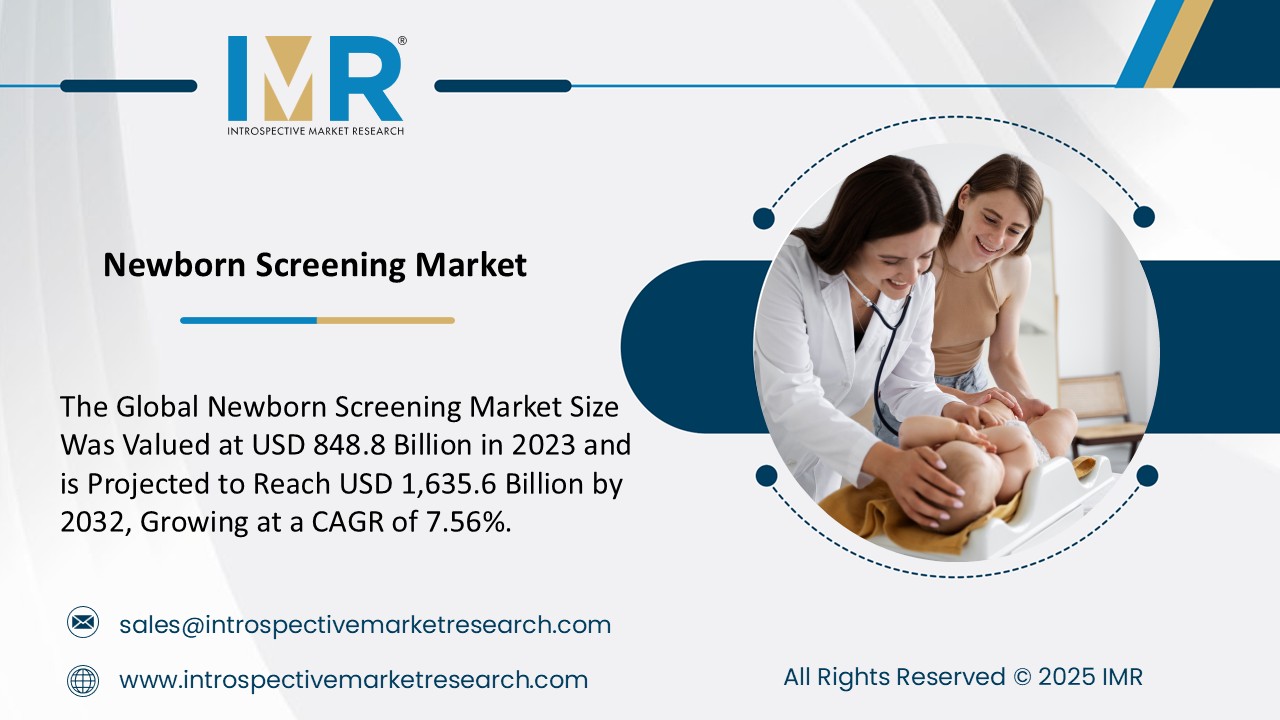
According to a new report published by Introspective Market Research, titled, “Newborn Screening Market by Product Type, Technology, and End User, The Global Newborn Screening Market Size Was Valued at USD 848.8 Billion in 2023 and is Projected to Reach USD 1,635.6 Billion by 2032, Growing at a CAGR of 7.56%.” The Newborn Screening Market is expanding rapidly due to heightened awareness of early disease detection and the increasing prevalence of genetic and metabolic disorders in infants. Newborn screening programs are designed to identify treatable conditions within days of birth, enabling early intervention and preventing severe health outcomes. The process typically involves testing a few drops of blood from the newborn’s heel for genetic, metabolic, hormonal, and functional disorders.
Compared to traditional diagnostic methods that often detect conditions after symptoms manifest, newborn screening allows healthcare providers to intervene before irreversible damage occurs. Governments and healthcare organizations worldwide are mandating newborn screening programs, improving access to early diagnosis and treatment.
The technology’s versatility and growing adoption in both public health and private healthcare settings underline its critical role in preventative medicine. With ongoing advances in molecular testing, tandem mass spectrometry, and data analytics, newborn screening is evolving into a cornerstone of neonatal care.
The Newborn Screening Market is segmented into Product Type, Technology, and End User.
By Product Type, the market is categorized into (Instruments, Reagents & Assay Kits, and Software).
By Technology, the market is categorized into (Tandem Mass Spectrometry, Immunoassays, Molecular Assays, and Others).
By End User, the market is categorized into (Hospitals, Clinical Laboratories, and Public Health Programs).
A major growth driver for the global Newborn Screening Market is the increasing implementation of government-supported screening programs worldwide. Public health authorities across developed and emerging economies are introducing mandatory testing policies and expanding the number of conditions screened. The rise in congenital disorders and early diagnosis demand is motivating healthcare systems to invest in better instruments and molecular technologies, thereby propelling market growth over the next decade.
An emerging opportunity in the Newborn Screening Market lies in the integration of genomic sequencing technologies. Next-generation sequencing (NGS) can detect a broader range of genetic disorders than conventional methods, offering comprehensive insights into infant health. As sequencing costs continue to decline and bioinformatics tools advance, hospitals and research institutions are actively exploring genomic-based newborn screening programs to personalize care and reduce long-term disease burdens.
Newborn Screening Market, Segmentation
The Newborn Screening Market is segmented on the basis of Product Type, Technology, and End User.
Product Type
The Product Type segment is further classified into Instruments, Reagents & Assay Kits, and Software. Among these, the Reagents & Assay Kits sub-segment accounted for the highest market share in 2023. The recurring demand for testing reagents and assay kits, driven by a growing number of screening tests worldwide, is fueling this segment’s dominance. Continuous innovation in assay sensitivity and specificity, combined with expanding screening panels, is strengthening the recurring revenue base for manufacturers.
Technology
The Technology segment is further classified into Tandem Mass Spectrometry, Immunoassays, Molecular Assays, and Others. Among these, the Tandem Mass Spectrometry (MS/MS) sub-segment accounted for the highest market share in 2023. MS/MS offers high throughput and precision in detecting multiple metabolic disorders from a single blood sample. Its ability to simultaneously analyze numerous biomarkers with minimal false positives makes it the preferred method in large-scale screening programs across hospitals and public laboratories.
Some of The Leading/Active Market Players Are–
- PerkinElmer Inc. (U.S.)
- Bio-Rad Laboratories, Inc. (U.S.)
- Agilent Technologies, Inc. (U.S.)
- Thermo Fisher Scientific, Inc. (U.S.)
- Trivitron Healthcare (India)
- Natus Medical Incorporated (U.S.)
- Medtronic plc (Ireland)
- Masimo Corporation (U.S.)
- Centogene N.V. (Germany)
- Waters Corporation (U.S.)
- GE HealthCare Technologies Inc. (U.S.)
- Baebies, Inc. (U.S.)
- AB Sciex LLC (U.S.)
- MP Biomedicals LLC (U.S.)
- BioMérieux SA (France)
- and other active players.
Key Industry Developments
In February 2024, PerkinElmer introduced a next-generation automated newborn screening platform integrating liquid chromatography with tandem mass spectrometry.
This innovation enhances assay throughput and accuracy while reducing manual handling, supporting large-scale implementation in national screening programs.
In June 2024, Thermo Fisher Scientific expanded its neonatal diagnostic product line by launching an advanced enzyme assay kit for lysosomal storage disorders.
The product enables faster detection of metabolic diseases in newborns, aligning with global initiatives for early diagnosis and prevention in pediatric healthcare.
Key Findings of the Study
- Reagents & Assay Kits dominated product segment in 2023.
- Tandem Mass Spectrometry led the technology category.
- North America held the largest market share.
- Growth driven by government-backed screening mandates.
- Genomic-based screening expected to shape future trends.