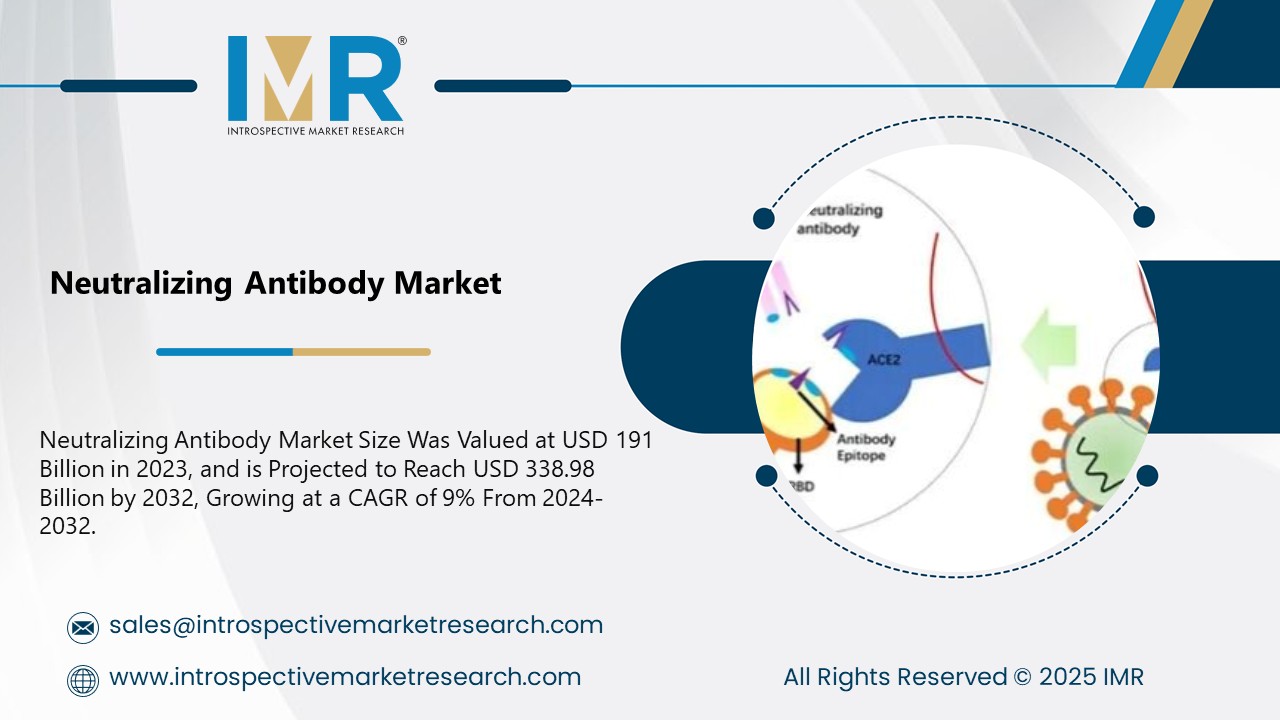
According to a new report published by Introspective Market Research, titled, Neutralizing Antibody (NAb) Market by Type, Application, and End-User, The Global Neutralizing Antibody (NAb) Market Size Was Valued at USD 191 Billion in 2023 and is Projected to Reach USD 338.98 Billion by 2032, Growing at a CAGR of 9%. The neutralizing antibody market comprises therapeutics and diagnostic tools leveraging antibodies that can directly block the biological activity of pathogens or toxins. These specialized antibodies bind to specific targets, preventing them from interacting with host cells or initiating disease processes. Unlike non-neutralizing antibodies, which primarily mark targets for immune destruction, neutralizing antibodies offer a direct protective mechanism, making them highly effective in preventing and treating infectious diseases, autoimmune disorders, and certain cancers. Their precise targeting and minimal off-target effects offer significant advantages over traditional broad-spectrum drugs.
Neutralizing antibodies find critical applications across various industries, primarily in biopharmaceuticals, diagnostics, and research and development. In the pharmaceutical sector, they are developed as monoclonal antibody drugs for conditions ranging from viral infections like COVID-19 and RSV to autoimmune diseases such as rheumatoid arthritis and psoriasis. Diagnostic kits utilize neutralizing antibodies for accurate detection of pathogen exposure and assessment of vaccine efficacy. Research institutions extensively employ them to study disease mechanisms and develop novel therapeutic strategies, underscoring their pivotal role in modern medicine.
One key growth driver for the neutralizing antibody (NAb) market is the increasing incidence of infectious diseases and the emergence of new viral strains. Recent global pandemics, such as COVID-19, have underscored the urgent need for effective and rapidly deployable therapeutics, driving significant investment in neutralizing antibody research and development. These antibodies offer a targeted approach to combating pathogens by directly blocking their ability to infect host cells, making them invaluable tools in pandemic preparedness and response. The continuous threat of new infectious agents ensures sustained demand for these innovative biological treatments.
a significant market opportunity lies in the development of multi-specific and broadly neutralizing antibodies capable of targeting multiple strains or variants of a pathogen simultaneously. Traditional neutralizing antibodies often target specific epitopes, which can be easily circumvented by viral mutations. Innovations in engineering antibodies that can bind to conserved regions or engage multiple targets would offer enhanced efficacy and broader protection against rapidly evolving pathogens. This advancement could revolutionize the treatment and prevention of diseases like influenza, HIV, and respiratory syncytial virus (RSV), creating substantial market value.
Neutralizing Antibody (NAb) Market, Segmentation
The Neutralizing Antibody (NAb) Market is segmented on the basis of Type, Application, and End-User.
Type
The Type segment is further classified into Monoclonal Antibodies, Polyclonal Antibodies, and Recombinant Antibodies. Among these, the Monoclonal Antibodies sub-segment accounted for the highest market share in 2023. Monoclonal antibodies (mAbs) dominate the market due to their high specificity, purity, and ability to be produced in large, consistent quantities. Their precision in targeting specific antigens makes them ideal for therapeutic applications, minimizing off-target effects and maximizing efficacy. The extensive research and development in mAb technology, coupled with their successful clinical track record in treating various diseases, firmly establishes them as the leading type.
Application
The Application segment is further classified into Infectious Diseases, Autoimmune Diseases, Cancer, and Others. Among these, the Infectious Diseases sub-segment accounted for the highest market share in 2023. The infectious diseases application holds the largest market share primarily driven by recent global health crises and the continuous need for effective antiviral and antibacterial therapies. Neutralizing antibodies have proven highly effective in preventing viral entry and clearing pathogens, playing a crucial role in managing outbreaks and treating severe infections. The rapid development and deployment of these antibodies during the COVID-19 pandemic significantly boosted this segment's growth and importance.
Some of The Leading/Active Market Players Are-
- Eli Lilly and Company (USA)
- Regeneron Pharmaceuticals, Inc. (USA)
- AstraZeneca Plc (UK)
- GlaxoSmithKline plc (UK)
- Gilead Sciences, Inc. (USA)
- Celltrion Healthcare Co., Ltd. (South Korea)
- Roche Holding AG (Switzerland)
- Amgen Inc. (USA)
- Johnson & Johnson (USA)
- Merck & Co., Inc. (USA)
- Bristol-Myers Squibb Company (USA)
- Sanofi S.A. (France)
- Takeda Pharmaceutical Company Limited (Japan)
- CureVac N.V. (Germany)
- Vir Biotechnology, Inc. (USA)
- and other active players.
Key Industry Developments
- In November 2023, AstraZeneca announced positive results from a Phase 3 clinical trial for its long-acting antibody combination designed for pre-exposure prophylaxis of RSV in infants and high-risk adults. This trial highlighted the potential of neutralizing antibodies in preventing severe respiratory infections, expanding their application beyond active treatment. The positive data marked a significant step towards protecting vulnerable populations from seasonal viruses.
- In June 2023, Eli Lilly and Company partnered with a major diagnostics firm to develop a rapid neutralizing antibody test for emerging viral threats. This collaboration aimed to accelerate the assessment of immunity levels and vaccine efficacy, providing critical data for public health responses. The initiative underscored the growing importance of integrated diagnostic and therapeutic strategies in combating infectious diseases.
Key Findings of the Study
- Monoclonal antibodies lead the market due to their specificity and production scalability.
- The infectious diseases segment holds the largest share, driven by global health challenges.
- Rising incidence of infectious diseases and emerging pathogens are key growth drivers.
- Focus on multi-specific and broadly neutralizing antibodies represents a major market trend.
- Use Arrow Up and Arrow Down to select a turn, Enter to jump to it, and Escape to return to the chat.