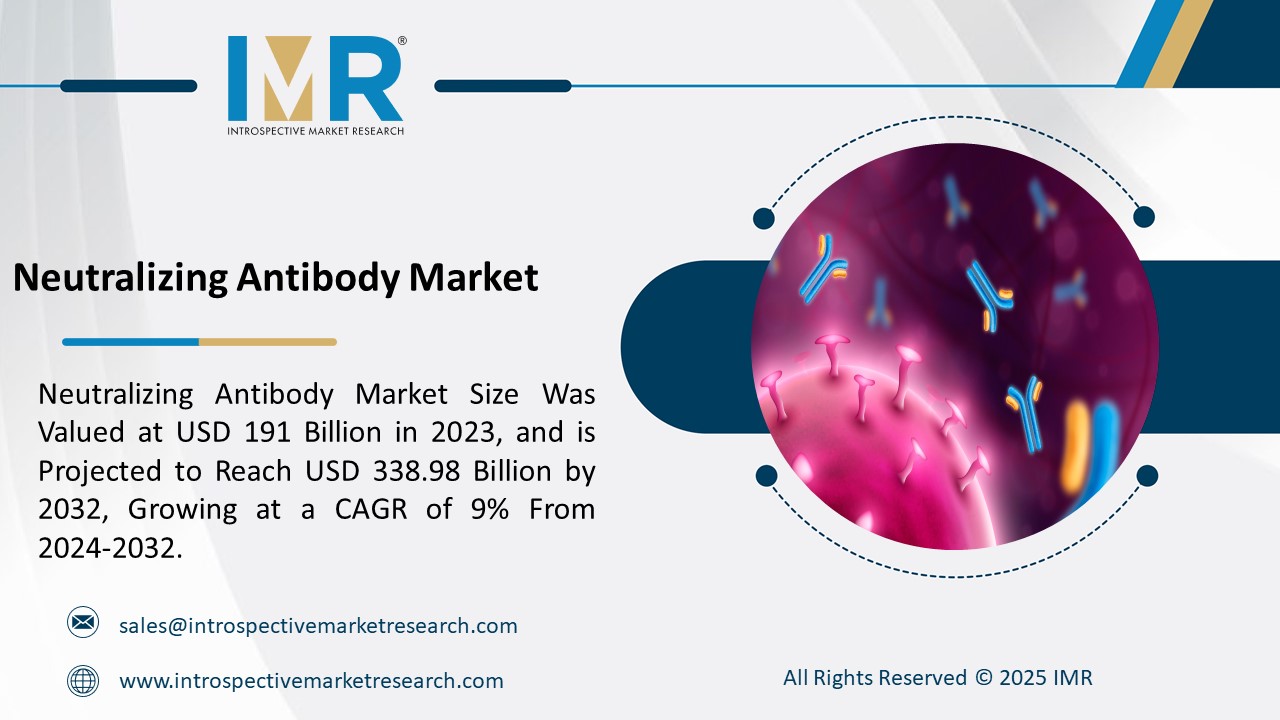
According to a new report published by Introspective Market Research, titled, Neutralizing Antibody Market by Type (Monoclonal Antibodies, Polyclonal Antibodies), Application (Infectious Diseases, Autoimmune Diseases, Cancer, Other Applications), and End-User (Hospitals, Research Institutes, Pharmaceutical & Biotechnology Companies), The Global Neutralizing Antibody Market Size Was Valued at USD 191 Billion in 2023 and is Projected to Reach USD 338.98 Billion by 2032, Growing at a CAGR of 9%. Neutralizing antibodies are specialized immune proteins that play a critical role in the body's defense mechanisms. Unlike other antibodies, neutralizing antibodies specifically bind to pathogens (such as viruses or bacteria) or toxins, effectively blocking their ability to infect cells or cause harm. By inhibiting the functional activity of these harmful agents, they prevent disease progression or mitigate its severity.
The market for neutralizing antibodies is a rapidly expanding segment within the biopharmaceutical industry, driven by their significant therapeutic potential. These antibodies are at the forefront of developing innovative treatments for a wide array of conditions, including infectious diseases, autoimmune disorders, and various forms of cancer. Their high specificity and targeted action offer advantages over traditional therapies, leading to more effective treatments with potentially fewer side effects.
The escalating global incidence of infectious diseases and the continuous emergence of novel pathogens represent a primary growth driver for the neutralizing antibody market. Events such as the COVID-19 pandemic have underscored the critical need for effective antibody-based therapies for rapid intervention and prevention. Neutralizing antibodies offer a highly targeted and potent defense against viruses and bacteria, prompting significant investment in their research and development. This ongoing threat from infectious agents ensures sustained demand for innovative neutralizing antibody solutions.
A substantial market opportunity exists in the development of multi-specific or broadly neutralizing antibodies designed to target multiple strains of a pathogen or different pathogenic mechanisms simultaneously. For instance, broadly neutralizing antibodies against highly mutable viruses like influenza or HIV could offer universal protection, overcoming the limitations of current strain-specific treatments. Furthermore, the application of neutralizing antibodies in combination therapies for complex diseases such as cancer or chronic autoimmune conditions holds immense potential. Advances in antibody engineering and computational biology are crucial in realizing these complex therapeutic strategies.
Neutralizing Antibody Market, Segmentation
Type
-
The Type segment is further classified into Monoclonal Antibodies and Polyclonal Antibodies. Among these, the Monoclonal Antibodies sub-segment accounted for the highest market share in 2023. Monoclonal antibodies (mAbs) are laboratory-produced antibodies that mimic the body’s natural immune response but are designed to target specific antigens with high precision. Their unparalleled specificity, consistency, and ability to be manufactured at scale have made them the dominant type in therapeutic development. mAbs are widely used in treating cancer, autoimmune diseases, and infectious diseases, driving significant investment and adoption across the pharmaceutical industry due to their proven efficacy and safety profiles.
Application
-
The Application segment is further classified into Infectious Diseases, Autoimmune Diseases, Cancer, and Other Applications. Among these, the Infectious Diseases sub-segment accounted for the highest market share in 2023. The significant and continuous threat posed by infectious agents, including viruses and bacteria, has propelled the demand for neutralizing antibodies in this application area. Neutralizing antibodies provide a direct and effective means to block pathogen entry and replication, offering both prophylactic and therapeutic benefits. Recent global health crises have further accelerated research and development, leading to rapid advancements and widespread adoption of these therapies for conditions ranging from viral infections to bacterial toxins.
Some of The Leading/Active Market Players Are-
- Eli Lilly and Company (USA)
- Regeneron Pharmaceuticals, Inc. (USA)
- GlaxoSmithKline plc (UK)
- AstraZeneca Plc (UK)
- Celltrion Healthcare Co., Ltd. (South Korea)
- Vir Biotechnology, Inc. (USA)
- Amgen Inc. (USA)
- AbbVie Inc. (USA)
- Johnson & Johnson (USA)
- F. Hoffmann-La Roche Ltd. (Switzerland)
- Bristol Myers Squibb Company (USA)
- Takeda Pharmaceutical Company Limited (Japan)
- Sanofi S.A. (France)
- Gilead Sciences, Inc. (USA)
- Emergent BioSolutions Inc. (USA)
- other active players.
Key Industry Developments
-
In March 2023, Regeneron Pharmaceuticals announced positive results from a Phase 3 trial for a new neutralizing antibody therapy targeting an emerging infectious disease. The trial demonstrated significant efficacy in preventing severe outcomes in high-risk patients. This development highlights Regeneron's commitment to addressing global health threats and expanding its portfolio of antibody-based therapeutics, potentially offering a crucial new option for protecting vulnerable populations against rapidly spreading infections.
- In January 2023, Eli Lilly and Company expanded its research collaboration with a biotechnology firm to accelerate the discovery and development of novel neutralizing antibodies for autoimmune conditions. This partnership aims to leverage advanced antibody engineering platforms to identify highly specific therapeutic candidates. The collaboration reflects Eli Lilly's strategic focus on strengthening its immunology pipeline and addressing unmet medical needs in chronic inflammatory and autoimmune disorders through innovative antibody-based treatments.
Key Findings of the Study
- Monoclonal antibodies lead the market due to their high specificity and manufacturing scalability.
- Infectious diseases constitute the largest application segment, driven by global health threats.
- The rising incidence of infectious diseases is a key growth driver.
- Development of multi-specific and broadly neutralizing antibodies offers significant opportunities.
- Advances in antibody engineering are fueling market innovation.