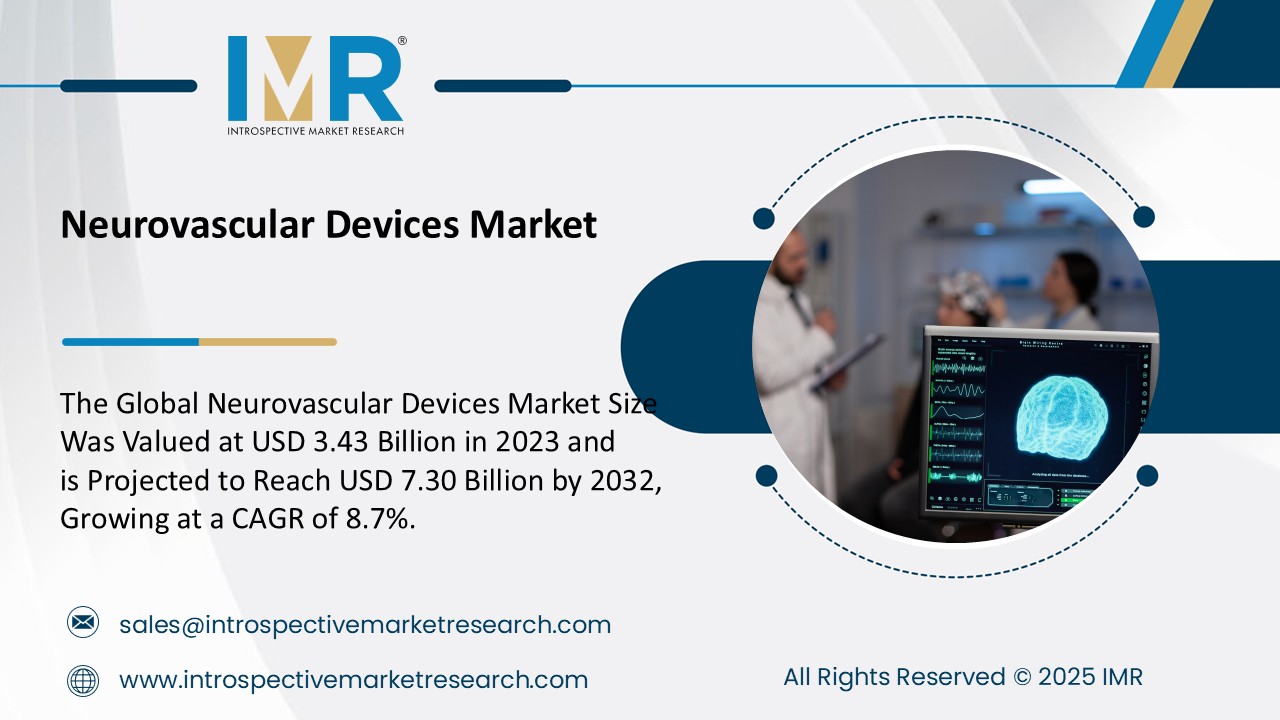
According to a new report published by Introspective Market Research, titled, Neurovascular Devices Market by Device Type, Therapeutic Application, and End-Use, The Global Neurovascular Devices Market Size Was Valued at USD 3.43 Billion in 2023 and is Projected to Reach USD 7.30 Billion by 2032, Growing at a CAGR of 8.7%. The neurovascular devices market is expanding rapidly as the global prevalence of stroke, aneurysms, and other neurovascular disorders continues to rise. Neurovascular devices—including embolization coils, stenting systems, and neurothrombectomy tools—enable precise, minimally invasive treatment for complex conditions affecting the brain’s blood vessels. These advanced devices offer significant advantages over traditional surgical approaches, including reduced complication risks, shorter recovery time, and improved clinical outcomes.
Major industries utilizing neurovascular devices include hospitals, specialty clinics, and research institutions, with increasing adoption in developed and emerging regions. Technological innovations in device materials, imaging, and delivery systems have simplified procedures and enhanced the efficiency of neurovascular interventions, supporting the market’s growth trajectory.
The Neurovascular Devices Market is segmented into Device Type, Therapeutic Application, and End-Use.
- By Device Type: Cerebral Embolization and Aneurysm Coiling Devices (Embolic coils, flow diversion devices, liquid embolic agents), Cerebral Angioplasty and Stenting Systems (Carotid artery stents, embolic protection), Neurothrombectomy Devices (Clot retrieval devices, suction catheters, vascular snares), Support Devices (Micro catheters, micro guidewires, trans radial access devices).
- By Application: Stroke, Cerebral Artery Disease, Cerebral Aneurysms, Aneurysmal Subarachnoid Hemorrhage, Others.
- By End-Use: Hospitals, Specialty Clinics, Research Institutions, Others.
Rising incidence of neurovascular disorders—particularly ischemic strokes and cerebral aneurysms—is a major market driver. As the global population ages and risk factors such as hypertension and diabetes become more prevalent, demand for effective, minimally invasive neurovascular treatments is accelerating. Healthcare providers are favoring these devices due to their enhanced safety profile, ability to deliver targeted therapy, and increasingly favorable reimbursement policies in developed countries.
Key opportunities exist in expanding access to advanced neurovascular therapies in emerging markets, where infrastructure development and an increase in specialty clinics support higher adoption rates. Continued investment by device makers in R&D—along with strategic partnerships and geographic expansion—are unlocking new patient populations. Innovations such as robotic-assisted surgery, AI-powered diagnostics, and novel embolizaton materials enable differentiated, scalable solutions for both high-burden and underserved regions.
Neurovascular Devices Market, Segmentation
The Neurovascular Devices Market is segmented on the basis of Device Type, Therapeutic Application, and End-Use.
Device Type
The Device Type segment is further classified into Cerebral Embolization & Aneurysm Coiling Devices, Cerebral Angioplasty & Stenting Systems, Neurothrombectomy Devices, and Support Devices. Among these, Cerebral Embolization & Aneurysm Coiling Devices held the highest market share in 2024. These devices are preferred for the minimally invasive prevention of aneurysm rupture, driven by their effective outcomes and broad clinical acceptance. Adoption is supported by widespread clinical validation and technological improvements, including flow diversion and liquid embolic agents.
Therapeutic Application
The Therapeutic Application segment is further classified into Stroke, Cerebral Artery Disease, Cerebral Aneurysm, and Others. In 2024, Stroke emerged as the segment with the largest share, due to the global increase in stroke incidence and the demand for rapid intervention tools—such as neurothrombectomy and microcatheter devices—that offer effective treatment and improved patient survival rates.
Leading/Active Market Players
- Medtronic (USA)
- Stryker Corporation (USA)
- Johnson & Johnson (USA)
- Penumbra Inc. (USA)
- Terumo Neuro (Japan)
- Royal Philips (Netherlands)
- Heraeus Medevio (Germany)
- Evasc Neurovascular (Canada)
- NeuroVasc Technologies (USA)
- iVascular (Spain)
- Kaneka Corporation (Japan)
- Perflow Medical (Israel)
- Rapid Medical (Israel)
- Other active players.
Key Industry Developments
In May 2024, Medtronic launched its next-generation flow diversion stent, targeting complex cerebral aneurysms.
This technology is designed to improve safety and efficacy, with greater flexibility and compatibility for minimally invasive procedures, boosting hospital adoption across major global markets.
In August 2024, Stryker Corporation received FDA approval for an AI-powered neurothrombectomy platform for stroke care.
This system integrates real-time imaging and machine learning algorithms to aid clinicians in the rapid identification and removal of cerebral blood clots, supporting enhanced treatment outcomes for stroke patients.
Key Findings of the Study
- Cerebral Embolization & Aneurysm Coiling Devices dominated device type in 2024.
- Stroke intervention was the largest application segment in both developed and emerging markets.
- North America led global share due to advanced healthcare infrastructure and early technology adoption.
- Growth driven by aging demographics and expanding use of minimally invasive therapies.
- Technology trends include robotic-assisted surgery and AI-integrated diagnostics.