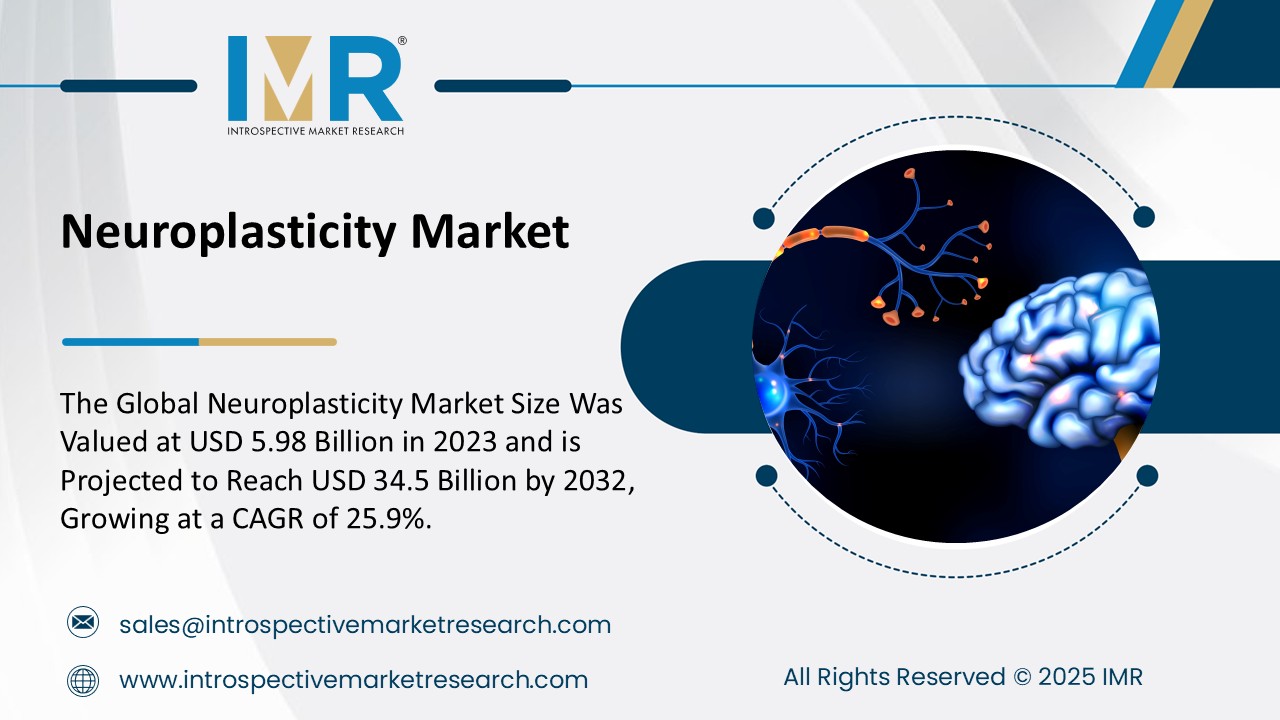
According to a new report published by Introspective Market Research, titled, Neuroplasticity Market by Therapy Type, Application, and End-User, The Global Neuroplasticity Market Size Was Valued at USD 5.98 Billion in 2023 and is Projected to Reach USD 34.5 Billion by 2032, Growing at a CAGR of 25.9%. The global neuroplasticity market is experiencing remarkable growth as research in neuroscience translates into innovative therapies aimed at rehabilitation and cognitive enhancement. Neuroplasticity, the brain’s natural ability to restructure and form new neural pathways, serves as the foundation for treatments that improve recovery from trauma, stroke, and neurodegenerative disorders. This approach has opened new possibilities for patients suffering from brain injury, dementia, or learning impairments.
Unlike conventional treatments that primarily address symptoms without altering brain function, neuroplasticity interventions utilize brain training, non-invasive stimulation, and advanced digital therapeutics for long-term recovery. These therapies are increasingly being adopted in rehabilitation centers, specialist clinics, and hospitals. The market is also expanding beyond healthcare by supporting mental wellness, memory training, and learning enhancement applications, which further strengthens its global potential.
The Neuroplasticity Market is segmented into Therapy Type, Application, and End-User.
- By Therapy Type, the market is categorized into Cognitive Training, Brain Stimulation, Pharmacological Therapy, and Other Therapies.
- By Application, the market is categorized into Stroke Recovery, Brain Injury Rehabilitation, Neurodegenerative Disorders, and Mental Health Management.
- By End-User, the market is categorized into Hospitals, Specialty Clinics, and Research Institutions.
The rising global incidence of neurological disorders and brain injuries is a primary growth driver of the neuroplasticity market. Stroke alone impacts millions annually and is one of the leading causes of disability worldwide. Traditional rehabilitation methods often fail to fully restore the patient’s lost functions. Neuroplasticity-centered therapies—such as digital cognitive training platforms and neuromodulation devices—enable the brain to relearn and regain capabilities. These methods, strengthened by AI-driven personalization and wearable-based monitoring, are becoming widely accepted, fueling significant market growth globally.
One of the major opportunities for the neuroplasticity market lies in the integration of cutting-edge digital health technologies like VR-based brain training, AI-enabled rehabilitation programs, and smart wearables. Emerging economies, where access to costly physical rehabilitation facilities is limited, are expected to benefit enormously from these cost-efficient, scalable solutions. Beyond clinical rehabilitation, the neuroplasticity market is expanding into consumer applications such as stress management, learning enhancement, and cognitive performance optimization, thereby opening additional market streams for technology providers and healthcare innovators.
Neuroplasticity Market, Segmentation
The Neuroplasticity Market is segmented on the basis of Therapy Type, Application, and End-User.
Therapy Type
The Therapy Type segment is further classified into Cognitive Training, Brain Stimulation, Pharmacological Therapy, and Other Therapies. Among these, Cognitive Training accounted for the highest market share in 2023. This was due to the growing adoption of digital platforms and gamified learning applications that deliver measurable improvements in memory, problem-solving, and recovery post-injury. Non-invasive and cost-effective, cognitive training solutions are widely accessible for patients and are being used both in clinical and non-clinical environments, making them the leading therapy sub-segment.
Application
The Application segment is further classified into Stroke Recovery, Brain Injury Rehabilitation, Neurodegenerative Disorders, and Mental Health Management. Among these, Stroke Recovery accounted for the highest market share in 2023. With stroke-related disabilities increasing worldwide, healthcare providers are turning to neuroplasticity-based methods such as brain stimulation devices and intensive cognitive exercises to enhance motor and speech recovery. These therapies have shown strong clinical outcomes, leading to higher adoption among hospitals and rehabilitation centers.
Leading/Active Market Players
- Medtronic PLC (Ireland)
- Boston Scientific Corporation (USA)
- Abbott Laboratories (USA)
- Neuronetics Inc. (USA)
- Helius Medical Technologies (USA)
- Magstim Company Ltd. (UK)
- NeuroMetrix, Inc. (USA)
- MindMaze SA (Switzerland)
- BrainsWay Ltd. (Israel)
- Neuronix Ltd. (Israel)
- Cogstate Ltd. (Australia)
- Constant Therapy Health (USA)
- NeuroPace, Inc. (USA)
- Novartis AG (Switzerland)
- Axonics Inc. (USA)
- Other active players.
Key Industry Developments
In April 2024, MindMaze SA launched an AI-integrated digital neurorehabilitation platform designed to accelerate stroke recovery using personalized therapy modules.
This solution combines gamification with real-time performance monitoring, making it more engaging for patients and providing healthcare professionals with advanced data to optimize treatment.
In September 2024, Helius Medical Technologies received expanded FDA clearance for its neuromodulation therapy device targeting traumatic brain injury rehabilitation.
The clearance significantly broadens the clinical applications of non-invasive therapies, reinforcing the growing acceptance of neuroplasticity-based treatments within U.S. healthcare frameworks.
Key Findings of the Study
- Cognitive Training dominated the therapy type segment in 2023.
- Stroke Recovery was the leading application segment.
- North America held the largest market share in 2023 due to early adoption of advanced rehab technologies.
- Growth driver: Rising prevalence of neurological injuries and disorders.
- Market trend: Expanding role of digital health, AI, and virtual reality in rehabilitation.