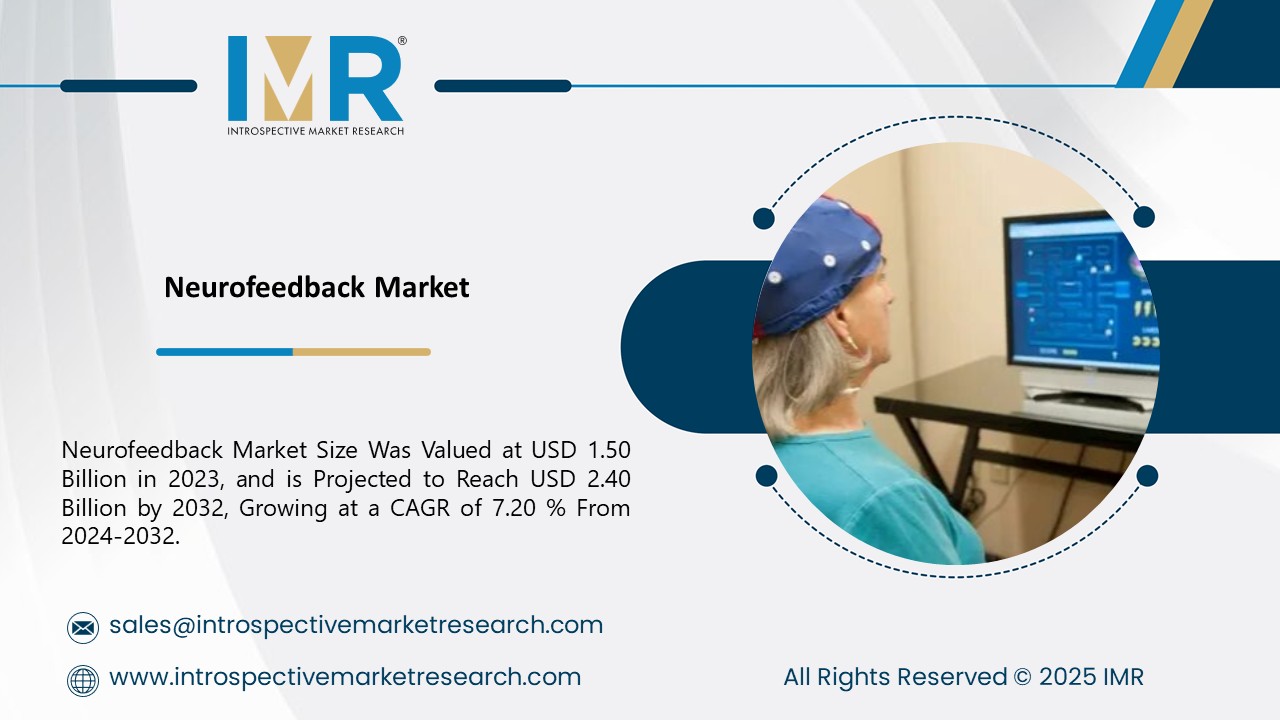
According to a new report published by Introspective Market Research, titled, Neurofeedback Market by Product Type, Application, and End-User, The Global Neurofeedback Market Size Was Valued at USD 1.50 Billion in 2023 and is Projected to Reach USD 2.40 Billion by 2032, Growing at a CAGR of 7.20%. The neurofeedback market is experiencing significant expansion as a cutting-edge therapeutic approach utilizing real-time brainwave activity monitoring to help individuals self-regulate their brain function. This non-invasive method offers a sophisticated alternative to traditional pharmacological interventions for a range of neurological and psychological conditions. By providing immediate feedback on brainwave patterns, neurofeedback empowers users to actively train their brains for improved cognitive performance, emotional regulation, and symptom reduction.
Neurofeedback systems typically involve sensors placed on the scalp to detect electrical activity in the brain, which is then translated into visual or auditory feedback for the user. This process allows individuals to consciously or unconsciously modify their brainwave patterns, leading to lasting improvements. The technology finds widespread application in areas such as ADHD, anxiety, depression, insomnia, and even peak performance training for athletes and executives, offering a personalized and drug-free pathway to enhanced well-being.
The Neurofeedback Market is segmented into Product Type, Application, and End-User. By Product Type, the market is categorized into (Devices, Software, and Services). By Application, the market is categorized into (ADHD, Anxiety, Depression, Sleep Disorders, Addiction, and Others). By End-User, the market is categorized into (Hospitals, Clinics, Home Care Settings, and Academic & Research Institutions).
A key growth driver for the neurofeedback market is the increasing prevalence of neurological and psychological disorders globally, coupled with a rising demand for non-pharmacological treatment options. Conditions such as ADHD, anxiety, and depression affect millions worldwide, and conventional treatments often come with side effects or limited efficacy for some individuals. Neurofeedback offers a promising alternative, appealing to patients and healthcare providers seeking a drug-free, personalized approach to brain health. Growing awareness and acceptance among the medical community, alongside positive clinical outcomes, are further propelling its adoption.
A significant market opportunity lies in the expanding application of neurofeedback beyond traditional clinical settings into areas like corporate wellness, athletic performance enhancement, and educational institutions. As awareness of brain health and cognitive optimization grows, there is an increasing demand for tools that can improve focus, reduce stress, and enhance overall mental resilience. Neurofeedback, with its ability to train specific brainwave patterns, is ideally positioned to meet these needs, opening up new avenues for market penetration and consumer adoption in preventive and performance-oriented markets.
Neurofeedback Market, Segmentation
The Neurofeedback Market is segmented on the basis of Product Type, Application, and End-User.
Product Type
- The Product Type segment is further classified into Devices, Software, and Services. Among these, the Devices sub-segment accounted for the highest market share in 2023. Neurofeedback devices encompass the hardware components used to capture and process brainwave data, including EEG sensors, amplifiers, and processing units. These devices are fundamental to the neurofeedback process, providing the raw data that software then interprets. Advances in sensor technology, miniaturization, and wireless connectivity are continually enhancing the usability and accuracy of these devices, making them more accessible for both clinical and home-use applications. The innovation in device technology directly impacts the efficacy and convenience of neurofeedback therapy.
Application
- The Application segment is further classified into ADHD, Anxiety, Depression, Sleep Disorders, Addiction, and Others. Among these, the ADHD sub-segment accounted for the highest market share in 2023. Neurofeedback has long been recognized as an effective intervention for Attention-Deficit/Hyperactivity Disorder (ADHD), offering a non-pharmacological approach to improve attention, impulsivity, and hyperactivity. By training individuals to increase specific brainwave patterns (e.g., SMR or beta waves) and decrease others (e.g., theta waves), neurofeedback helps normalize brain activity associated with attention and executive function. Numerous studies have demonstrated its efficacy in reducing ADHD symptoms, leading to its widespread adoption in clinics specializing in neurodevelopmental disorders.
Some of The Leading/Active Market Players Are-
- BrainMaster Technologies, Inc. (USA)
- NeuroCare Group GmbH (Germany)
- EEG Info (USA)
- Mind Media B.V. (Netherlands)
- NeuroSky, Inc. (USA)
- Bio-Medical Instruments, Inc. (USA)
- Thought Technology Ltd. (Canada)
- Mitsar Co. Ltd. (Russia)
- Wearable Sensing (USA)
- QEEG-Pro (Netherlands)
- Emotiv Systems, Inc. (USA)
- Advanced Brain Monitoring, Inc. (USA)
- NeurOptimal (USA)
- InteraXon Inc. (Canada)
- CogniSens Inc. (Canada)
Key Industry Developments
- In January 2023, a leading neurofeedback software provider launched a new AI-powered platform designed to personalize treatment protocols and enhance client engagement.
This new platform leverages artificial intelligence to analyze individual brainwave data with greater precision, automatically suggesting optimized training protocols tailored to each user's specific neurological profile and therapeutic goals. It also incorporates gamified elements and real-time progress tracking to keep clients motivated and engaged throughout their neurofeedback journey, promising more efficient and effective outcomes. - In September 2022, a major university hospital announced the completion of a large-scale clinical trial demonstrating the long-term efficacy of neurofeedback for chronic pain management.
The trial involved hundreds of participants and showed significant and sustained reductions in pain intensity and improved quality of life for patients undergoing neurofeedback therapy compared to control groups. This landmark study provides robust evidence supporting neurofeedback as a viable non-pharmacological option for individuals suffering from chronic pain, potentially expanding its integration into pain management clinics worldwide.
Key Findings of the Study
- The Devices and ADHD segments hold dominant market shares.
- North America leads the market due to robust healthcare infrastructure.
- Increasing prevalence of neurological disorders and demand for non-invasive therapies are key growth drivers.
- Growing adoption in performance enhancement and corporate wellness presents significant market trends.