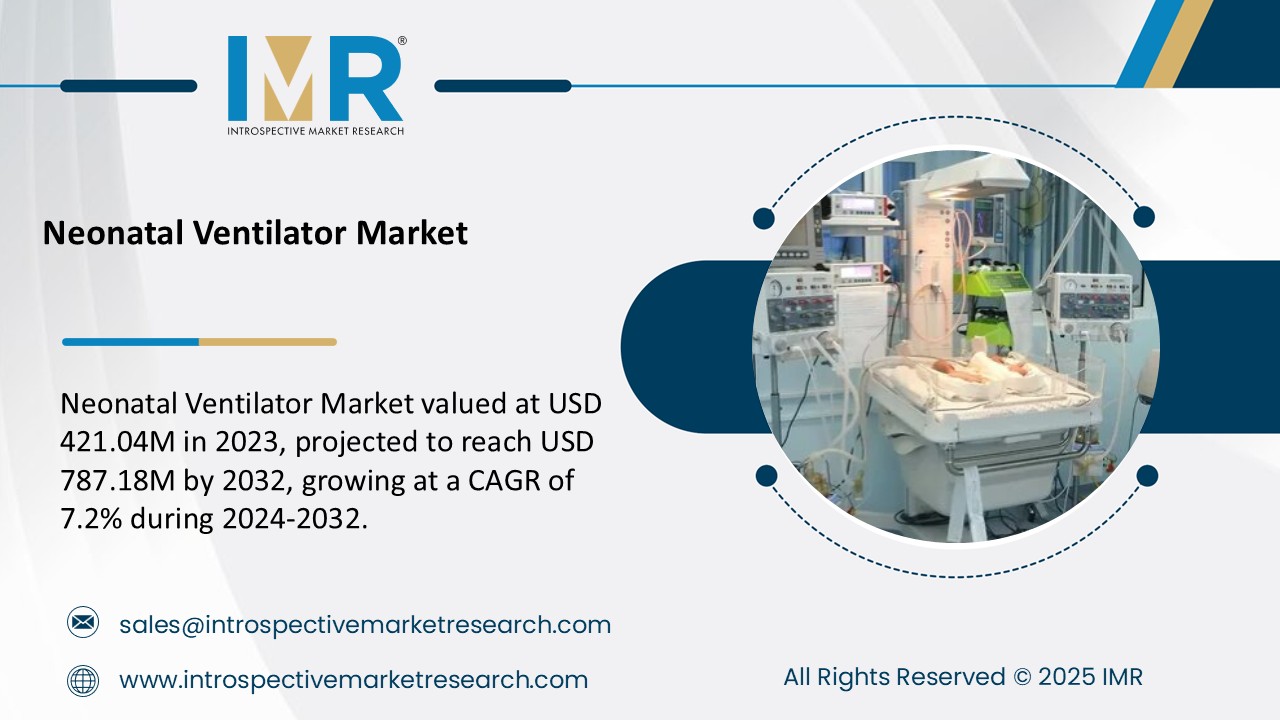
According to a new report published by Introspective Market Research, titled, Neonatal Ventilator Market by Ventilator Type, Interface, End-User, and Region, The Global Neonatal Ventilator Market Size Was Valued at USD 421.04 Million in 2023 and is Projected to Reach USD 787.18 Million by 2032, Growing at a CAGR of 7.2%. The Neonatal Ventilator Market plays a critical role in neonatal intensive care by delivering life-sustaining respiratory support to newborns, especially preterm and low birth-weight infants. These specialized ventilators are designed with high sensitivity, gentle ventilation parameters, and advanced monitoring to address the fragile respiratory systems of neonates. The devices offer a range of functionalities, including invasive and non-invasive modes, ensuring optimal respiratory care for vulnerable patients in neonatal intensive care units (NICUs).
Compared to conventional ventilators, neonatal ventilators provide more precise control of air pressure, volume, and oxygen concentration, reducing the risk of lung damage. They also integrate with monitoring technologies to provide real-time feedback on patient status. These advancements support healthcare providers in managing respiratory distress syndrome (RDS), apnea, bronchopulmonary dysplasia (BPD), and other critical conditions among newborns. The rising prevalence of preterm births and the growing awareness of neonatal care are fueling demand for technologically advanced ventilators globally.
The Neonatal Ventilator Market is segmented into Ventilator Type, Interface, and End-User. By Ventilator Type, the market is categorized into (Invasive Ventilators, Non-Invasive Ventilators). By Interface, the market is categorized into (Face Mask, Nasal Prongs, Nasal Masks). By End-User, the market is categorized into (Hospitals, Clinics, Ambulatory Surgical Centers).
One of the primary drivers of the Neonatal Ventilator Market is the increasing number of preterm births worldwide. According to the World Health Organization (WHO), approximately 15 million babies are born prematurely each year. These infants are often unable to breathe adequately on their own, requiring immediate and sustained respiratory support. The growing demand for neonatal intensive care, particularly in emerging economies, is significantly increasing the deployment of neonatal ventilators in healthcare settings. Furthermore, improved healthcare infrastructure and funding in neonatal care are also supporting this growth trend.
An emerging opportunity in the Neonatal Ventilator Market is the integration of AI and automation into ventilator systems. Advanced neonatal ventilators now feature predictive analytics, real-time monitoring, and automated adjustments to minimize manual intervention. These innovations not only enhance patient outcomes but also reduce clinician fatigue in high-pressure environments like NICUs. With increasing investments in healthcare technology and digital transformation in hospitals, the adoption of intelligent neonatal ventilators is expected to rise, creating strong growth prospects for manufacturers and technology providers in the years ahead.
Detailed Segmentation
Neonatal Ventilator Market, Segmentation
The Neonatal Ventilator Market is segmented on the basis of Ventilator Type, Interface, and End-User.
Ventilator Type
The Ventilator Type segment is further classified into Invasive Ventilators and Non-Invasive Ventilators. Among these, the Invasive Ventilators sub-segment accounted for the highest market share in 2023. Invasive ventilators are widely used for critical neonates with severe respiratory conditions requiring intubation. These systems provide reliable ventilation support and precise oxygen control, making them essential in NICUs. Their extensive use in hospitals and high success rate in managing complex neonatal respiratory disorders contribute to their dominant share.
Interface
The Interface segment is further classified into Face Mask, Nasal Prongs, and Nasal Masks. Among these, the Nasal Prongs sub-segment accounted for the highest market share in 2023. Nasal prongs are commonly used for delivering non-invasive respiratory support in neonatal care due to their ease of use and comfort for the infant. They help reduce the need for intubation and support spontaneous breathing. Their growing adoption in both developed and developing healthcare settings has made them the preferred interface type.
Some of The Leading/Active Market Players Are–
- GE Healthcare (USA)
- Medtronic plc (Ireland)
- Vyaire Medical Inc. (USA)
- Drägerwerk AG & Co. KGaA (Germany)
- Smiths Medical (UK)
- Hamilton Medical AG (Switzerland)
- Koninklijke Philips N.V. (Netherlands)
- Getinge AB (Sweden)
- Mindray Medical International Limited (China)
- Inspiration Healthcare Group plc (UK)
- ResMed Inc. (USA)
- Nihon Kohden Corporation (Japan)
- Fritz Stephan GmbH (Germany)
- Bunnell Incorporated (USA)
- Allied Healthcare Products Inc. (USA)
- and other active players.
Key Industry Developments
In February 2024, Dräger announced the launch of its new Babylog VN900 ventilator designed for neonatal and premature infant care.
The new system features improved user interface, enhanced data integration, and advanced lung-protective ventilation modes. It supports both invasive and non-invasive ventilation and incorporates monitoring tools to help clinicians manage patient outcomes more precisely. The system has been rolled out across several European and North American hospitals.
In June 2024, GE Healthcare entered into a strategic partnership with a leading AI company to integrate predictive analytics into its neonatal ventilator systems.
The collaboration focuses on early detection of respiratory complications in neonates using machine learning algorithms. These tools will enable real-time clinical insights, helping reduce neonatal mortality and improve ventilator management in NICUs. This move positions GE Healthcare as a key innovator in neonatal respiratory support solutions.
Key Findings of the Study
- Invasive ventilators dominate the market due to their use in critical care settings.
- Nasal prongs lead the interface segment, driven by non-invasive care preferences.
- Hospitals are the largest end-users due to growing NICU infrastructure.
- Rising preterm birth rates globally are a key growth driver.
- AI integration offers a strong innovation opportunity in the market.