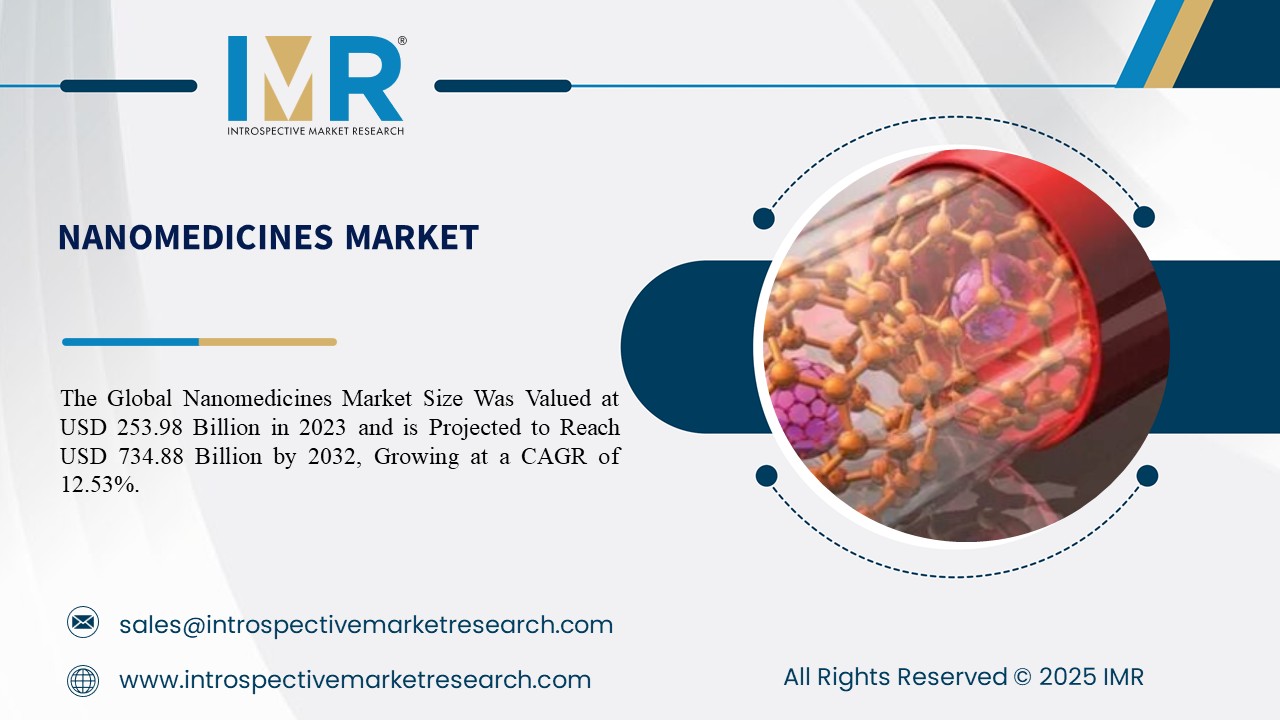
According to a new report published by Introspective Market Research, titled, Nanomedicines Market by Product, Application, and End-User, The Global Nanomedicines Market Size Was Valued at USD 253.98 Billion in 2023 and is Projected to Reach USD 734.88 Billion by 2032, Growing at a CAGR of 12.53%. The global Nanomedicines Market is witnessing exponential growth, driven by the increasing adoption of nanotechnology in healthcare. Nanomedicines utilize nanoscale materials for targeted drug delivery, diagnostics, and regenerative therapies, offering enhanced bioavailability and reduced side effects compared to conventional medicines. Their ability to improve therapeutic outcomes makes them a breakthrough in modern medicine.
These medicines are being widely used across oncology, neurology, cardiology, and infectious disease treatment. Unlike traditional drugs, nanomedicines can be engineered to reach specific cells or tissues, enabling precision medicine and personalized treatment approaches. With ongoing research and regulatory approvals, nanomedicine-based therapies are steadily transitioning from research laboratories to mainstream clinical practice.
Growing R&D investments, technological advancements, and increasing demand for effective treatments against chronic and rare diseases position the nanomedicines market for strong growth in the coming years.
The Nanomedicines Market is segmented into Product, Application, and End-User.
- By Product, the market is categorized into Nanoparticles, Liposomes, Nanocrystals, and Others.
- By Application, the market is categorized into Oncology, Neurology, Cardiology, Anti-Inflammatory, and Infectious Diseases.
- By End-User, the market is categorized into Hospitals, Specialty Clinics, and Research Organizations.
A major growth driver for the Nanomedicines Market is the rising prevalence of chronic diseases coupled with the need for targeted drug delivery systems. Nanomedicines provide site-specific drug delivery, ensuring better efficacy while minimizing toxicity and side effects. This makes them highly suitable for treating cancer, cardiovascular conditions, and neurological disorders, where precision and reduced adverse effects are crucial.
An important market opportunity lies in the expansion of nanomedicines into personalized and regenerative medicine. With advancements in nanotechnology, researchers are exploring innovative therapies like gene delivery systems and stem cell-based nanomedicine applications. Growing collaborations between pharmaceutical companies and research institutes are expected to unlock new solutions, particularly for rare diseases and unmet medical needs.
Nanomedicines Market, Segmentation
The Nanomedicines Market is segmented on the basis of Product, Application, and End-User.
Product
-
The Product segment is further classified into Nanoparticles, Liposomes, Nanocrystals, and Others. Among these, the Nanoparticles sub-segment accounted for the highest market share in 2023. Nanoparticles are widely used in drug delivery systems due to their small size, surface modification ability, and controlled release properties. Their application in oncology and cardiovascular therapies continues to expand, supported by increasing regulatory approvals and clinical trials
Application
- The Application segment is further classified into Oncology, Neurology, Cardiology, Anti-Inflammatory, and Infectious Diseases. Among these, the Oncology sub-segment accounted for the highest market share in 2023. Cancer therapies rely heavily on nanomedicines as they enable precise drug targeting, minimizing damage to healthy tissues. With the rising global cancer burden, investments in nanomedicine-based oncology treatments are expected to accelerate significantly.
-
Some of The Leading/Active Market Players Are-
- Pfizer Inc. (U.S.)
- Novartis AG (Switzerland)
- Johnson & Johnson (U.S.)
- AstraZeneca (U.K.)
- Merck & Co., Inc. (U.S.)
- Roche Holding AG (Switzerland)
- Amgen Inc. (U.S.)
- Teva Pharmaceutical Industries Ltd. (Israel)
- Celgene Corporation (U.S.)
- Gilead Sciences, Inc. (U.S.)
- Sanofi S.A. (France)
- Bristol Myers Squibb (U.S.)
- AbbVie Inc. (U.S.)
- Takeda Pharmaceutical Company (Japan)
- Bayer AG (Germany) and other active players.
Key Industry Developments
- In March 2024, Pfizer announced the launch of its nanoparticle-based oncology drug targeting lung cancer.The therapy leverages nanoparticle formulations for enhanced drug delivery, improving treatment efficacy and reducing systemic toxicity. This development highlights the growing adoption of nanotechnology in oncology treatment worldwide.
- In June 2024, Novartis partnered with a leading nanotech startup to accelerate research in nanomedicine-based therapies for neurodegenerative diseases.The collaboration aims to advance nanocarrier systems that can cross the blood-brain barrier, addressing unmet needs in conditions such as Alzheimer’s and Parkinson’s disease.
Key Findings of the Study
- Nanoparticles lead the product segment due to versatility and widespread drug delivery use.
- Oncology remains the largest application area, driven by cancer prevalence.
- North America and Europe dominate due to advanced R&D infrastructure.
- Increasing chronic disease prevalence and precision medicine demand fuel growth.
- Collaborations and investments are accelerating innovation in nanomedicine