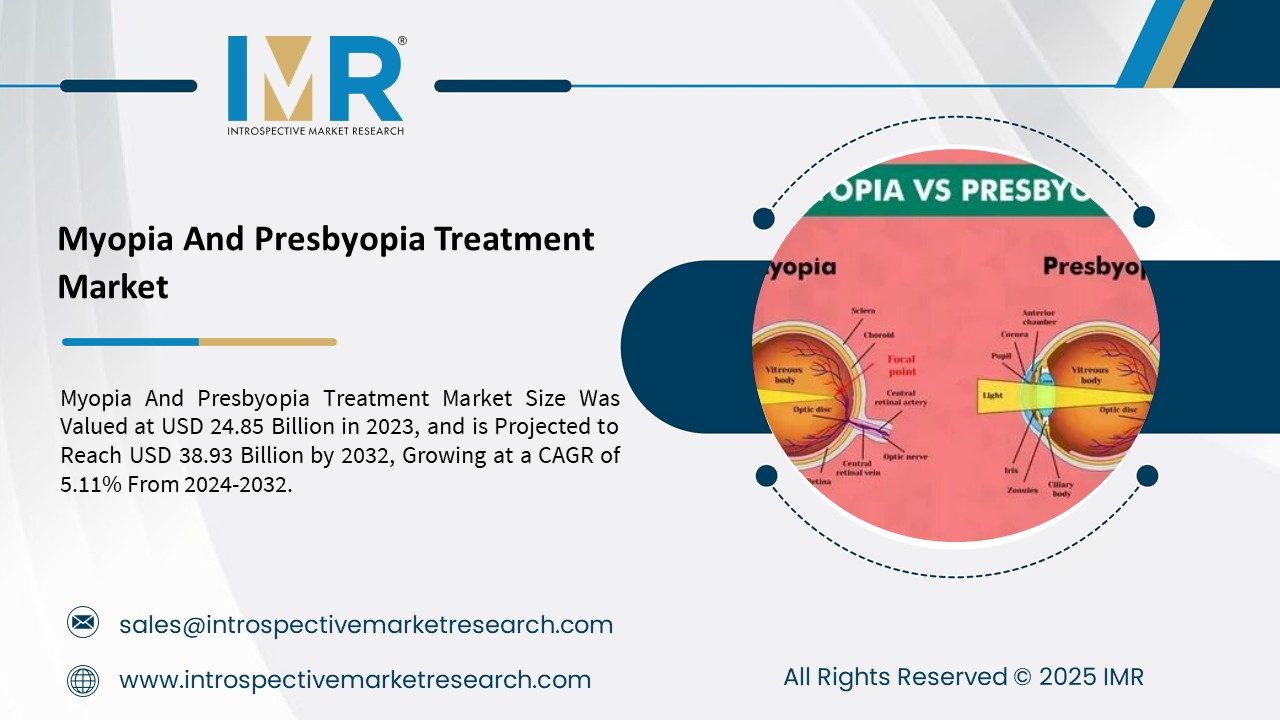
According to a new report published by Introspective Market Research, titled, Myopia and Presbyopia Treatment Market by Treatment Type, Age Group, and Distribution Channel, The Global Myopia and Presbyopia Treatment Market Size Was Valued at USD 24.85 Billion in 2023 and is Projected to Reach USD 38.93 Billion by 2032, Growing at a CAGR of 5.11%.The global Myopia and Presbyopia Treatment Market is experiencing robust growth due to the rising prevalence of vision-related disorders worldwide. Myopia, commonly known as nearsightedness, and presbyopia, an age-related inability to focus on nearby objects, are two of the most widespread refractive errors affecting populations across age groups. With lifestyle changes such as increased screen exposure and aging demographics, demand for advanced treatment options has surged.
Modern treatment methods, including corrective lenses, refractive surgery, and pharmacological therapies, offer significant advantages over traditional alternatives. Unlike conventional eyeglasses, contact lenses and surgical procedures such as LASIK and intraocular lenses provide improved vision clarity and convenience. Moreover, advancements in pharmacological treatments targeting progressive myopia control have opened new avenues for effective long-term management.
With technological innovation, greater awareness of eye health, and accessibility to advanced ophthalmic care, the market is positioned to expand steadily, catering to both younger patients with myopia and older adults with presbyopia.
The Myopia and Presbyopia Treatment Market is segmented into Treatment Type, Age Group, and Distribution Channel.
- By Treatment Type, the market is categorized into Corrective Lenses, Surgical Procedures, and Pharmacological Therapy.
- By Age Group, the market is categorized into Children & Young Adults, Adults, and Geriatrics.
- By Distribution Channel, the market is categorized into Hospitals, Ophthalmic Clinics, and Retail Pharmacies.
A key growth driver for the Myopia and Presbyopia Treatment Market is the rising global prevalence of refractive errors. Increasing digital screen usage, urbanization, and reduced outdoor activities among children have led to a spike in myopia cases, while the aging population has fueled presbyopia incidence. Together, these trends are driving continuous demand for innovative treatment solutions worldwide.
A significant market opportunity lies in the adoption of advanced pharmacological and surgical treatments. Innovations such as low-dose atropine for myopia control, multifocal intraocular lenses, and laser-based corrective surgeries are increasingly gaining traction. The growing preference for minimally invasive and long-term treatment options, along with expanding healthcare infrastructure in emerging economies, presents lucrative opportunities for industry players.
Myopia and Presbyopia Treatment Market, Segmentation
The Myopia and Presbyopia Treatment Market is segmented on the basis of Treatment Type, Age Group, and Distribution Channel.
Treatment Type
- The Treatment Type segment is further classified into Corrective Lenses, Surgical Procedures, and Pharmacological Therapy. Among these, the Corrective Lenses sub-segment accounted for the highest market share in 2023. Eyeglasses and contact lenses remain the most widely adopted solutions due to affordability, non-invasiveness, and easy accessibility. With continuous product innovations, such as anti-fatigue lenses and advanced multifocal contact lenses, corrective lenses continue to dominate the market, particularly in developing regions where cost-sensitive consumers prefer affordable yet effective vision correction methods.
Age Group
- The Age Group segment is further classified into Children & Young Adults, Adults, and Geriatrics. Among these, the Geriatrics sub-segment accounted for the highest market share in 2023. The prevalence of presbyopia rises significantly after the age of 40, making this demographic the largest consumer group for treatment solutions. With growing life expectancy and increased awareness of eye health, demand for surgical procedures such as lens replacement and advanced bifocal or multifocal corrective lenses is growing rapidly in this segment.
Some of The Leading/Active Market Players Are-
- Alcon Inc. (Switzerland)
- Bausch + Lomb (U.S.)
- EssilorLuxottica (France)
- Johnson & Johnson Vision Care (U.S.)
- CooperVision, Inc. (U.S.)
- ZEISS Group (Germany)
- Hoya Corporation (Japan)
- NIDEK Co., Ltd. (Japan)
- Topcon Corporation (Japan)
- Carl Zeiss Meditec AG (Germany)
- STAAR Surgical (U.S.)
- Ziemer Ophthalmic Systems (Switzerland)
- Novartis AG (Switzerland)
- Menicon Co., Ltd. (Japan)
- RxSight, Inc. (U.S.) and other active players.
Key Industry Developments
- In April 2024, Johnson & Johnson Vision launched its next-generation multifocal contact lenses designed to address both presbyopia and early-onset myopia progression.
The product incorporates advanced optical designs to provide superior vision clarity at multiple distances. This innovation enhances convenience for patients, reducing dependence on separate vision correction solutions for different conditions. - In July 2024, EssilorLuxottica partnered with leading optometry associations to expand awareness campaigns for myopia management in children.
The initiative aims to promote early detection and the adoption of evidence-based treatments, such as specialized lenses and atropine therapy, to control myopia progression. This reflects a growing industry focus on preventive and pediatric eye care.
Key Findings of the Study
- Corrective Lenses remain the leading treatment type due to affordability and accessibility.
- Geriatrics represent the largest consumer segment, driven by rising presbyopia prevalence.
- North America and Asia-Pacific are key regional markets.
- Growing screen usage and aging demographics drive demand.
- Innovation in surgical and pharmacological treatments is a major trend.