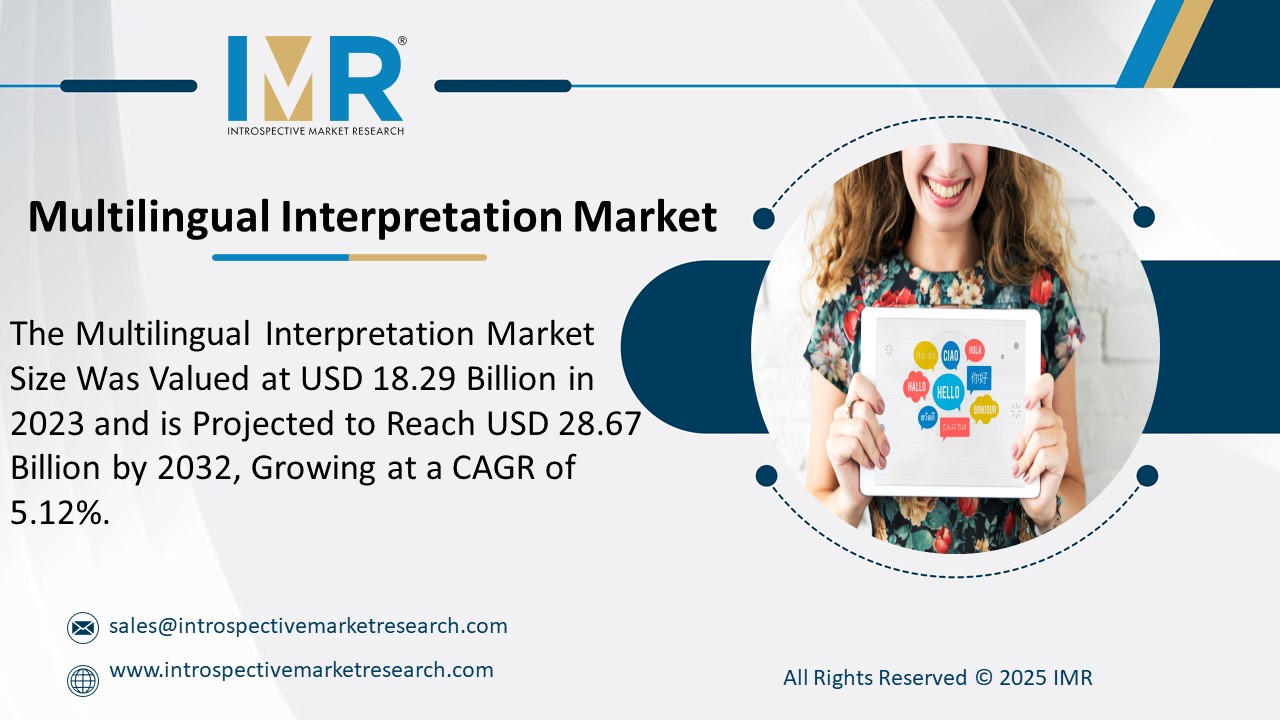
According to a new report published by Introspective Market Research, titled, Multilingual Interpretation Market by Service Type, Deployment Mode, End-User, and Region, The Global Multilingual Interpretation Market Size Was Valued at USD 18.29 Billion in 2023 and is Projected to Reach USD 28.67 Billion by 2032, Growing at a CAGR of 5.12%.
The Global Multilingual Interpretation Market is witnessing steady growth as globalization, cross-border trade, and international collaboration expand across sectors. Multilingual interpretation refers to real-time translation of spoken or signed languages, enabling participants speaking different languages to communicate seamlessly. This service is increasingly important in sectors such as conferences, legal proceedings, diplomacy, medical consultations, and virtual events.
Compared to traditional in-person interpreters, modern multilingual interpretation leverages remote simultaneous interpretation (RSI), cloud platforms, and AI-assisted tools to reduce costs, improve scalability, and maintain accuracy. These innovations allow organizations to host multilingual meetings without the need to physically bring interpreters to each site, making communication more efficient and inclusive.
Demand for multilingual interpretation is being driven by the rise in multilingual virtual events, growing cross-border healthcare interactions, and increasing international expansion of businesses. As organizations focus on inclusivity and accessibility, the need for high-quality interpretation services continues to rise, particularly in sectors like legal, healthcare, education, and global organizations.
The Multilingual Interpretation Market is segmented into Service Type, Deployment Mode, and End-User. By Service Type, the market is categorized into (Simultaneous Interpretation, Consecutive Interpretation, Whispered Interpretation). By Deployment Mode, the market is categorized into (On-site Interpretation, Remote Interpretation, Hybrid Interpretation). By End-User, the market is categorized into (Conferences & Events, Legal & Courts, Healthcare & Telemedicine, Government & Diplomatic, Others).
One key growth driver in the multilingual interpretation market is the surge in hybrid and virtual events across industries. As more global conferences, webinars, and multinational fora adopt remote or hybrid formats, the demand for real-time multilingual interpretation tools and services escalates. Organizations need interpretation solutions that can support multiple language channels, integrate with virtual meeting platforms, and ensure minimal latency. This trend is reinforced by the cost and logistical advantages of remote simultaneous interpretation, which reduces the need to transport interpreters physically, while providing flexibility in scaling for large global audiences.
A major opportunity in the market lies in the integration of artificial intelligence and machine learning into interpretation services. AI-powered tools, such as speech recognition, neural machine translation, and interpretation assistance software, can improve speed, consistency, and reduce error rates. While human interpreters remain essential for nuance and context, hybrid models combining AI support with human oversight offer scalable solutions. These hybrid systems can lower costs, increase availability in low-resource languages, and enable broader penetration into small and mid-size enterprises, remote regions, and sectors such as telehealth and education.
Multilingual Interpretation Market, Segmentation
The Multilingual Interpretation Market is segmented on the basis of Service Type, Deployment Mode, and End-User.
Service Type
The Service Type segment is further classified into Simultaneous Interpretation, Consecutive Interpretation, and Whispered Interpretation. Among these, the Simultaneous Interpretation sub-segment accounted for the highest market share in 2024. Simultaneous interpretation is widely preferred in large-scale conferences, virtual events, and multilingual summits because it allows real-time translation without interrupting the flow of speech, enabling smoother multilingual communication and better participant experience.
Deployment Mode
The Deployment Mode segment is further classified into On-site Interpretation, Remote Interpretation, and Hybrid Interpretation. Among these, the Remote Interpretation sub-segment accounted for the highest market share in 2024. The remote model has gained prominence due to its flexibility, cost efficiency, and ability to support participants from anywhere without travel constraints. The adoption of remote interpretation accelerated during the pandemic and continues to be favored due to its scalability and integration with virtual meeting platforms.
Some of The Leading/Active Market Players Are-
- LanguageLine Solutions (USA)
- Lionbridge Technologies (USA)
- TransPerfect (USA)
- KUDO (USA)
- Interprefy (Switzerland)
- Zoom Video Communications (USA)
- VoiceBoxer (Netherlands)
- InWhatLanguage (USA)
- Welocalize (USA)
- Translations.com (USA)
- other active players.
Key Industry Developments
-
In June 2024, KUDO launched a new AI-assisted simultaneous interpretation feature integrated within major virtual meeting platforms.
KUDO’s innovation leverages neural machine translation to provide real-time translation support across multiple languages during virtual events, supplemented by human interpreters for oversight and quality assurance. The integration with platforms such as Zoom, Microsoft Teams, and Webex allows event organizers to enable multilingual interpretation channels natively, reducing setup time and technical complexity. This development is expected to enhance scalability and accessibility, particularly for mid-size organizations and locations with limited access to professional interpreters. - In November 2023, Interprefy partnered with a major global conference provider to expand remote interpretation services across Asia-Pacific.
Through the collaboration, Interprefy extended its remote simultaneous interpretation infrastructure into multiple APAC markets, deploying local language support and interpreter networks. The expansion included investment in local data centers to minimize latency and improve audio quality. This enables conferences held across Asia-Pacific to offer multilingual interpretation more reliably, particularly in languages less served by global providers, thus broadening accessibility in emerging markets.
Key Findings of the Study
- Simultaneous interpretation dominates due to its suitability for large-scale and real-time events.
- Remote deployment leads the segment, driven by flexibility and cost efficiencies.
- Asia-Pacific and North America show high adoption due to cross-border business and virtual events.
- AI-assisted interpretation presents a scalable opportunity across sectors.
- Growth is fueled by rising demand for multilingual virtual events, telehealth, and legal services.