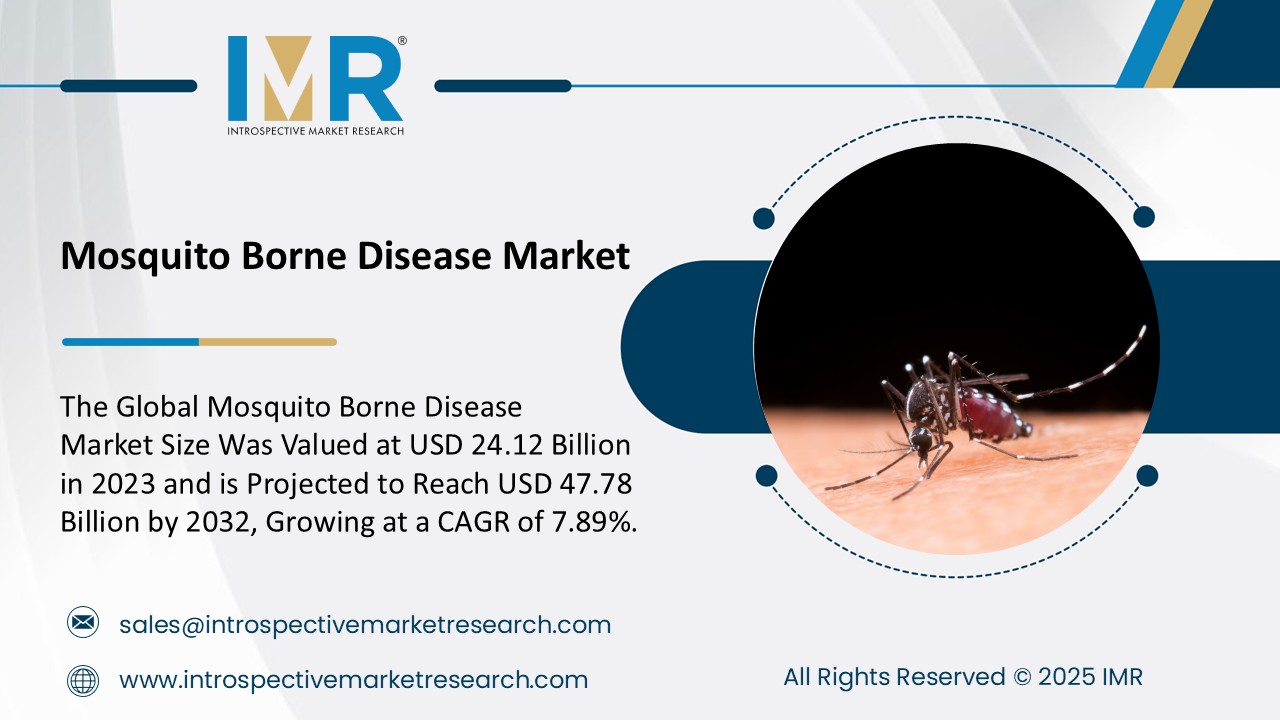
According to a new report published by Introspective Market Research, titled, Mosquito Borne Disease Market by Disease Type, Product Type, and End User, The Global Mosquito Borne Disease Market Size Was Valued at USD 24.12 Billion in 2023 and is Projected to Reach USD 47.78 Billion by 2032, Growing at a CAGR of 7.89%.The Mosquito Borne Disease Market encompasses products and services targeting prevention, diagnosis, and treatment of diseases transmitted by mosquitoes, including malaria, dengue, yellow fever, Zika, and chikungunya. The market benefits from ongoing R&D in pharmaceuticals, diagnostics, vaccines, and vector control technologies, offering safer and faster alternatives to traditional mosquito-control methods. Solutions such as genetically engineered mosquitoes, improved insecticides, rapid diagnostic kits, and new-generation vaccines drive higher efficacy and better patient outcomes.
Increasing global travel, climate change, and urbanization have expanded the geographic spread of mosquito-borne diseases, resulting in policy responses, funding initiatives, and heightened demand in both endemic and emerging countries. The market serves public health agencies, hospitals, research institutions, and home-use consumers, helping reduce morbidity and mortality rates and supporting proactive surveillance and eradication programs worldwide.
The Mosquito Borne Disease Market is segmented into Disease Type, Product Type, and End User. By Disease Type, the market is categorized into Malaria, Dengue, Zika Virus, Chikungunya, Yellow Fever, Japanese Encephalitis, Filariasis, and Others. By Product Type, the market includes Vaccines, Diagnostic Kits, Therapeutics, Insecticides, Repellents, and Larvicides. By End User, the market consists of Hospitals & Clinics, Laboratories, Public Health Agencies, Academic & Research Institutes, and Home Users.
A major growth driver for the market is the rising incidence and geographic expansion of mosquito-borne diseases due to changing environmental conditions and increased global mobility. The demand for innovative vector control and patient management solutions is further strengthened by international health policies, funding from governments and organizations, and high-profile initiatives for malaria and dengue eradication. Continuous advancements in vaccine technologies, biologics, and rapid diagnostics are accelerating response effectiveness and market growth.
Significant market opportunity exists in the development and deployment of next-generation vaccines, genetic vector control, and precision monitoring systems powered by AI and geospatial analytics. As public health agencies seek more sustainable and cost-efficient solutions, opportunities arise for companies to collaborate with governments on eradication campaigns, offer integrated digital surveillance tools, and scale affordable kits and treatments for resource-limited regions. Growth prospects are particularly robust in Asia-Pacific, Latin America, and Africa, where disease burdens are highest and funding is rising.
Mosquito Borne Disease Market, Segmentation
The Mosquito Borne Disease Market is segmented on the basis of Disease Type, Product Type, and End User.
Disease Type
The Disease Type segment is further classified into Malaria, Dengue, Zika Virus, Chikungunya, Yellow Fever, Japanese Encephalitis, Filariasis, and Others. Malaria accounted for the highest market share in 2023. Malaria prevention and treatment commands the greatest investment due to its prevalence, mortality rate, and international eradication efforts. Extensive research on vaccine development, widespread distribution of bed nets and insecticides, and high-profile funding from agencies like WHO and UNICEF continue to shape the segment’s growth.
Product Type
The Product Type segment is further classified into Vaccines, Diagnostic Kits, Therapeutics, Insecticides, Repellents, and Larvicides. Vaccines represented the highest market share in 2023. Major advances in malaria and dengue vaccines, alongside clinical trials for Zika, are driving rapid uptake in public health programs and immunization campaigns. Vaccine solutions are prioritized for preventative strategies and offer high efficacy, cost savings, and community-wide impact in endemic countries.
Some of the Leading/Active Market Players Are–
- GlaxoSmithKline plc (UK)
- Sanofi (France)
- Novartis AG (Switzerland)
- Bharat Biotech (India)
- F. Hoffmann-La Roche AG (Switzerland)
- Pfizer Inc. (USA)
- Abbott Laboratories (USA)
- Sumitomo Chemical Co., Ltd (Japan)
- Bayer AG (Germany)
- Johnson & Johnson (USA)
- Reckitt Benckiser Group plc (UK)
- Godrej Consumer Products Limited (India)
- Merck & Co., Inc. (USA)
- BASF SE (Germany)
- Syngenta AG (Switzerland)
- Other active players.
Key Industry Developments
In May 2024, GlaxoSmithKline secured WHO prequalification for its innovative malaria vaccine targeting pediatric populations in sub-Saharan Africa.
This paves the way for broad vaccine rollout programs funded by global health agencies, promising a major reduction in childhood malaria mortality rates and supporting regional eradication goals.
In August 2024, Sanofi launched an upgraded dengue vaccine covering additional viral strains for mass immunization across Southeast Asia and Latin America.
The improved vaccine offers stronger efficacy and a simplified dosing regimen, accelerating progress toward wider dengue prevention, particularly among children and at-risk urban populations.
Key Findings of the Study
- Malaria and vaccines dominate market segments.
- Asia-Pacific and Africa are leading regions.
- Rising disease incidence and new technologies propel growth.
- Advancement in genetic vector control and AI-powered surveillance is a key trend.
- Market set to reach USD 47.78 billion by 2032 at 7.89% CAGR.