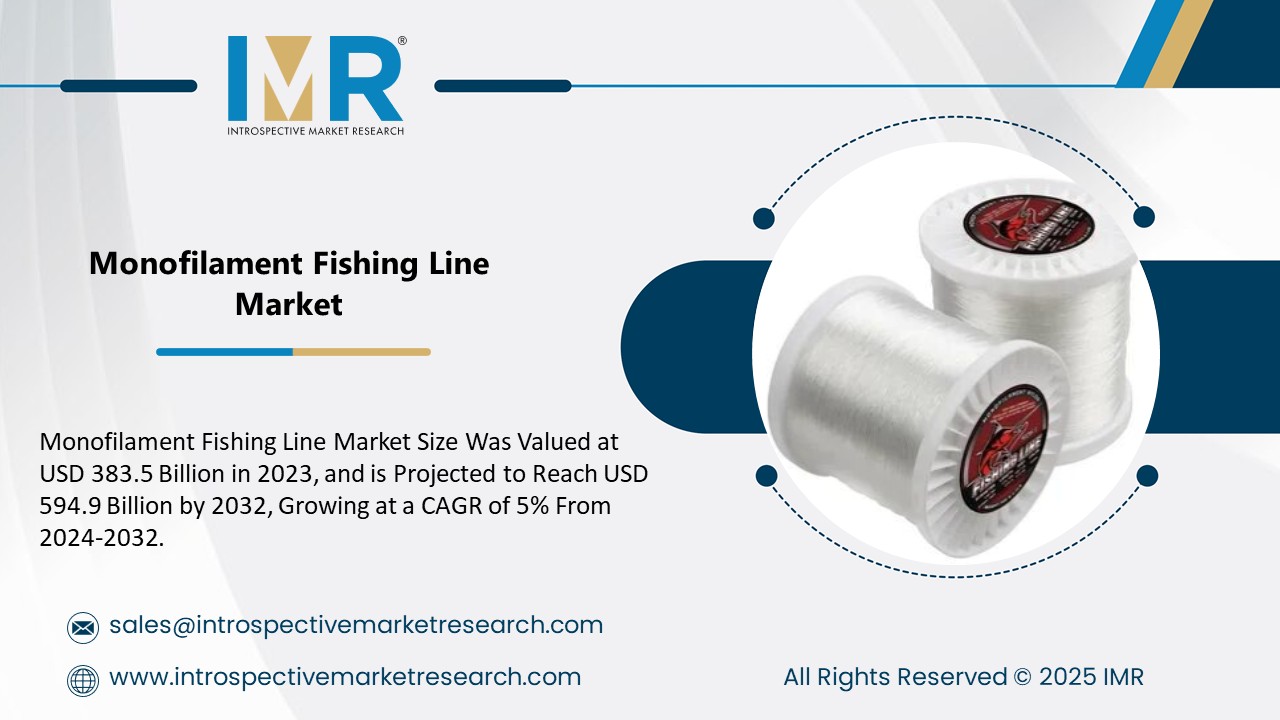
According to a new report published by Introspective Market Research, titled, Monofilament Fishing Line Market by Material Type, Application, End-User, and Region, The Global Monofilament Fishing Line Market Size Was Valued at USD 383.5 Billion in 2023 and is Projected to Reach USD 594.9 Billion by 2032, Growing at a CAGR of 5%. The Monofilament Fishing Line market encompasses the production and sale of single-strand fishing lines, primarily made from nylon or other synthetic polymers. These lines are widely favored by anglers globally due to their inherent characteristics such as excellent knot strength, good abrasion resistance, elasticity, and affordability. Unlike braided or fluorocarbon lines, monofilament offers a balance of stretch and shock absorption, making it forgiving for beginners and effective for a variety of fishing techniques.
Its main uses span across recreational and commercial fishing. In recreational angling, monofilament is the go-to choice for freshwater and saltwater fishing, suitable for casting, trolling, and bait fishing. Its versatility allows it to be used for targeting various species, from panfish to large game fish. In commercial applications, it finds use in longline fishing, gillnetting, and as snelling material due to its strength and resistance to environmental factors. The continuous innovation in polymer technology further enhances its performance characteristics, ensuring its sustained popularity in the fishing industry.
A key growth driver for the monofilament fishing line market is the increasing global participation in recreational fishing activities. With a growing emphasis on outdoor leisure, tourism, and hobbies, more individuals are engaging in fishing as a relaxing and enjoyable pastime. This surge in angler numbers, from casual weekend hobbyists to dedicated sports fishermen, directly translates into higher demand for essential fishing gear, including monofilament lines. The accessibility and relatively low cost of monofilament lines make them particularly attractive to new entrants in the fishing community, further fueling market expansion as the base of active anglers continues to grow worldwide.
A significant market opportunity for monofilament fishing lines lies in the continuous innovation and development of advanced polymer materials. While traditional nylon monofilament remains popular, there is growing potential in creating specialized monofilament lines with enhanced properties. This includes developing lines with superior abrasion resistance for fishing in challenging environments, improved UV stability for extended durability, reduced memory for better casting, and optimized diameters for specific fishing techniques. Investing in R&D to incorporate these advanced characteristics can create premium monofilament products that cater to discerning anglers, offering a competitive edge and unlocking new revenue streams within the established market.
Monofilament Fishing Line Market, Segmentation
The Monofilament Fishing Line Market is segmented on the basis of Material Type, Application, and End-User.
Material Type
- The Material Type segment is further classified into Nylon, Polyethylene (PE), and Others. Among these, the Nylon sub-segment accounted for the highest market share in 2023. Nylon has historically been the most widely used material for monofilament fishing lines due to its excellent balance of strength, stretch, abrasion resistance, and cost-effectiveness. Its inherent elasticity provides shock absorption, which is crucial for fighting strong fish and preventing hook pull-outs. Furthermore, nylon monofilament is relatively easy to manufacture, making it widely available and affordable for anglers of all experience levels. Continuous advancements in nylon polymer technology have also allowed for improved versions with enhanced knot strength and reduced memory, solidifying its dominant position in the market.
Application
- The Application segment is further classified into Freshwater Fishing, Saltwater Fishing, and Commercial Fishing. Among these, the Freshwater Fishing sub-segment accounted for the highest market share in 2023. Freshwater fishing dominates the application segment primarily due to the vast number of participants and the extensive array of accessible freshwater bodies globally, including lakes, rivers, and ponds. Monofilament line is a versatile and cost-effective choice for a wide range of freshwater species and techniques, from bait fishing for panfish to casting for bass and trout. Its forgiving stretch and good knot strength make it ideal for the diverse conditions encountered in freshwater environments, appealing to a broad demographic of recreational anglers.
Some of The Leading/Active Market Players Are-
- Pure Fishing Inc. (USA)
- Berkley (USA)
- Shimano (Japan)
- Daiwa Corporation (Japan)
- Sufix (USA)
- Stren (USA)
- SpiderWire (USA)
- Momoi Fishing (Japan)
- Yo-Zuri (Japan)
- Seaguar (Japan)
- Platypus Fishing Lines (Australia)
- Cortland Line Company (USA)
- codeCodepowerPro (USA)
- Rapala VMC Corporation (Finland)
Key Industry Developments
- In March 2023, Pure Fishing Inc., a leading global fishing tackle company, announced the launch of its new line of Berkley® X5 Braid, an advanced five-carrier braided fishing line designed for superior strength and casting performance, complementing its existing monofilament offerings.
This development, while focusing on braided lines, signals Pure Fishing's continuous innovation across its product portfolio to meet diverse angler demands. By enhancing their overall line-up, including strong complementary products like high-performance braids, they solidify their position as a comprehensive solution provider, which in turn can drive sales of their core monofilament lines as part of a complete fishing system. - In September 2022, Shimano introduced new enhancements to its popular range of fishing reels, incorporating advanced line management systems optimized for various line types, including monofilament. These innovations aim to improve casting distance and reduce line twist for smoother performance.
Shimano's focus on improving reel technology to work seamlessly with different line types, including monofilament, directly benefits the monofilament fishing line market. By creating reels that optimize monofilament performance, such as reducing memory and improving casting, it encourages anglers to continue using and investing in high-quality monofilament lines, driving demand and enhancing the overall fishing experience.
Key Findings of the Study
- Nylon material type holds the largest market share due to its balanced properties and affordability.
- The Freshwater Fishing application segment leads owing to widespread recreational participation.
- A key growth driver is the increasing global engagement in recreational fishing activities.
- Market trends include continuous innovation in polymer technology for enhanced line performance.
- A significant opportunity lies in developing specialized monofilament lines for niche fishing techniques.