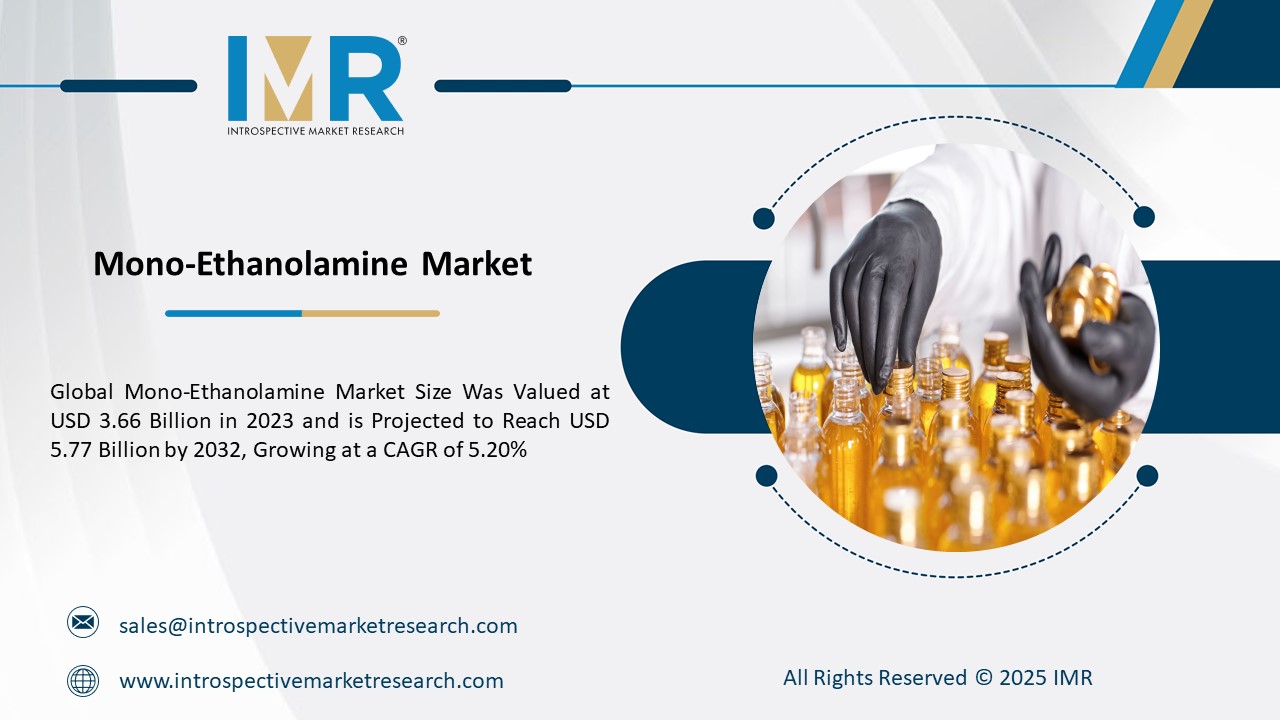
According to a new report published by Introspective Market Research, titled, Mono-Ethanolamine (MEA) Market by Grade, Application, and Region, the Global Mono-Ethanolamine Market Size Was Valued at USD 3.66 Billion in 2023 and is Projected to Reach USD 5.77 Billion by 2032, Growing at a CAGR of 5.20%.The Mono-Ethanolamine Market is a vital component of the global chemicals industry, distinguished by its wide adoption across numerous sectors such as detergents, water treatment, personal care, gas treatment, and pharmaceuticals. Mono-ethanolamine (MEA) is a clear, viscous liquid primarily used as an intermediate in the synthesis of surfactants, emulsifiers, and corrosion inhibitors, offering significant utility compared to conventional alternatives like ammonia or simple ethanol derivatives due to its unique amphoteric nature and ability to form stable compounds.
The increasing preference for MEA is driven by its high reactivity and versatility, which provide advantages in chemical manufacturing, especially for eco-friendly formulations and low-toxicity end-products. Industries benefit from MEA’s effective performance in gas sweetening and neutralizing acid components, with core applications spanning oil & gas, textiles, construction, agriculture, and advanced pharmaceutical synthesis.
The Mono-Ethanolamine Market is segmented into Grade, Application, and Region. By Grade, the market is categorized into Industrial Grade, Pharmaceutical Grade, and Others. By Application, the market is categorized into Chemical Industry, Detergents, Personal Care Products, Agrochemicals, Gas Treatment, and Others. By Region, the market is categorized into North America, Europe, Asia-Pacific, Latin America, Middle East & Africa.
One of the primary growth drivers for the global Mono-Ethanolamine Market is the escalating demand for surfactants in the detergent and personal care industries. MEA acts as a foundational ingredient for manufacturing environmentally compliant and highly effective cleaning agents, supporting both household and industrial scale requirements. This surge is further reinforced by increasing urbanization, rising disposable incomes, and an emphasis on enhanced hygiene standards worldwide.
A significant market opportunity exists in the rapid adoption of MEA-based formulations for industrial gas treatment and water purification applications. Regulatory movements promoting greener technologies are encouraging the replacement of older, less efficient chemicals with MEA due to its lower toxicity and environmental impact, unlocking new growth avenues as more governments and industries invest in sustainable development and clean air and water technologies.
Mono-Ethanolamine Market, Segmentation
The Mono-Ethanolamine Market is segmented on the basis of Grade, Application, and Region.
Grade
The Grade segment is further classified into Industrial Grade, Pharmaceutical Grade, and Others. Among these, the Industrial Grade sub-segment accounted for the highest market share in 2023. Industrial Grade MEA is prized for its cost effectiveness and broad utility, serving as a backbone material for detergents, emulsifiers, herbicides, and gas sweetening agents. Its bulk usage in high-volume manufacturing processes makes it the dominant choice for diverse industrial sectors seeking scalable, reliable chemical solutions.
Application
The Application segment is further classified into Chemical Industry, Detergents, Personal Care Products, Agrochemicals, Gas Treatment, and Others. Among these, the Detergents sub-segment captured the highest market share in 2023. This dominance is attributed to consistent demand for laundry and surface cleaning products globally. MEA’s unique properties, enabling efficient emulsification and removal of oily residues, have cemented its role as a preferred ingredient in modern detergent formulations, particularly as consumers and manufacturers move toward eco-friendly alternatives.
Some of The Leading/Active Market Players Are
- BASF SE (Germany)
- Dow (United States)
- Nouryon (Netherlands)
- Nippon Shokubai Co., Ltd. (Japan)
- SABIC (Saudi Arabia)
- Huntsman Corporation (United States)
- Akzo Nobel (Netherlands)
- Ineos Oxides (Switzerland)
- Mitsui Chemicals (Japan)
- Indorama Ventures (Thailand)
- Jiangsu Haian (China)
- Lubrizol (United States)
- Colonial Chemical (United States)
- Enaspol (Czech Republic)
- Kao Corporation (Japan)
- Other active players.
Key Industry Developments
- In February 2023, Nippon Shokubai obtained ISCC PLUS certification for mono-ethanolamine produced at its Himeji and Kawasaki plants, enabling sustainable production using biomass-derived raw materials.This development establishes Nippon Shokubai as a pioneer in the sustainable chemicals market and supports the availability of certified, low-environmental-impact MEA for various industrial users and consumer products.
- In October 2022, Statistics Canada reported a notable 2.8% increase in sales for personal and household goods, propelled by a 3.9% rise in the pharmaceuticals and pharmacy supplies sector, reaching new records.This highlights the growing significance of MEA as a critical pharmaceutical raw material, reflecting escalating global demand from health-related manufacturing, which positively impacts market dynamics.
Key Findings of the Study
- Industrial Grade and Detergents are the dominant segments in the Mono-Ethanolamine Market.
- Asia-Pacific remains the leading region, driven by significant demand from manufacturing and processing industries.
- Growth is fueled by surging application in detergents, gas sweetening, and environmental-friendly chemical formulations.
- Market trends point to sustainability, green certifications, and adoption in pharmaceutical and agrochemical synthesis.