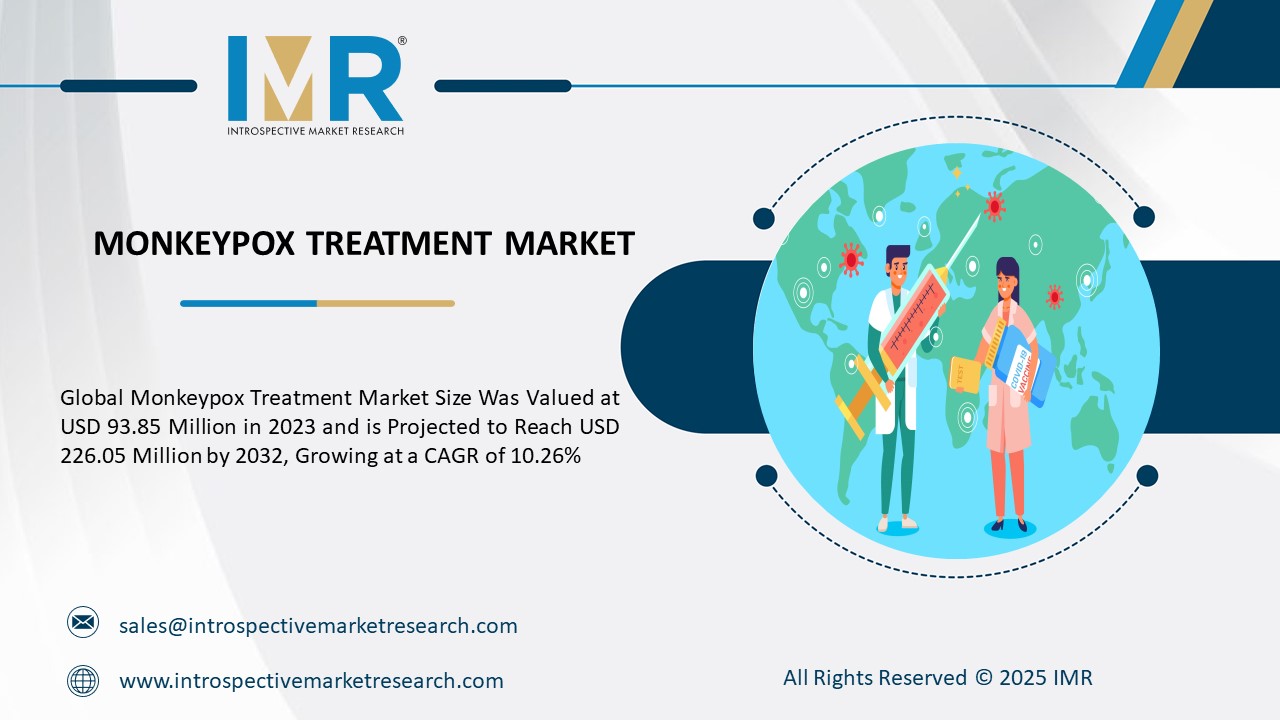
According to a new report published by Introspective Market Research, titled, Monkeypox Treatment Market by Drug Type, Route of Administration, and Distribution Channel, The Global Monkeypox Treatment Market Size Was Valued at USD 93.85 Million in 2023 and is Projected to Reach USD 226.05 Million by 2032, Growing at a CAGR of 10.26%.The Monkeypox Treatment Market is witnessing significant growth as global public health agencies and biopharmaceutical firms accelerate efforts to contain recurring zoonotic outbreaks. Monkeypox, a viral disease caused by the Orthopoxvirus genus, has increasingly become a health concern due to its human-to-human transmissibility and potential for global outbreaks. The availability of antiviral drugs such as Tecovirimat, Cidofovir, and Brincidofovir, along with supportive therapies, has strengthened the treatment landscape. Moreover, the integration of vaccination programs alongside therapeutics is enhancing patient outcomes and reducing severe complications associated with monkeypox infections.
The market expansion is supported by rising government funding, strengthened surveillance programs, and the strategic involvement of key players driving clinical research and product approvals. Global health organizations like the World Health Organization (WHO) and the U.S. Centers for Disease Control (CDC) are collaborating with pharmaceutical companies to broaden access to therapeutic solutions and accelerate drug development. Technological progress in molecular diagnostics and telemedicine-based outbreak management further supports treatment efficacy and public preparedness.
The Monkeypox Treatment Market is segmented into Drug Type, Route of Administration, and Distribution Channel.
-
By Drug Type: Antiviral Drugs (Tecovirimat, Brincidofovir, Cidofovir, Others), Vaccines, and Supportive Therapy.
-
By Route of Administration: Oral, Injectable, and Topical.
-
By Distribution Channel: Hospital Pharmacies, Retail Pharmacies, Government & Public Health Distributors, and Online Pharmacies.
A major growth driver for the Monkeypox Treatment Market is the increasing incidence of monkeypox infections in humans, linked to cross-species transmission and global travel. In alignment with the WHO’s classification of monkeypox as a public health emergency, government-backed initiatives and pharmaceutical R&D funding have increased significantly. The successful repurposing of smallpox antivirals, rising clinical testing of novel molecules, and improved treatment guidelines in collaboration with global health authorities continue to propel market growth worldwide.
Substantial market opportunity exists in developing next-generation antiviral therapies and combination treatment regimens to improve patient recovery rates. Biopharma collaborations focusing on broad-spectrum antiviral development and rapid vaccine deployment provide a promising path forward. The increased use of digital platforms for outbreak tracking, telemedicine consultations, and disease surveillance also opens new commercial frontiers for stakeholders. Additionally, favorable regulatory pathways under emergency use authorizations (EUAs) will spur innovation and accelerate product commercialization across key regions.
Monkeypox Treatment Market, Segmentation
The Monkeypox Treatment Market is segmented on the basis of Drug Type, Route of Administration, and Distribution Channel.
Drug Type
The Drug Type segment is further classified into Antiviral Drugs, Vaccines, and Supportive Therapies. Among these, the Antiviral Drugs sub-segment accounted for the highest market share in 2023. Drugs like Tecovirimat (SIGA Technologies) and Brincidofovir (Chimerix) have seen increasing use due to their proven efficacy and regulatory approvals in the U.S., U.K., and Europe. Growing clinical data and patient accessibility have made antivirals the first-line therapeutic response during outbreaks.
Route of Administration
The Route of Administration segment is divided into Oral, Injectable, and Topical routes. The Oral sub-segment dominated the market in 2023, attributed to ease of administration, stable pharmacokinetics, and improved patient compliance. Drugs like Brincidofovir and Tecovirimat have gained traction for at-home treatment settings as oral antivirals show consistent results and cost-effectiveness compared to injectable counterparts.
Some of The Leading Market Players Are
- SIGA Technologies, Inc. (United States)
- Bavarian Nordic A/S (Denmark)
- Chimerix, Inc. (United States)
- Emergent BioSolutions Inc. (United States)
- Pfizer Inc. (United States)
- Sanofi Pasteur (France)
- Moderna, Inc. (United States)
- AstraZeneca Plc (United Kingdom)
- GlaxoSmithKline Plc (United Kingdom)
- Tonix Pharmaceuticals Holding Corp. (United States)
- ViiV Healthcare (United Kingdom)
- Valneva SE (France)
- Boehringer Ingelheim GmbH (Germany)
- Bharat Biotech International Ltd. (India)
- Serum Institute of India Pvt. Ltd. (India)
- Other active players.
Key Industry Developments
- In July 2024, SIGA Technologies received expanded EMA approval for Tecovirimat use across multiple European Union member states for treating adults and children over 13 kg infected with monkeypox.This regulatory milestone enhances availability across Europe and solidifies Tecovirimat’s position as the standard of care in managing Orthopoxvirus infections.
- In November 2024, Bavarian Nordic announced the scale-up of its JYNNEOS vaccine production facilities to meet rising global demand amid recurring outbreaks.The company’s collaboration with U.S. and EU health authorities ensures improved supply chain reliability and accelerated vaccine distribution in high-risk regions.
Key Findings of the Study
- Antiviral drugs, particularly Tecovirimat and Brincidofovir, lead the global market in treatment adoption.
- North America and Europe dominate due to strong governmental support and pharmaceutical R&D.
- Oral therapeutics hold the highest demand for their accessibility and patient compliance advantages.
- Increased collaboration between governments and biopharma innovators drives sustained growth in outbreak preparedness and response capacity.