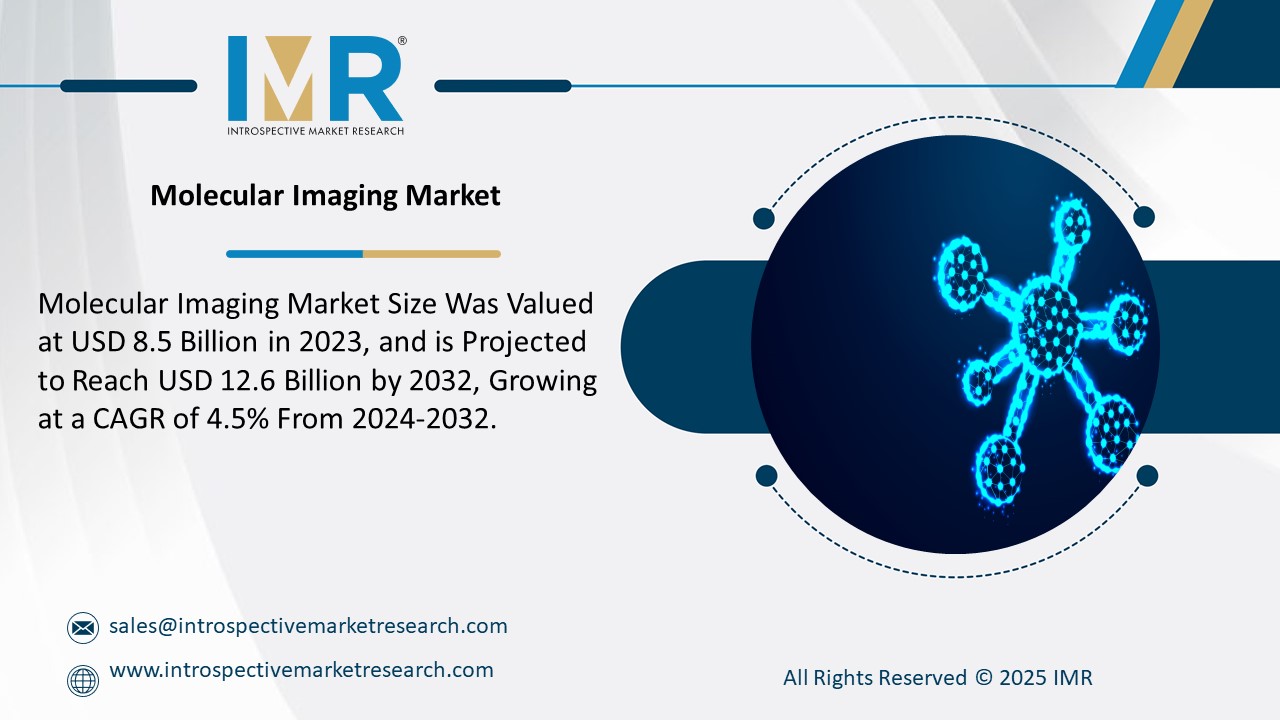
The global Molecular Imaging Market is witnessing steady growth, driven by technological advancements in diagnostic imaging and the growing prevalence of chronic diseases. Molecular imaging allows visualization, characterization, and quantification of biological processes at the molecular and cellular levels within humans and other living systems. Unlike traditional imaging, which primarily provides anatomical details, molecular imaging reveals functional information, enabling early detection and precise treatment planning. This technology plays a pivotal role in oncology, cardiology, neurology, and infectious disease diagnosis, as it enhances physicians’ ability to detect diseases at early stages and monitor therapeutic responses. The increasing adoption of hybrid imaging systems, such as PET/CT and SPECT/CT, alongside the growing demand for personalized medicine, is further boosting the market’s expansion. Additionally, continuous R&D activities and government initiatives supporting advanced imaging modalities are driving market growth globally.
A key growth driver for the molecular imaging market is the increasing prevalence of cancer and cardiovascular diseases globally. As the global burden of chronic diseases rises, there is a growing need for advanced imaging technologies that can provide functional insights into disease progression. Molecular imaging enables clinicians to detect early-stage pathologies, evaluate metabolic changes, and monitor therapy effectiveness with high precision. This has led to increased adoption of PET and SPECT imaging systems, particularly in oncology diagnostics and personalized treatment planning. One of the significant opportunities for the molecular imaging market lies in the integration of artificial intelligence (AI) and advanced radiotracers. AI-powered image processing tools enhance diagnostic accuracy and reduce interpretation time, while the development of novel radiopharmaceuticals expands the range of detectable diseases. Furthermore, growing investment in precision medicine and the shift toward hybrid imaging technologies open new avenues for market expansion, especially in emerging economies where healthcare infrastructure is rapidly improving.
Molecular Imaging Market, Segmentation
The Molecular Imaging Market is segmented on the basis of Product Type, Application, and End User.
Product Type
-
The Product Type segment is further classified into Positron Emission Tomography (PET), Single Photon Emission Computed Tomography (SPECT), Magnetic Resonance Imaging (MRI), and Others. Among these, the PET segment accounted for the highest market share in 2023. PET imaging’s ability to detect molecular activity before anatomical changes occur has made it essential for cancer and neurological disease diagnosis. Increasing adoption of PET/CT systems and the availability of new tracers are propelling growth in this segment.
Application
- The Application segment is further classified into Oncology, Cardiology, Neurology, and Others. Among these, the Oncology segment accounted for the highest market share in 2023. Molecular imaging is extensively used in cancer detection, staging, and treatment monitoring. The growing prevalence of cancer, combined with the rising demand for personalized therapies and early diagnostic tools, continues to strengthen the dominance of this segment.
Some of the Leading/Active Market Players Are:
• Siemens Healthineers (Germany)
• GE Healthcare (United States)
• Canon Medical Systems Corporation (Japan)
• Bruker Corporation (United States)
• Mediso Ltd. (Hungary)
• Koninklijke Philips N.V. (Netherlands)
• PerkinElmer Inc. (United States)
• Shimadzu Corporation (Japan)
• MR Solutions Ltd. (United Kingdom)
• CMR Naviscan Corporation (United States)
• Sofie Biosciences (United States)
• Aspect Imaging (Israel)
• Positron Corporation (United States)
• Cubresa Inc. (Canada)
• Spectrum Dynamics Medical (Israel)
and other active players.
Key Industry Developments
- In April 2024, Siemens Healthineers launched the Biograph Vision Quadra PET/CT system, featuring an extended axial field of view for faster imaging. This innovation allows simultaneous scanning of multiple organs, enhancing image quality and reducing radiation exposure, thereby improving workflow efficiency in clinical imaging centers.
- In January 2024, GE Healthcare partnered with Minerva Imaging to co-develop new PET tracers for cancer diagnosis. This collaboration aims to accelerate the development of advanced molecular imaging agents that improve early detection and monitoring of therapeutic response in oncology.
Key Findings of the Study
• PET imaging dominated the market in 2023, driven by rising cancer diagnostics.
• Oncology applications accounted for the largest share globally.
• North America led the market, supported by strong healthcare infrastructure.
• AI integration and new radiotracers are emerging as major trends.
• Growing investment in hybrid imaging systems to enhance diagnostic accuracy.