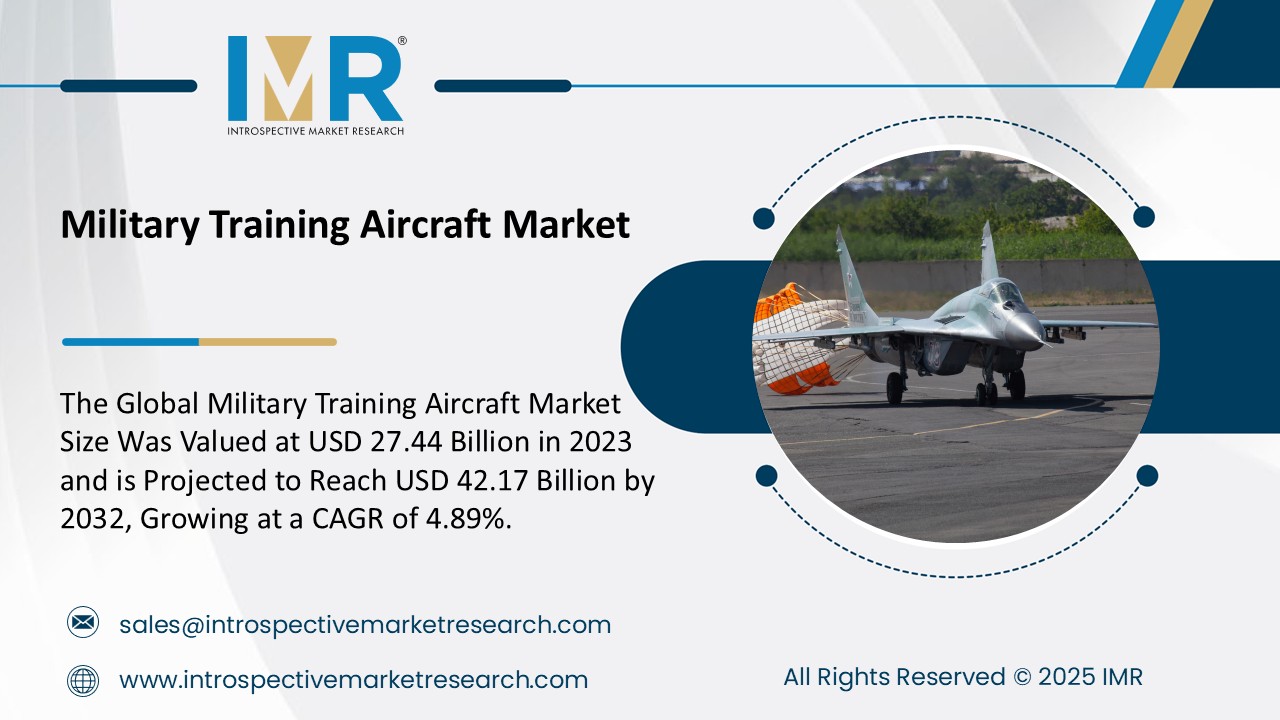
According to a new report published by Introspective Market Research, titled, Military Training Aircraft Market by Type (Fixed-Wing, Rotary-Wing), Training Type (Combat Training, Basic and Intermediate Pilot Training, Advanced Pilot Training), Seat Type (Single, Twin), and Application (Armed, Unarmed), The Global Military Training Aircraft Market Size Was Valued at USD 27.44 Billion in 2023 and is Projected to Reach USD 42.17 Billion by 2032, Growing at a CAGR of 4.89%. The military training aircraft market comprises specialized aircraft designed to train pilots and crew in foundational through advanced flight and combat skills prior to assignment to frontline combat aircraft. These aircraft represent a critical pillar of modern air force readiness, enabling safe, cost-effective training aligned to real-world operational needs. As militaries worldwide embrace new combat technologies and platforms, the demand for sophisticated trainer aircraft continues to rise.
Military training aircraft offer significant advantages over using frontline combat aircraft for instruction, most notably in safety, versatility, and reduced operational costs. Modular avionics and advanced simulation features have made these aircraft central to structured training pipelines in the world's leading air forces. Primary applications span basic and intermediate flight training, advanced combat simulation, and mission-specific procedures, supporting a rapidly growing pilot population.
The Military Training Aircraft Market is segmented into Type, Training Type, and Application.
- By Type: Fixed-Wing, Rotary-Wing.
- By Training Type: Combat Training, Basic and Intermediate Pilot Training, Advanced Pilot Training.
- By Application: Armed, Unarmed.
A major growth driver for the military training aircraft market is the sustained increase in defense budgets globally, spurred by heightened geopolitical tensions and technological modernization programs in both Western and emerging nations. Governments are prioritizing next-generation pilot proficiency, fueling robust investments in both fixed-wing and rotary-wing training platforms equipped with digital cockpits, simulated combat systems, and integrated mission suites.
A key opportunity lies in the adoption of multi-role trainer aircraft that bridge the gap between basic instruction and operational deployment, enabling seamless transitions for pilots as they prepare for missions in high-performance aircraft. Collaboration between domestic manufacturers and international defense contractors is supporting the introduction of advanced trainer types with both instructional and light combat capabilities, maximizing cost efficiency for budget-conscious air forces.
Military Training Aircraft Market, Segmentation
The Military Training Aircraft Market is segmented on the basis of Type, Training Type, and Application.
Type
The Type segment is further classified into Fixed-Wing and Rotary-Wing. Among these, the Fixed-Wing sub-segment accounted for the highest market share in 2023. Fixed-wing trainers are widely favored by global air forces due to their versatility, cost-effectiveness, and ability to provide foundational through advanced training for pilots transitioning to both fighter and transport platforms. Their simulation of real-world combat flight conditions and adaptability to emerging digital training technologies contribute to their dominance in the market.
Training Type
The Training Type segment is further classified into Combat Training, Basic and Intermediate Pilot Training, Advanced Pilot Training. Among these, the Basic and Intermediate Pilot Training sub-segment accounted for the highest market share in 2023. This is attributed to its essential role as the initial phase in all air force pilot pipelines. Trainers in this segment teach foundational flight skills, navigation, and aerobatics, supporting the global need for pilot training as defense modernization accelerates.
Some of The Leading/Active Market Players Are
- BAE Systems (UK)
- Lockheed Martin Corporation (US)
- Northrop Grumman Corporation (US)
- The Boeing Company (US)
- Leonardo S.p.A. (Italy)
- Saab AB (Sweden)
- Textron Inc. (US)
- Airbus SE (France)
- Embraer SA (Brazil)
- Korea Aerospace Industries (South Korea)
- Hindustan Aeronautics Ltd. (India)
- Diamond Aircraft Industries (Austria)
- IRKUT CORPORATION (Russia)
- Pilatus Aircraft Ltd (Switzerland)
- Calidus LLC (UAE)
- Other active players.
Key Industry Developments
In January 2025, Textron Inc. partnered with Kanematsu Group to supply Beechcraft T-6 Texan II trainers and integrated ground-based training systems to modernize pilot training for the Japan Air Self-Defense Force. The partnership aims to deliver advanced training solutions and long-term logistics to support evolving JASDF pilot needs amid regional security developments.
In August 2024, Lockheed Martin Corporation signed an agreement with Martin-Baker Australia to deliver ejection seat training for Australia’s PC-21 training fleet. This partnership will enhance ejection seat survival skills for pilots, ensuring better flight safety as the RAAF integrates the PC-21 trainer into its national pilot training system.
Key Findings of the Study
- Fixed-wing and basic/intermediate pilot training segments dominate the global market.
- North America is the leading region, driven by substantial defense budgets and major manufacturers.
- Market growth is fueled by global defense modernization, increased pilot training demand, and simulator integration.
- Industry trends include multi-role platforms, public-private partnerships, and adoption of advanced digital simulation technologies.