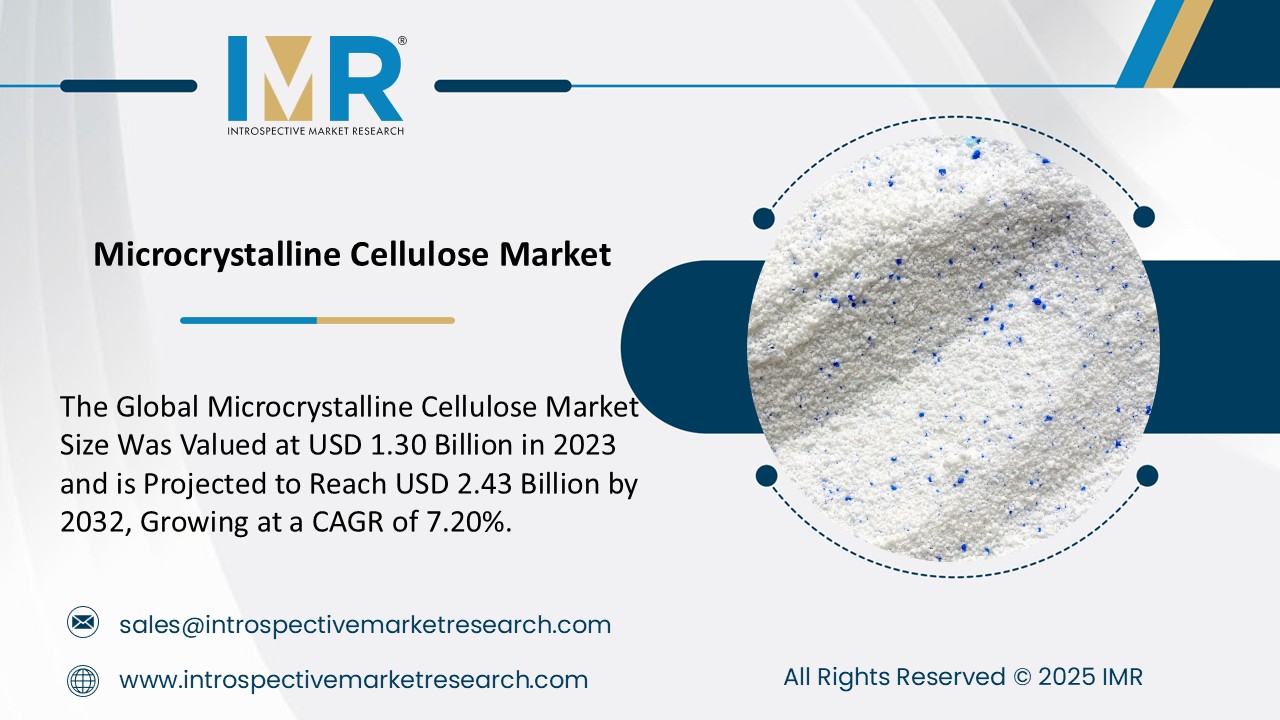
According to a new report published by Introspective Market Research, titled, Microcrystalline Cellulose Market by Source Type, Application, and Region, The Global Microcrystalline Cellulose Market Size Was Valued at USD 1.30 Billion in 2023 and is Projected to Reach USD 2.43 Billion by 2032, Growing at a CAGR of 7.20%.The global Microcrystalline Cellulose (MCC) market is witnessing significant growth driven by its multifunctional applications across pharmaceutical, food, and cosmetic industries. MCC is a purified, partially depolymerized cellulose used primarily as an excipient in tablet formulations due to its excellent binding, compressibility, and disintegration properties. Compared to traditional fillers and binders, MCC offers higher consistency, safety, and regulatory compliance, making it a preferred choice in drug manufacturing and functional food products.
MCC also serves as a fat replacer, stabilizer, and texturizer in processed foods and beverages, aligning with the rising consumer demand for low-calorie and plant-based products. With increasing pharmaceutical production, specialty foods, and personal care products, MCC’s versatility and sustainable sourcing advantages foster its adoption in major industries worldwide.
The Microcrystalline Cellulose Market is segmented into Source Type, Application, and Region. By Source Type, the market is categorized into Wood-based and Non-Wood-based. By Application, the market is categorized into Food and Beverages, Pharmaceutical, Personal Care, Paints and Coatings, and Others. By Region, the market is categorized into North America, Europe, Asia Pacific, Latin America, and Middle East & Africa.
One of the key growth drivers for the Microcrystalline Cellulose market is the rising pharmaceutical manufacturing globally. MCC is widely used as a direct compression excipient in tablet and capsule formulations, improving product efficacy and manufacturing efficiency. The increasing prevalence of chronic diseases, aging populations, and growing generic drug adoption contribute to sustained demand for MCC in pharmaceutical applications.
An emerging market opportunity lies in the growing use of non-wood-based MCC derived from agricultural residues such as maize stems and sorghum stalks. These eco-friendly and sustainable sources reduce dependency on wood pulp, addressing deforestation concerns while appealing to environmentally conscious consumers and regulatory mandates. This shift also opens new avenues in the food and personal care sectors seeking biodegradable and clean-label ingredients.
Microcrystalline Cellulose Market, Segmentation
The Microcrystalline Cellulose Market is segmented on the basis of Source Type, Application, and Region.
Source Type
The Wood-based segment is further classified as the highest market share segment, accounting for the largest revenue in 2023. Wood-based MCC is favored for its consistent particle size, high purity, and superior binding efficiency, making it ideal for pharmaceutical and nutraceutical products due to stringent quality requirements.
Application
The Pharmaceutical segment leads the market, holding the highest market share in 2023. MCC’s extensive use as a binder, filler, and disintegrant in oral solid dosage forms drives this dominance. Pharmaceutical manufacturers value MCC for its capacity to enhance tablet stability and drug delivery performance.
Some of The Leading/Active Market Players Are-
- IFF Pharma Solutions (USA)
- Mingtai Chemical (China)
- Sigachi Industries (India)
- Asahi Kasei Corporation (Japan)
- DuPont (USA)
- JRS Pharma (Germany)
- Roquette Frères (France)
- DFE Pharma (Netherlands)
- FMC Corporation (USA)
- Blanver (USA)
- and other active players.
Key Industry Developments
In August 2025, Sigachi Industries announced the expansion of its production capacity for non-wood-based MCC in India.
This expansion aims to cater to the rising demand for sustainable MCC sources driven by pharmaceutical and food industries, emphasizing eco-friendly raw material usage and cost efficiencies.
In March 2025, JRS Pharma introduced a new line of organic-certified MCC products aligned with European regulatory trends.
This development targets growing consumer preference for bio-based, biodegradable excipients and ingredients in pharmaceutical and personal care formulations, enhancing the company’s market positioning in sustainability.
Key Findings of the Study
- Wood-based MCC dominates the global market with the highest share.
- Pharmaceuticals lead in application, with growing demand fueled by chronic disease prevalence.
- Asia Pacific exhibits the fastest market growth due to expanding pharmaceutical and food industries.
- Non-wood MCC presents significant opportunities amid increasing sustainability focus.
- Leading players focus on capacity expansion and sustainable innovations.