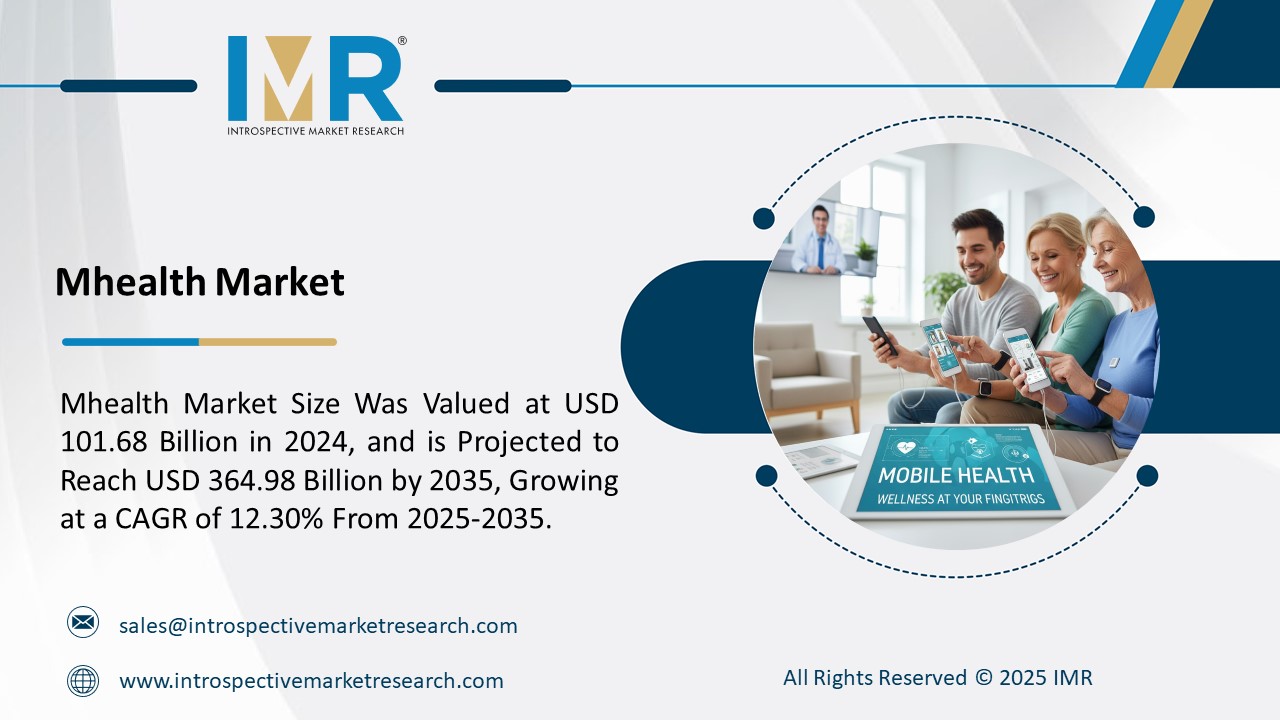
According to a new report published by Introspective Market Research, titled, Mhealth Market by Component, Service, and End User, The Global Mhealth Market Size Was Valued at USD 101.68 Billion in 2024 and is Projected to Reach USD 364.98 Billion by 2035, Growing at a CAGR of 12.30%. The global mHealth market is witnessing substantial growth, driven by rapid technological advancements in digital health solutions and increasing smartphone penetration worldwide. mHealth, or mobile health, leverages mobile devices, wearable sensors, and wireless technologies to deliver healthcare services, monitor patient health, and improve clinical outcomes. It offers a cost-effective and accessible alternative to traditional in-person care models, especially beneficial for remote and underserved populations.
The growing integration of mobile applications with telemedicine, diagnostics, and electronic health records (EHRs) is enhancing patient engagement and healthcare management. The widespread adoption of health and fitness apps, coupled with government initiatives promoting digital healthcare ecosystems, continues to bolster market expansion. Moreover, the increasing prevalence of chronic diseases and the need for real-time patient data are fueling the demand for mHealth solutions across hospitals, clinics, and homecare settings.
One of the primary drivers of the mHealth market is the increasing adoption of smartphones and mobile internet worldwide. The growing use of mobile applications for health tracking, teleconsultation, and remote monitoring enables users to manage their well-being conveniently. This trend is particularly accelerated by the rising burden of chronic diseases such as diabetes, cardiovascular disorders, and hypertension, where continuous monitoring and data-driven insights are critical for effective management.
An emerging opportunity for the mHealth market lies in the integration of artificial intelligence (AI) and machine learning (ML) technologies into mobile health platforms. AI-powered analytics can enhance diagnostic accuracy, predict disease progression, and personalize treatment plans. Moreover, partnerships between technology companies and healthcare providers are expected to create innovative digital health ecosystems that support predictive and preventive care globally.
Mhealth Market, Segmentation
Component
-
The Component segment is further classified into Wearables, mHealth Apps, and Services. Among these, the mHealth Apps sub-segment accounted for the highest market share in 2024.
- Mobile health applications are the cornerstone of mHealth adoption, offering users functionalities ranging from fitness tracking and medication reminders to remote consultation and diagnostic support. Their accessibility, low cost, and ability to integrate with wearable devices have made them indispensable in managing patient health and wellness across diverse demographics.
Service
- The Service segment is further classified into Monitoring Services, Diagnostic Services, and Treatment Services. Among these, the Monitoring Services sub-segment accounted for the highest market share in 2024.
- Monitoring services enable continuous assessment of vital parameters such as heart rate, blood pressure, and glucose levels. These solutions provide real-time insights to both patients and physicians, improving decision-making and early intervention. Their significance has grown post-pandemic, as healthcare systems increasingly rely on remote monitoring to enhance efficiency and reduce hospital readmissions.
Some of The Leading/Active Market Players Are–
- Apple Inc. (U.S.)
- Samsung Electronics Co., Ltd. (South Korea)
- Fitbit, Inc. (U.S.)
- Medtronic plc (Ireland)
- Philips Healthcare (Netherlands)
- Omron Healthcare Co., Ltd. (Japan)
- Boston Scientific Corporation (U.S.)
- Qualcomm Technologies, Inc. (U.S.)
- Cerner Corporation (U.S.)
- AliveCor Inc. (U.S.)
- Garmin Ltd. (Switzerland)
- BioTelemetry, Inc. (U.S.)
- Dexcom, Inc. (U.S.)
- Withings (France)
- iHealth Lab Inc. (U.S.)
- other active players.
Key Industry Developments
- In February 2024, Apple Inc. announced the enhancement of its Health app ecosystem with advanced health-tracking features, including blood pressure monitoring and medication adherence reminders. This move strengthens Apple’s position in preventive digital healthcare, empowering users to manage health data more comprehensively.
- In July 2023, Philips introduced an AI-enabled remote patient monitoring platform to assist clinicians in managing chronic conditions. The platform provides real-time analytics and early alerts, aiming to reduce hospital admissions and improve care coordination across telehealth networks.
Key Findings of the Study
- The mHealth Apps segment dominated the market in 2024.
- Monitoring Services held the largest share among service types.
- North America led the global market due to high digital health adoption.
- Integration of AI and IoT technologies drives innovation in mHealth.
- Rising smartphone penetration and chronic disease prevalence are key growth enablers.