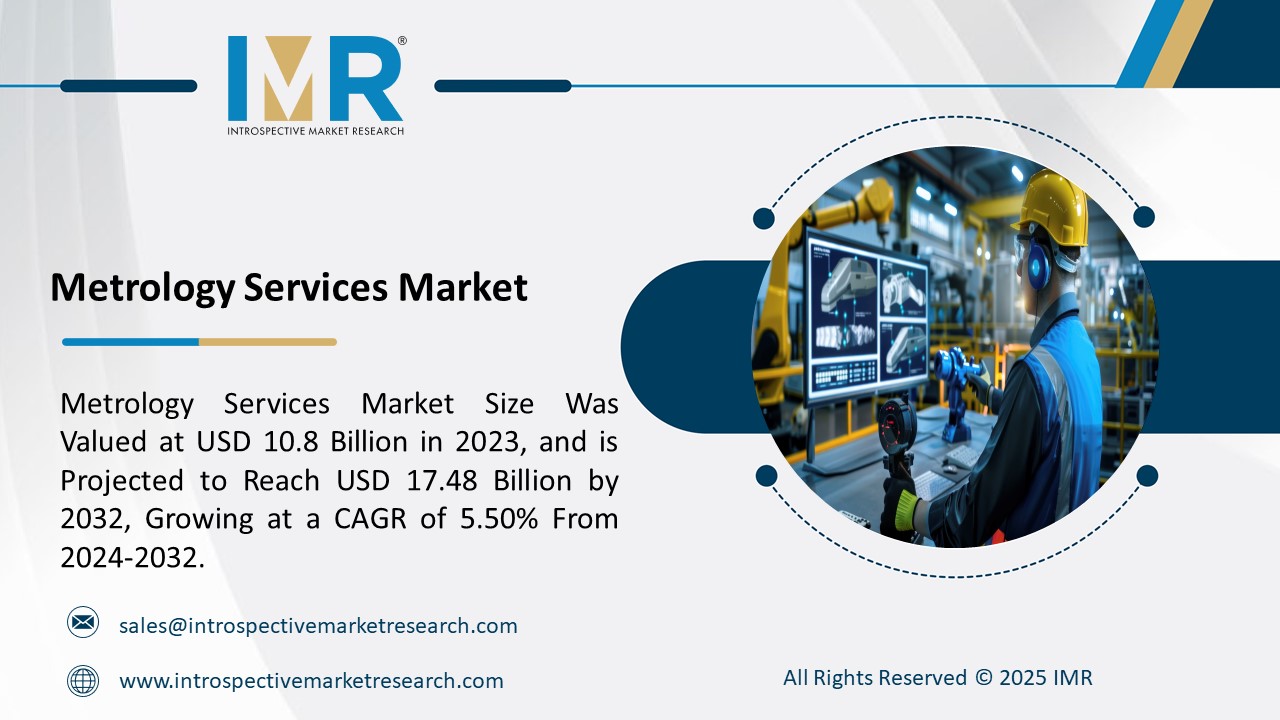
According to a new report published by Introspective Market Research, titled, Metrology Services Market by Product Type, Application, and End-Use Industry, The Global Metrology Services Market Size Was Valued at USD 10.8 Billion in 2023 and is Projected to Reach USD 17.48 Billion by 2032, Growing at a CAGR of 5.50%. The global Metrology Services Market is experiencing steady growth as industries worldwide increasingly emphasize precision, quality assurance, and compliance with strict manufacturing standards. Metrology services, which include dimensional measurement, calibration, 3D scanning, and inspection, are becoming critical in ensuring product quality and performance across diverse industries such as automotive, aerospace, electronics, energy, and heavy machinery.
Unlike traditional manual measurements, advanced metrology services provide higher accuracy, reduce operational errors, and shorten production cycles. They also play a pivotal role in Industry 4.0 by enabling smart manufacturing and digital twin technologies. With the rapid adoption of automation and robotics, metrology is no longer just a quality-control tool but an integral part of process optimization and innovation.
As companies expand globally and regulatory frameworks tighten, the need for advanced metrology solutions is growing significantly. The demand is further boosted by the surge in high-precision applications in emerging technologies such as electric vehicles, semiconductors, and renewable energy systems.
One of the key growth drivers of the global metrology services market is the increasing demand for precision engineering in the automotive and aerospace industries. These industries require components with extremely tight tolerances, and any deviation can lead to significant safety risks and operational inefficiencies. Metrology services provide high-accuracy inspection and measurement, ensuring compliance with global quality standards such as ISO/TS and AS9100. With electric vehicles, lightweight aircraft components, and autonomous technologies on the rise, manufacturers are investing heavily in advanced metrology to ensure both performance and safety. This demand is expected to drive continuous market expansion.
A major market opportunity lies in the integration of metrology services with Industry 4.0 and smart manufacturing technologies. As factories adopt automation, IoT, and digital twins, metrology services can provide real-time quality monitoring and predictive analytics. This not only reduces rework and wastage but also helps optimize production efficiency. The use of portable metrology devices and cloud-based inspection solutions is enabling remote collaboration, accelerating product development cycles, and reducing time-to-market. With growing adoption in emerging economies and small-to-medium enterprises (SMEs), this digital integration of metrology is poised to create lucrative growth avenues over the forecast period.
Metrology Services Market, Segmentation
The Metrology Services Market is segmented on the basis of Product Type, Application, and End-Use Industry.
Product Type
- The Product Type segment is further classified into Coordinate Measuring Machines (CMM), Optical Digitizers and Scanners (ODS), X-Ray & Computed Tomography, and Others. Among these, the Coordinate Measuring Machines (CMM) sub-segment accounted for the highest market share in 2023.
- CMMs dominate due to their widespread use in quality inspection, particularly in automotive and aerospace applications where extremely precise 3D measurements are required. Their ability to handle large and complex geometries makes them indispensable for advanced manufacturing. With technological improvements, including portable and automated CMMs, their adoption continues to expand, solidifying their market leadership.
Application
-
The Application segment is further classified into Reverse Engineering, Quality Control & Inspection, Mapping, and Others. Among these, the Quality Control & Inspection sub-segment accounted for the highest market share in 2023.
- The growth of this segment is attributed to industries’ increasing emphasis on maintaining strict quality standards and certifications. Quality control through metrology services reduces operational costs, enhances product reliability, and ensures compliance with regulatory frameworks. The rising need for zero-defect manufacturing in automotive, aerospace, and semiconductors continues to propel this segment forward.
Some of The Leading/Active Market Players Are-
-
Hexagon AB (Sweden)
- Carl Zeiss AG (Germany)
- Nikon Metrology NV (Belgium)
- FARO Technologies Inc. (USA)
- Renishaw PLC (UK)
- Applied Materials Inc. (USA)
- KLA Corporation (USA)
- GOM GmbH (Germany)
- Creaform Inc. (Canada)
- Perceptron Inc. (USA)
- Mitutoyo Corporation (Japan)
- Trimet Group (Germany)
- SGS SA (Switzerland)
- Intertek Group PLC (UK)
- Wenzel Group GmbH & Co. KG (Germany)
Key Industry Developments
-
In April 2024, Hexagon AB introduced its latest automated 3D laser scanning system designed to enhance accuracy and speed in large-scale industrial inspections.
The new system integrates with robotic arms and digital twin platforms, enabling manufacturers to achieve real-time measurement insights. This development underscores the growing role of automation and AI-driven inspection in modern metrology services. - In January 2024, Nikon Metrology partnered with a leading automotive OEM to deploy advanced X-ray computed tomography systems for electric vehicle battery inspection.
This collaboration aims to enhance safety and reliability by ensuring defect-free EV batteries. It reflects the rising demand for non-destructive testing in high-growth industries like electric mobility and energy storage.
Key Findings of the Study
-
Coordinate Measuring Machines (CMM) dominated the product type segment in 2023.
- Quality Control & Inspection applications held the largest market share.
- Automotive and aerospace industries remain the key end-users driving demand.
- Integration with Industry 4.0 presents significant growth opportunities.
- Europe and North America are leading regions, with Asia-Pacific showing fastest growth.