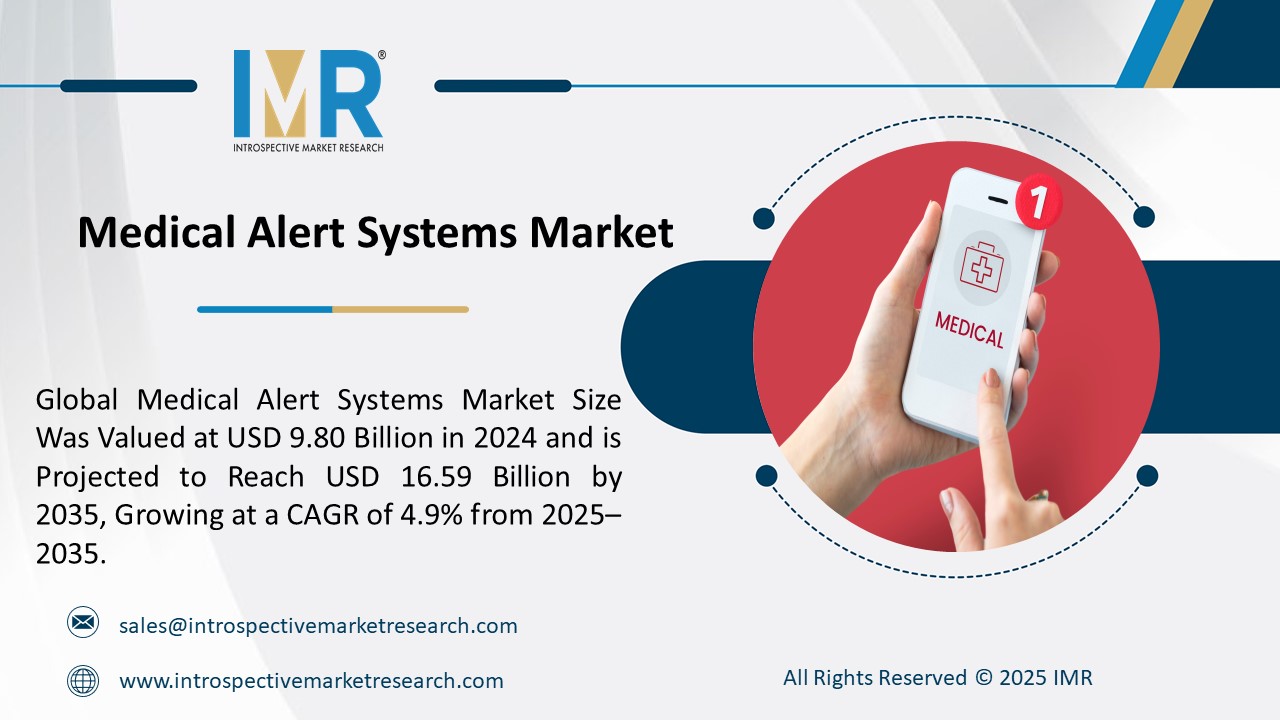
“According to a new report published by Introspective Market Research, titled, Medical Alert Systems Market by Product Type, Connectivity, and End User, The Global Medical Alert Systems Market Size Was Valued at USD 9.80 Billion in 2024 and is Projected to Reach USD 16.59 Billion by 2035, Growing at a CAGR of 4.9% from 2025–2035.”
The medical alert systems market comprises personal emergency response systems designed to provide immediate assistance to individuals during medical emergencies such as falls, cardiac events, or sudden illness. These systems typically include wearable devices, mobile pendants, wall-mounted buttons, and GPS-enabled units that connect users to monitoring centers or caregivers. Compared to traditional caregiving and emergency response methods, medical alert systems offer faster response times, continuous monitoring, and greater independence for users.
Medical alert systems are widely adopted across home care settings, assisted living facilities, and hospitals, particularly among the elderly and individuals with chronic conditions. Advancements such as mobile connectivity, fall detection sensors, and integration with smartphones have significantly enhanced usability and reliability. These systems reduce healthcare costs by preventing hospital readmissions and enabling early emergency intervention.
Growing awareness of personal safety, increasing aging population, and rising prevalence of age-related health conditions are supporting market expansion. Additionally, healthcare providers and insurers are increasingly promoting medical alert solutions as part of preventive care strategies, contributing to steady global demand during the forecast period.
Market Segmentation
The Medical Alert Systems Market is segmented into Product Type, Connectivity, and End User.
- By Product Type, the market is categorized into (In-Home Systems, Mobile Systems, and Fall Detection Systems).
- By Connectivity, the market is categorized into (Landline-Based, Cellular-Based, and GPS-Enabled Systems).
- By End User, the market is categorized into (Home Care Users, Assisted Living Facilities, and Hospitals & Clinics).
Growth Driver
One of the primary growth drivers of the medical alert systems market is the rapidly expanding geriatric population worldwide. Older adults are more susceptible to falls, chronic diseases, and medical emergencies that require immediate assistance. Medical alert systems enable seniors to live independently while ensuring quick emergency response, significantly reducing the risk of severe injury or fatality. Governments and healthcare organizations are actively promoting aging-in-place initiatives, further accelerating adoption. The growing burden on healthcare infrastructure and caregivers is also driving demand for automated, reliable emergency response solutions.
Market Opportunity
A key market opportunity lies in the integration of medical alert systems with smart home technologies and wearable health monitoring devices. The convergence of IoT, AI-based fall detection, and real-time health analytics allows providers to offer more personalized and predictive healthcare solutions. Emerging economies present untapped growth potential due to improving healthcare infrastructure and rising awareness of elderly safety. Subscription-based service models and partnerships with insurance providers further create long-term revenue opportunities for market participants.
Detailed Segmentation
Medical Alert Systems Market, Segmentation
The Medical Alert Systems Market is segmented on the basis of Product Type, Connectivity, and End User.
Product Type
The Product Type segment is further classified into In-Home Systems, Mobile Systems, and Fall Detection Systems. Among these, the In-Home Systems sub-segment accounted for the highest market share in 2024. In-home systems are widely adopted due to their affordability, ease of installation, and reliable landline or cellular connectivity. These systems are particularly popular among seniors living alone, offering continuous monitoring and quick access to emergency services within residential environments.
Connectivity
The Connectivity segment is further classified into Landline-Based, Cellular-Based, and GPS-Enabled Systems. Among these, Cellular-Based Systems held the highest market share in 2024. Cellular connectivity offers greater flexibility, uninterrupted service, and mobility compared to landline systems. Increasing smartphone penetration and improved cellular networks have accelerated the adoption of these systems, especially in urban and suburban regions.
Some of The Leading/Active Market Players Are-
• Philips Lifeline (Netherlands)
• ADT Health (USA)
• Bay Alarm Medical (USA)
• Life Alert (USA)
• Medical Guardian (USA)
• MobileHelp (USA)
• AlertOne (USA)
• Tunstall Healthcare (UK)
• Bosch Healthcare Solutions (Germany)
• Rescue Alert (USA)
and other active players.
Key Industry Developments
In March 2024, several leading providers expanded AI-powered fall detection capabilities across their product portfolios.
These enhancements improved detection accuracy and reduced false alarms, strengthening user confidence and system reliability while supporting proactive elderly care management.
In October 2024, strategic partnerships were formed between medical alert system providers and home healthcare agencies.
These collaborations aimed to integrate emergency response solutions into home care programs, improving patient outcomes and reducing emergency hospitalization rates.
Key Findings of the Study
• In-home systems dominated the product type segment
• Cellular-based connectivity led the market
• North America remained the leading region
• Aging population is the primary growth driver
• Smart and AI-enabled alert systems are emerging trends