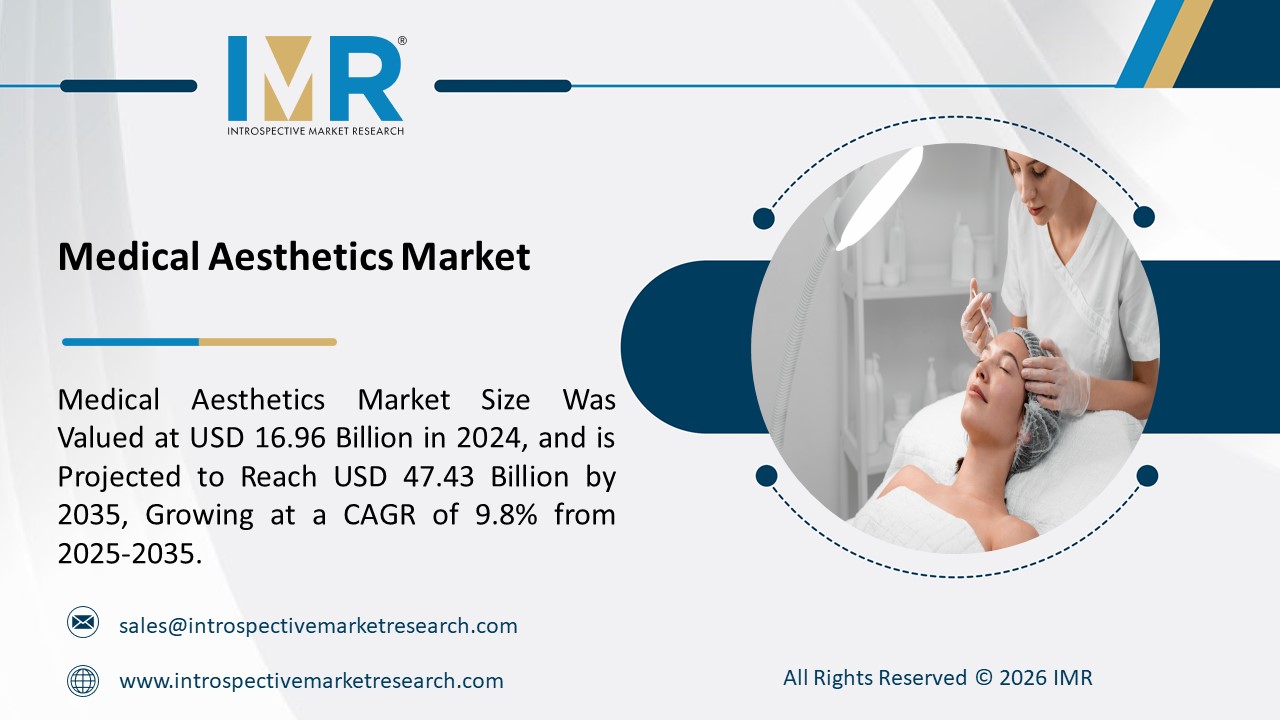
According to a new report published by Introspective Market Research, titled, “Medical Aesthetics Market by Product Type, Procedure, and End User,” The Global Medical Aesthetics Market Size Was Valued at USD 16.96 Billion in 2024 and is Projected to Reach USD 47.43 Billion by 2035, Growing at a CAGR of 9.8%.
The medical aesthetics market encompasses a diverse range of minimally invasive and non-invasive procedures, devices, and injectables designed to enhance cosmetic appearance. Key product categories include dermal fillers, botulinum toxin (Botox), body contouring devices, laser and energy-based systems, and aesthetic threads. This sector offers a significant advantage over traditional cosmetic surgery through reduced downtime, lower risk profiles, natural-looking results, and broader accessibility. Technological advancements have enabled highly targeted treatments with minimal discomfort, appealing to a growing demographic seeking subtle, preventative, and restorative enhancements.
The paramount growth driver for the medical aesthetics market is the rapid expansion of the non-surgical and minimally invasive procedure segment, fueled by technological innovation and shifting consumer preferences. Patients increasingly seek "lunchtime procedures" that offer noticeable yet subtle improvements with little to no downtime, avoiding the costs and risks associated with traditional surgery. Advancements in laser technology, radiofrequency (RF) devices, and ultrasound systems provide effective solutions for skin tightening, fat reduction, and cellulite treatment. Concurrently, the ongoing innovation in neuromodulators (like Botox) and hyaluronic acid fillers, offering longer-lasting and more natural results, creates a powerful cycle of repeat treatments and new patient acquisition, driving consistent and robust market expansion.
A significant market opportunity lies in the convergence of medical aesthetics with personalized medicine and advanced digital technologies. The development of AI-powered consultation tools for treatment simulation and outcome prediction can enhance patient engagement and satisfaction. Furthermore, there is immense potential in creating highly personalized treatment regimens using a combination of devices and injectables tailored to an individual's unique facial anatomy, aging pattern, and skin type ("combination therapy"). Expanding into underserved demographic segments, particularly men and younger adults seeking preventative treatments, along with geographic expansion into emerging economies with growing disposable incomes, represents a substantial frontier for growth. The rise of regenerative aesthetics, using technologies like platelet-rich plasma (PRP) and exosomes, also opens a new, high-value therapeutic avenue.
Medical Aesthetics Market, Segmentation
The Medical Aesthetics Market is segmented on the basis of Product Type, Procedure, and End User.
Product Type
The Product Type segment is further classified into Injectables, Energy-Based Devices, Implants, and Topical Products. Among these, the Injectables sub-segment accounted for the highest market share in 2024. This dominance is attributed to the high procedural volume, strong brand loyalty, and repeat treatment nature of neuromodulators (e.g., Botox) and dermal fillers. They are the entry point for many first-time aesthetic patients due to their quick, in-office application and immediate, visible results. The continuous introduction of new filler formulations for different indications (lips, cheeks, jawline) and the expansion of therapeutic uses (e.g., for migraines, hyperhidrosis) further solidify this segment's revenue leadership.
End User
The End User segment is further classified into Clinics, Hospitals & Surgical Centers, and Medical Spas & Beauty Centers. Among these, the Clinics sub-segment accounted for the highest market share in 2024. Specialty dermatology and plastic surgery clinics are the primary setting for medical aesthetic procedures, offering a professional, clinical environment that assures patient safety and efficacy. These clinics often house a comprehensive suite of devices and employ expert practitioners capable of performing a wide range of injectable and energy-based treatments, making them the preferred destination for consumers seeking high-quality, medically supervised aesthetic care.
Some of The Leading/Active Market Players Are-
- AbbVie Inc. (Allergan Aesthetics) (USA)
- Galderma S.A. (Switzerland)
- Merz Pharma GmbH & Co. KGaA (Germany)
- Alma Lasers (Sisram Medical Ltd) (Israel)
- Candela Medical (Syneron-Candela) (USA)
- Bausch Health Companies Inc. (Solta Medical) (Canada)
- Johnson & Johnson (USA)
- Lumenis Ltd. (USA)
- Cynosure, LLC. (USA)
- Revance Therapeutics, Inc. (USA)
- Sinclair Pharma (UK)
- Teoxane Laboratories (Switzerland)
- Suneva Medical, Inc. (USA)
- Venus Concept Ltd. (Canada)
- Cutera, Inc. (USA)
and other active players.
Key Industry Developments
In March 2024, Galderma launched RHA® Redensity, the first FDA-approved dermal filler specifically designed for the delicate under-eye area, addressing a high-demand indication with a tailored product.
This launch exemplifies the trend of hyper-specialization within the injectables market, where companies develop products for specific, nuanced anatomical areas, driving premium pricing and capturing new patient segments seeking targeted solutions.
In January 2024, Alma Lasers introduced the SOPHY® AI platform, an artificial intelligence-driven software for its laser devices that analyzes skin conditions and recommends personalized treatment parameters.
This development highlights the integration of AI and digital tools into aesthetic devices, aiming to standardize outcomes, improve practitioner efficiency, and enhance the consultative experience through data-driven personalization, representing the next wave of technological advancement.
Key Findings of the Study
- The Injectables segment (fillers & toxins) is the largest and highest-growth product category.
- Specialty Clinics are the dominant end-user setting for procedures.
- Market growth is primarily driven by the demand for non-surgical treatments and technological advancements.
- North America holds the largest market share, with the Asia-Pacific region experiencing the fastest growth.
- Personalization, combination therapies, and the rise of regenerative aesthetics are key market-defining trends.