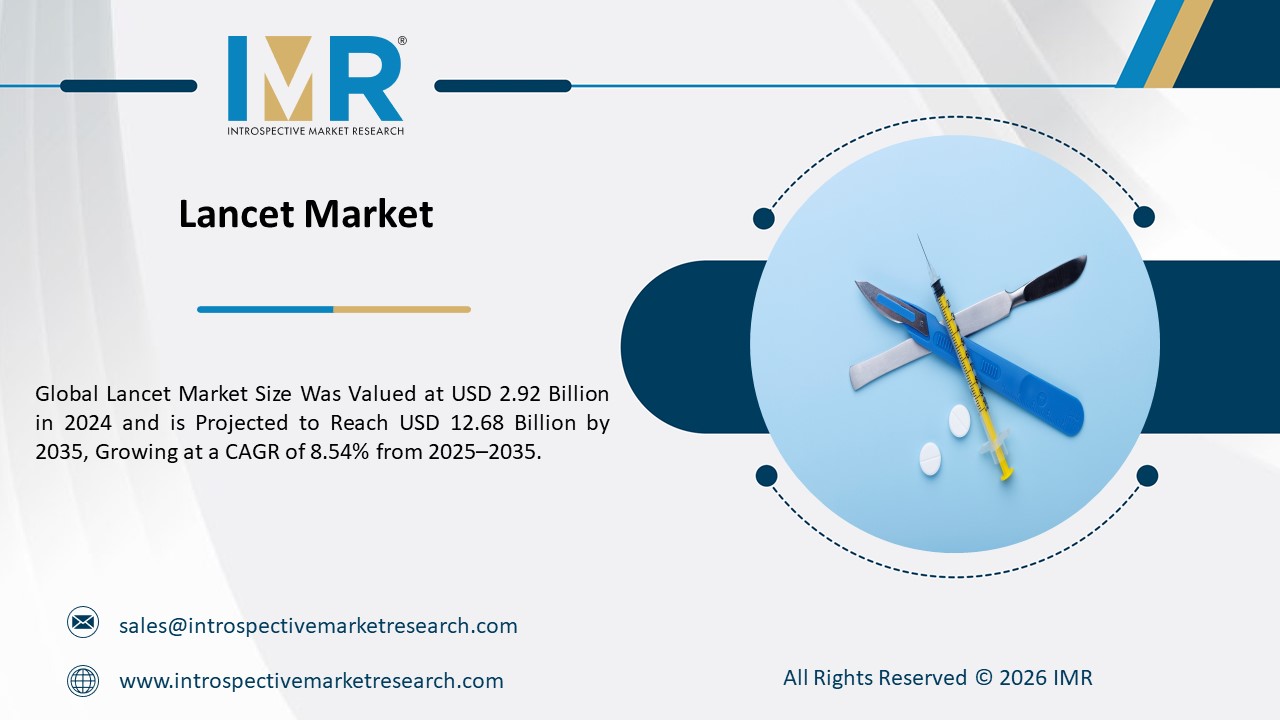
“According to a new report published by Introspective Market Research, titled, Lancet Market by Product Type, End User, and Distribution Channel, The Global Lancet Market Size Was Valued at USD 2.92 Billion in 2024 and is Projected to Reach USD 12.68 Billion by 2035, Growing at a CAGR of 8.54% from 2025–2035.”
The lancet market comprises medical-grade devices primarily used for capillary blood sampling, especially in glucose monitoring, hemoglobin testing, and other point-of-care diagnostic procedures. Lancets are widely used in hospitals, diagnostic laboratories, clinics, and homecare settings due to their simplicity, safety, and cost-effectiveness. Advances in lancet design, including ultra-thin needles and safety-engineered mechanisms, have significantly reduced patient pain and the risk of needle-stick injuries.
Compared to traditional blood collection methods, modern lancets offer improved accuracy, single-use sterility, and enhanced patient compliance. The rising prevalence of chronic diseases such as diabetes, increasing adoption of self-monitoring devices, and growing emphasis on preventive healthcare are key factors driving market expansion. Furthermore, technological innovations focused on painless and safety lancets are strengthening their adoption across both professional and home-based healthcare environments.
Market Segmentation
The Lancet Market is segmented into Product Type, End User, and Distribution Channel. By Product Type, the market is categorized into Safety Lancets, Standard Lancets, and Specialty Lancets. By End User, the market is categorized into Hospitals & Clinics, Diagnostic Laboratories, and Homecare Settings. By Distribution Channel, the market is categorized into Hospital Pharmacies, Retail Pharmacies, and Online Pharmacies.
Growth Driver
One of the primary growth drivers of the lancet market is the rapidly increasing global diabetic population. Diabetes management requires frequent blood glucose monitoring, which directly drives the demand for lancets. Rising awareness regarding early diagnosis and routine monitoring, coupled with the growing use of glucometers and point-of-care testing devices, has significantly increased lancet consumption. Additionally, government initiatives promoting diabetes screening and improved access to diagnostic tools in emerging economies further accelerate market growth.
Market Opportunity
A major market opportunity lies in the growing adoption of home-based healthcare and self-testing solutions. The shift toward decentralized healthcare, supported by telemedicine and remote patient monitoring, has increased demand for user-friendly and pain-free lancets. Manufacturers focusing on advanced safety lancets and ergonomic designs tailored for elderly and pediatric populations are well-positioned to capitalize on this opportunity. Expansion in emerging markets with improving healthcare infrastructure also presents significant untapped growth potential.
Detailed Segmentation
Lancet Market, Segmentation
The Lancet Market is segmented on the basis of Product Type, End User, and Distribution Channel.
Product Type
The Product Type segment is further classified into Safety Lancets, Standard Lancets, and Specialty Lancets. Among these, the Safety Lancets sub-segment accounted for the highest market share in 2024. This dominance is attributed to strict regulations regarding needle-stick injury prevention and growing awareness of infection control. Safety lancets are widely adopted in hospitals and diagnostic laboratories due to their retractable needle mechanisms and single-use design, ensuring enhanced safety for both patients and healthcare professionals.
End User
The End User segment is further classified into Hospitals & Clinics, Diagnostic Laboratories, and Homecare Settings. Among these, the Homecare Settings sub-segment accounted for the highest market share in 2024. The increasing preference for self-monitoring of blood glucose, rising geriatric population, and convenience offered by home testing have driven this segment. Easy availability of lancets through retail and online channels has further supported its growth.
Some of The Leading/Active Market Players Are-
• Roche Diagnostics (Switzerland)
• Abbott Laboratories (United States)
• Becton, Dickinson and Company (United States)
• Terumo Corporation (Japan)
• B. Braun Melsungen AG (Germany)
• Nipro Corporation (Japan)
• Medtronic plc (Ireland)
• ARKRAY Inc. (Japan)
• Sarstedt AG & Co. KG (Germany)
• Owen Mumford Ltd. (United Kingdom)
• Ypsomed Holding AG (Switzerland)
• Terumo Penpol Ltd. (India)
• Greiner Bio-One International GmbH (Austria)
and other active players.
Key Industry Developments
In March 2024, a leading medical device manufacturer launched a next-generation safety lancet designed to minimize pain and enhance user comfort.
The product integrates ultra-thin needle technology and automatic retraction features, targeting both professional healthcare settings and homecare users, strengthening the company’s position in the safety lancet segment.
In October 2023, a global diagnostics company expanded its lancet manufacturing facility in Asia to meet rising regional demand.
This expansion aimed to improve supply chain efficiency, reduce production costs, and support the growing adoption of blood glucose monitoring devices across emerging markets.
Key Findings of the Study
• Safety lancets dominate the product type segment
• Homecare settings represent the leading end-user segment
• North America holds a significant market share due to high diabetes prevalence
• Rising self-monitoring and preventive healthcare drive market growth
• Technological advancements remain a key market trend