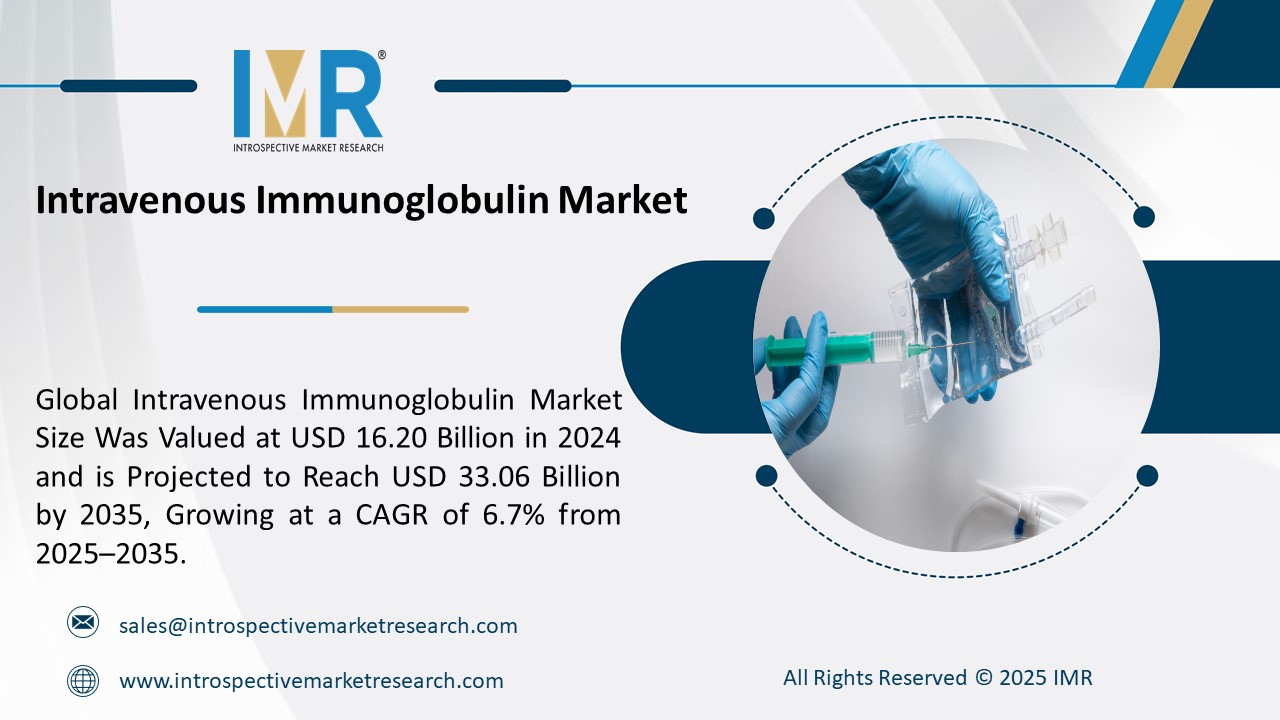
“According to a new report published by Introspective Market Research, titled, Intravenous Immunoglobulin Market by Product Type, Application, and Distribution Channel, The Global Intravenous Immunoglobulin Market Size Was Valued at USD 16.20 Billion in 2024 and is Projected to Reach USD 33.06 Billion by 2035, Growing at a CAGR of 6.7% from 2025–2035.”
The Intravenous Immunoglobulin (IVIG) market plays a critical role in modern therapeutics, offering life-saving treatment for patients with immune deficiencies, autoimmune disorders, and select neurological conditions. IVIG is a plasma-derived therapy containing pooled immunoglobulin G (IgG) antibodies, administered intravenously to enhance or regulate immune system function. Compared to conventional immunosuppressive therapies, IVIG provides targeted immune modulation with a well-established safety profile, making it a preferred option across multiple clinical indications.
The market is witnessing steady growth driven by rising prevalence of primary immunodeficiency diseases (PIDD), increasing incidence of autoimmune and inflammatory disorders, and expanding applications in neurology and hematology. Technological advancements in plasma fractionation, improved donor screening processes, and enhanced manufacturing efficiencies are further supporting market expansion.
Additionally, growing awareness among healthcare professionals, favorable reimbursement policies in developed economies, and increasing healthcare expenditure in emerging markets are strengthening adoption. As clinical research continues to uncover new therapeutic uses, IVIG remains a cornerstone therapy within hospital and specialty care settings worldwide.
Market Segmentation
The Intravenous Immunoglobulin Market is segmented into Product Type, Application, and Distribution Channel.
- By Product Type, the market is categorized into Standard IVIG, Hyperimmune IVIG, and Specific IVIG.
- By Application, the market is categorized into Primary Immunodeficiency Diseases, Autoimmune Disorders, Neurological Disorders, and Others.
- By Distribution Channel, the market is categorized into Hospital Pharmacies, Retail Pharmacies, and Online/Specialty Pharmacies.
Growth Driver
One of the primary growth drivers of the IVIG market is the rising prevalence of immune-related and autoimmune disorders globally. Increasing diagnosis rates of primary immunodeficiency diseases, chronic inflammatory demyelinating polyneuropathy (CIDP), myasthenia gravis, and Kawasaki disease have significantly boosted demand for IVIG therapies. Improved diagnostic capabilities and growing physician awareness have led to earlier and more frequent treatment initiation. Furthermore, IVIG’s broad therapeutic applicability, proven clinical efficacy, and expanding off-label use continue to drive consistent demand across hospitals and specialty clinics worldwide.
Market Opportunity
A major market opportunity lies in the expanding healthcare infrastructure and improving access to advanced biologics in emerging economies. Countries across Asia-Pacific, Latin America, and the Middle East are investing heavily in plasma collection facilities, healthcare modernization, and reimbursement frameworks. Additionally, ongoing R&D focused on novel IVIG formulations with improved tolerability and longer dosing intervals presents growth potential. Strategic collaborations between plasma collection centers and biopharmaceutical manufacturers are expected to enhance supply stability, addressing current shortages and opening new revenue avenues.
Detailed Segmentation
Intravenous Immunoglobulin Market, Segmentation
The Intravenous Immunoglobulin Market is segmented on the basis of Product Type, Application, and Distribution Channel.
Product Type
The Product Type segment is further classified into Standard IVIG, Hyperimmune IVIG, and Specific IVIG. Among these, the Standard IVIG sub-segment accounted for the highest market share in 2024. This dominance is attributed to its widespread use across multiple indications, established clinical guidelines, and broad availability. Standard IVIG is extensively prescribed due to its proven efficacy, consistent safety profile, and adaptability across immune-related disorders, making it the backbone of IVIG therapy worldwide.
Application
The Application segment is further classified into Primary Immunodeficiency Diseases, Autoimmune Disorders, Neurological Disorders, and Others. Among these, the Primary Immunodeficiency Diseases sub-segment accounted for the highest market share in 2024. Continuous lifelong treatment requirements, rising patient awareness, and improved diagnostic rates contribute to sustained demand. IVIG remains the gold-standard therapy for PIDD, ensuring stable growth within this application segment.
Some of The Leading/Active Market Players Are–
• CSL Behring (Australia)
• Grifols (Spain)
• Takeda Pharmaceutical Company (Japan)
• Octapharma (Switzerland)
• Kedrion Biopharma (Italy)
• Biotest AG (Germany)
• LFB Group (France)
• China Biologic Products (China)
• SK Plasma (South Korea)
• Bharat Serums and Vaccines (India)
…and other active players.
Key Industry Developments
In March 2024, leading plasma therapy manufacturers announced capacity expansion initiatives to address global IVIG supply constraints.
These expansions include investments in new plasma collection centers, enhanced fractionation facilities, and upgraded purification technologies, aimed at improving product availability and meeting rising global demand.
In September 2024, regulatory authorities approved expanded indications for IVIG use in select neurological and autoimmune conditions.
This approval supports broader clinical adoption, strengthens physician confidence, and is expected to positively influence long-term market growth across developed and emerging regions.
Key Findings of the Study
• Standard IVIG dominates the product segment due to broad clinical usage
• Primary immunodeficiency diseases remain the leading application area
• North America holds the largest market share, while Asia-Pacific is fastest growing
• Rising autoimmune disease prevalence is a key growth driver
• Capacity expansion and new indications are major market trends