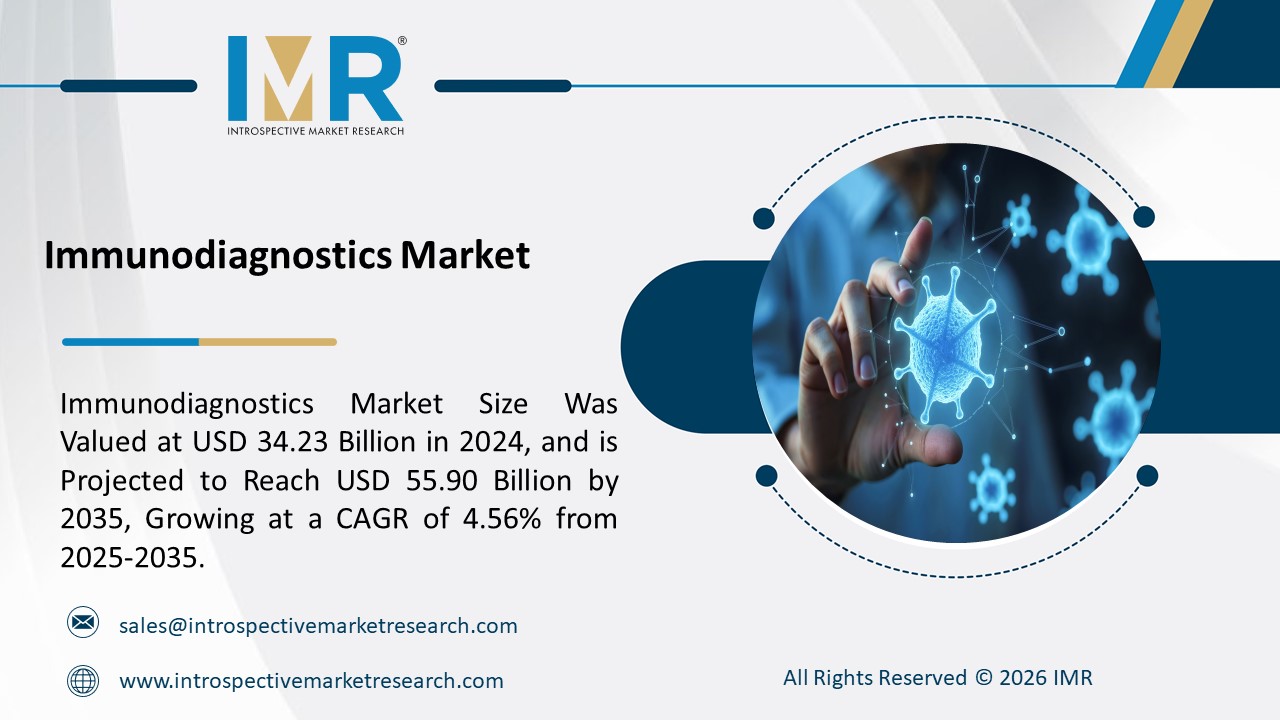
According to a new report published by Introspective Market Research, titled, “Immunodiagnostics Market by Product & Service, Technology, Application, and End User,” The Global Immunodiagnostics Market Size Was Valued at USD 34.23 Billion in 2024 and is Projected to Reach USD 55.90 Billion by 2035, Growing at a CAGR of 4.56%.
The immunodiagnostics market is a cornerstone of modern clinical laboratory medicine, specializing in tests that detect and measure specific proteins, antibodies, or antigens in a patient’s sample using antigen-antibody reactions. This market includes a wide array of products such as reagents, kits, instruments, and software for analyzing conditions ranging from infectious diseases to autoimmune disorders. Its key advantage lies in its exceptional specificity, sensitivity, and ability to provide quantitative results, enabling precise diagnosis, disease monitoring, and therapeutic guidance far superior to traditional culture methods or basic biochemical tests.
The most significant growth driver for the immunodiagnostics market is the persistently high and evolving global burden of infectious diseases, coupled with the continuous need for chronic disease management. The COVID-19 pandemic was a stark reminder of the critical need for rapid, accurate serological testing, leading to massive investments in immunoassay platforms. Beyond pandemics, the ongoing prevalence of HIV, Hepatitis, and emerging pathogens necessitates robust diagnostic surveillance. Simultaneously, the increasing incidence of chronic conditions like cancer, diabetes, and autoimmune disorders requires long-term monitoring of specific biomarkers (e.g., HbA1c, PSA, cardiac troponins) to guide treatment. This dual demand for both epidemic response and chronic care management creates a stable, high-volume foundation for market growth.
A major market opportunity lies in the ongoing transition from centralized laboratory testing to decentralized, point-of-care (POC) immunodiagnostics. There is significant demand for developing highly accurate, rapid, and easy-to-use POC immunoassays that can deliver lab-quality results in physician offices, clinics, pharmacies, or even at home. This shift improves patient outcomes through faster clinical decisions, enhances access in resource-limited settings, and creates new revenue streams. Furthermore, integrating immunoassays with multiplexing technologies and digital health platforms to enable simultaneous testing of multiple biomarkers from a single sample, and connecting results directly to electronic health records, represents a frontier for creating more comprehensive diagnostic profiles and streamlined workflows.
Immunodiagnostics Market, Segmentation
The Immunodiagnostics Market is segmented on the basis of Product & Service, Technology, Application, and End User.
Technology
The Technology segment is further classified into ELISA, Chemiluminescence Immunoassay (CLIA), Radioimmunoassay (RIA), Fluorescence Immunoassay, and Others. Among these, the Chemiluminescence Immunoassay (CLIA) sub-segment accounted for the highest market share in 2024. CLIA dominates due to its superior analytical sensitivity, wide dynamic range, and automation compatibility, making it the gold standard technology in high-throughput clinical laboratories. Its advantages over older technologies like ELISA (faster, no radiation hazards like RIA) have led to its widespread adoption for critical tests in infectious disease, endocrinology, and oncology, driving consistent reagent and instrument sales.
Application
The Application segment is further classified into Infectious Diseases, Oncology, Endocrinology, Autoimmune Diseases, Cardiology, and Others. Among these, the Infectious Diseases sub-segment accounted for the highest market share in 2024. This dominance is attributed to the enormous, continuous global volume of testing for diseases like HIV, Hepatitis, COVID-19, influenza, and sexually transmitted infections (STIs). Immunoassays are the primary method for detecting pathogen-specific antibodies or antigens, serving both diagnostic and screening purposes in public health. The recurrent nature of infectious outbreaks and routine screening programs ensures this remains the largest application segment.
Some of The Leading/Active Market Players Are-
- Abbott Laboratories (USA)
- F. Hoffmann-La Roche Ltd. (Switzerland)
- Siemens Healthineers AG (Germany)
- Danaher Corporation (Beckman Coulter, Radiometer) (USA)
- Thermo Fisher Scientific Inc. (USA)
- bioMérieux SA (France)
- Sysmex Corporation (Japan)
- Ortho Clinical Diagnostics (QuidelOrtho) (USA)
- DiaSorin S.p.A. (Italy)
- Bio-Rad Laboratories, Inc. (USA)
- PerkinElmer, Inc. (USA)
- Mindray Medical International Ltd. (China)
- QuidelOrtho Corporation (USA)
- SEKISUI Medical Co., Ltd. (Japan)
- Fujirebio (Japan)
and other active players.
Key Industry Developments
In February 2024, Roche launched the cobas pulse system, a new point-of-care solution that integrates a glucose meter with a digital health platform, initially for diabetes management, showcasing its move into connected POC diagnostics.
This launch reflects the strategic expansion of major diagnostics companies beyond core lab systems into integrated, digital POC ecosystems, aiming to capture data and value across the continuum of care, from acute testing to chronic disease management.
In January 2024, QuidelOrtho received FDA clearance for its Sofia® 2 SARS Antigen+ FIA, a rapid, instrument-based immunoassay for simultaneous qualitative detection of SARS-CoV-2 and influenza A+B antigens.
This development highlights the ongoing trend towards multiplexed immunoassays that increase testing efficiency and diagnostic yield, allowing clinicians to differentiate between pathogens with similar symptoms during a single patient visit, thereby improving treatment pathways and antimicrobial stewardship.
Key Findings of the Study
- Chemiluminescence Immunoassay (CLIA) is the dominant technology due to its performance and automation.
- Infectious Disease testing is the largest application area by volume and value.
- Market growth is driven by the high prevalence of infectious and chronic diseases requiring biomarker monitoring.
- North America holds the largest market share, with significant growth potential in the Asia-Pacific region.
- The key trends shaping the market are the shift to point-of-care testing and the development of multiplexed assays.