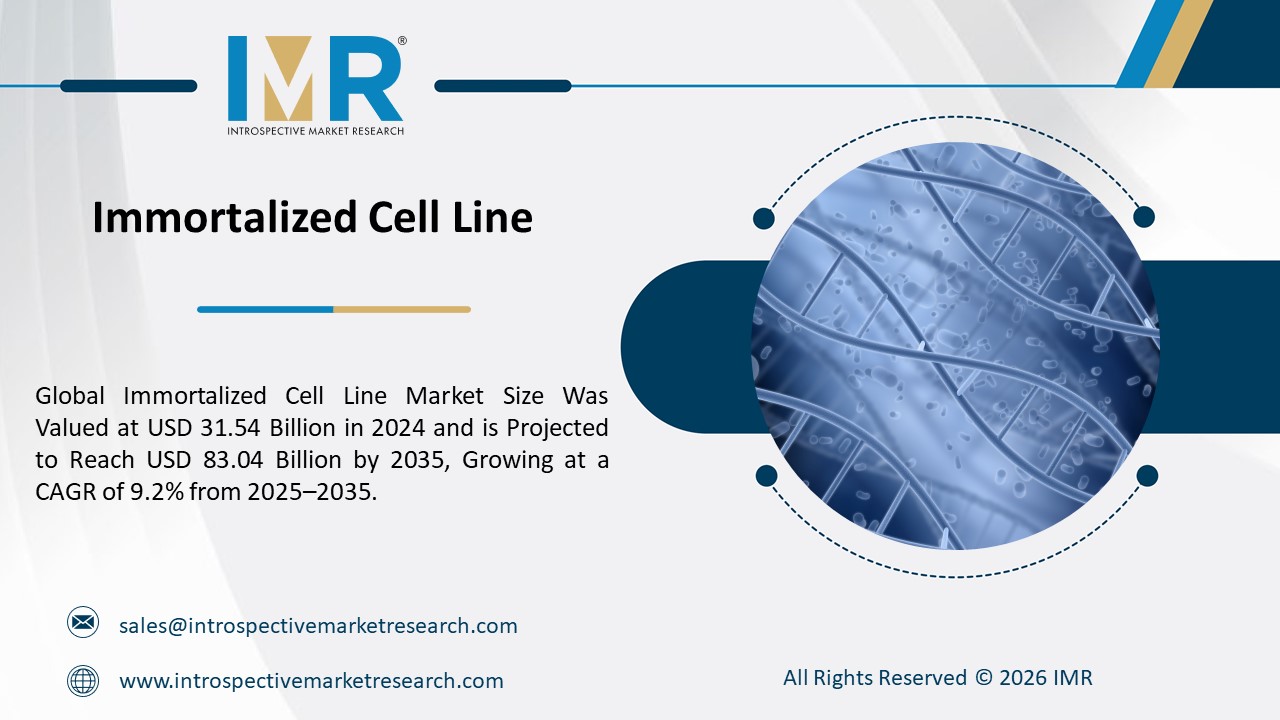
“According to a new report published by Introspective Market Research, titled, Immortalized Cell Line Market by Product Type, Application, and End User, The Global Immortalized Cell Line Market Size Was Valued at USD 31.54 Billion in 2024 and is Projected to Reach USD 83.04 Billion by 2035, Growing at a CAGR of 9.2% from 2025–2035.”
The global Immortalized Cell Line Market plays a critical role in modern biomedical research, drug discovery, and biopharmaceutical manufacturing. Immortalized cell lines are genetically modified or naturally occurring cells capable of proliferating indefinitely under controlled laboratory conditions. These cell lines provide a stable, reproducible, and cost-effective alternative to primary cells, making them indispensable for long-term experimental studies.
Immortalized cell lines are widely used in applications such as cancer research, vaccine production, toxicity testing, gene expression studies, and biologics development. Their advantages include consistent growth characteristics, ease of maintenance, and scalability for large-volume experiments. Compared to traditional primary cell cultures, immortalized cell lines reduce variability and ethical concerns while improving research efficiency.
The increasing demand for advanced therapeutics, rising investment in life sciences research, and rapid growth of biotechnology and pharmaceutical industries are significantly driving the adoption of immortalized cell lines. Technological advancements in cell engineering and increasing utilization in precision medicine further support market expansion during the forecast period.
Market Segmentation
The Immortalized Cell Line Market is segmented into Product Type, Application, and End User.
- By Product Type, the market is categorized into Human Cell Lines, Animal Cell Lines, and Hybrid Cell Lines.
- By Application, the market is categorized into Drug Discovery & Development, Cancer Research, Vaccine Production, Toxicology Testing, and Gene Therapy Research.
- By End User, the market is categorized into Pharmaceutical & Biotechnology Companies, Academic & Research Institutes, and Contract Research Organizations (CROs).
Growth Driver
One of the primary growth drivers of the immortalized cell line market is the surging demand for drug discovery and development activities. Pharmaceutical and biotechnology companies increasingly rely on immortalized cell lines for high-throughput screening, target validation, and toxicity testing due to their reproducibility and cost efficiency. The growing burden of chronic diseases, cancer, and infectious disorders has intensified R&D efforts globally. Additionally, regulatory agencies emphasize robust preclinical testing, further accelerating the use of standardized cell models. These factors collectively contribute to sustained demand for immortalized cell lines across the drug development pipeline.
Market Opportunity
A significant market opportunity lies in the expansion of personalized medicine and advanced cell-based therapies. Immortalized cell lines are increasingly utilized in genomics, proteomics, and precision medicine research to understand disease mechanisms at the molecular level. Emerging technologies such as CRISPR gene editing and 3D cell culture systems enhance the functionality of immortalized cell models. Furthermore, increasing investments in biotech startups and research infrastructure in emerging economies are expected to open new revenue streams for market players over the forecast period.
Detailed Segmentation
Immortalized Cell Line Market, Segmentation
The Immortalized Cell Line Market is segmented on the basis of Product Type, Application, and End User.
Product Type
The Product Type segment is further classified into Human Cell Lines, Animal Cell Lines, and Hybrid Cell Lines. Among these, the Human Cell Lines sub-segment accounted for the highest market share in 2024. Human cell lines are extensively used due to their direct relevance to human physiology and disease modeling. They are widely applied in cancer research, virology, drug screening, and genetic studies. Their ability to closely mimic human biological responses makes them the preferred choice for pharmaceutical and clinical research applications.
Application
The Application segment is further classified into Drug Discovery & Development, Cancer Research, Vaccine Production, Toxicology Testing, and Gene Therapy Research. Among these, the Drug Discovery & Development sub-segment accounted for the highest market share in 2024. This dominance is attributed to the increasing number of drug candidates and the need for reliable in vitro testing models. Immortalized cell lines enable rapid screening, improved reproducibility, and cost-effective experimentation, thereby accelerating drug development timelines.
Some of The Leading/Active Market Players Are-
-
Merck KGaA (Germany)
-
Thermo Fisher Scientific Inc. (USA)
-
Lonza Group AG (Switzerland)
-
ATCC (USA)
-
Corning Incorporated (USA)
-
Sartorius AG (Germany)
-
PromoCell GmbH (Germany)
-
Takara Bio Inc. (Japan)
-
Sigma-Aldrich (USA)
-
Celartia Ltd. (UK)
-
Bio-Techne Corporation (USA)
-
Charles River Laboratories (USA)
-
DSM-Firmenich (Netherlands)
-
WuXi AppTec (China)
-
HiMedia Laboratories (India)
-
and other active players.
Key Industry Developments
In March 2024, a leading biotechnology company expanded its immortalized human cell line portfolio to support advanced cancer and gene therapy research.
This development enhances the availability of high-quality, standardized cell models for pharmaceutical companies and research institutions, accelerating innovation in targeted therapeutics.
In September 2023, a major life sciences company invested in new cell culture manufacturing facilities to meet rising global demand.
The expansion strengthens production capacity, improves supply chain reliability, and supports large-scale biopharmaceutical research and vaccine development initiatives.
Key Findings of the Study
-
Human cell lines dominated the product segment in 2024
-
Drug discovery & development emerged as the leading application
-
North America held the largest market share globally
-
Rising R&D investment is a key growth driver
-
Technological advancements remain a major market trend