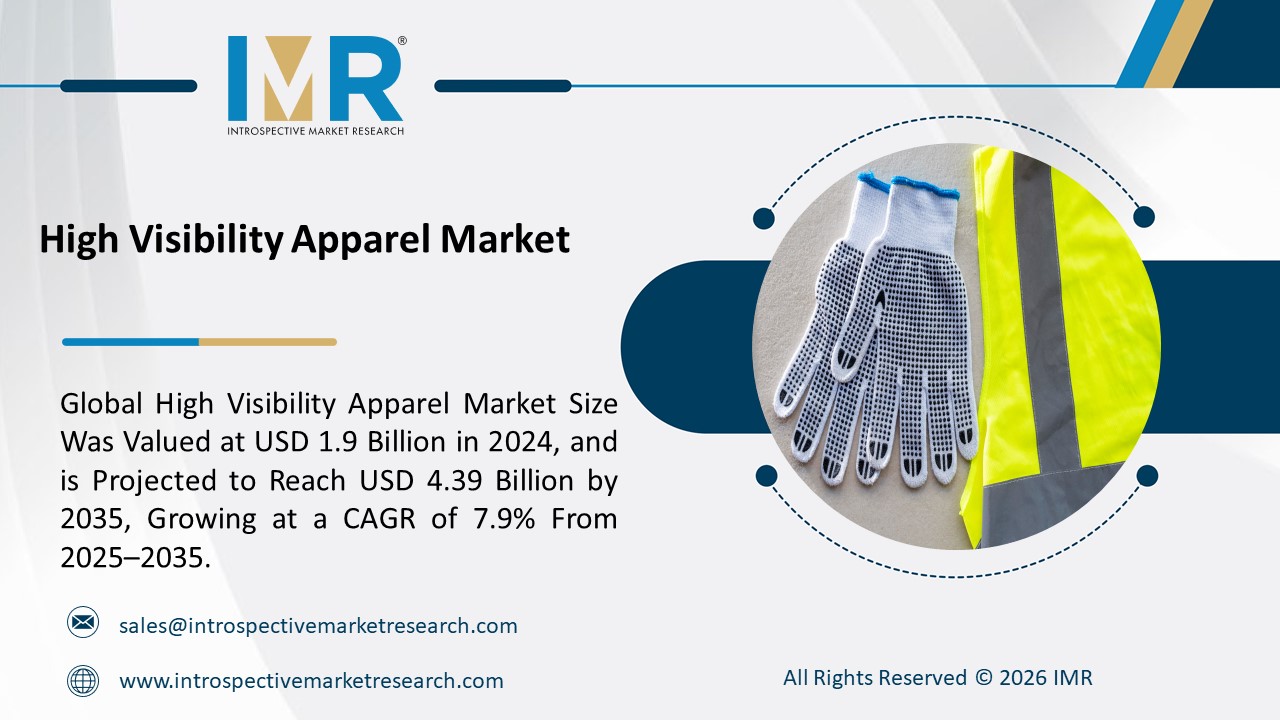
According to a new report published by Introspective Market Research, titled, “High Visibility Apparel Market by Product Type, Application, and End-User,” The Global High Visibility Apparel Market Size Was Valued at USD 1.9 Billion in 2024 and is Projected to Reach USD 4.39 Billion by 2035, Growing at a CAGR of 7.9% From 2025–2035.
The High Visibility Apparel (HVA) market comprises specialized clothing designed to make the wearer conspicuously visible in hazardous environments and low-light conditions. This includes safety vests, jackets, trousers, coveralls, and accessories made with fluorescent background materials (in colors like lime-yellow, orange-red, and red) combined with retro-reflective tape. The core advantage over standard workwear is its life-saving functionality; it enhances worker detection and recognition by up to 300 meters in daylight and by vehicle headlights at night, significantly reducing the risk of accidents and collisions. This personal protective equipment (PPE) is mandated by stringent occupational health and safety regulations worldwide, such as ANSI/ISEA standards in North America and EN ISO standards in Europe. Its primary use is to protect workers who operate near moving vehicles, machinery, or in complex traffic situations. Major industries driving demand include construction, oil & gas, transportation & logistics, roadway maintenance, airport ground operations, and emergency services. The market's growth is underpinned by a universal commitment to improving workplace safety, reducing liability for employers, and protecting the well-being of the workforce in increasingly busy and high-risk industrial and public environments.
The foremost growth driver for the High Visibility Apparel market is the global escalation of stringent workplace safety regulations and heightened corporate liability concerns. Governments and regulatory bodies worldwide are continuously tightening occupational safety standards, making certified high-visibility gear a non-negotiable legal requirement for an expanding list of job roles and industries. Simultaneously, companies face immense financial and reputational risks from workplace accidents. Investing in compliant, high-quality HVA is a critical, cost-effective strategy to mitigate these risks, ensure regulatory compliance, and demonstrate a tangible commitment to corporate social responsibility and employee welfare, driving consistent, non-discretionary demand.
A pivotal market opportunity lies in the innovation and integration of smart technology and advanced materials into high-visibility apparel. Moving beyond basic compliance, next-generation HVA is evolving into "connected PPE." This includes garments embedded with GPS trackers for lone worker safety, sensors that monitor vital signs or detect hazardous gases, and heated elements for comfort in extreme cold. Additionally, the use of lighter, more breathable, and durable fabrics enhances wearer comfort and compliance, especially for long shifts. Companies that lead in developing these technologically advanced, multi-functional safety solutions can access premium market segments, build long-term contracts with safety-conscious corporations, and transform HVA from a basic commodity into a high-value safety management tool.
High Visibility Apparel Market, Segmentation
The High Visibility Apparel Market is segmented on the basis of Product Type, Application, and End-User.
Product Type
The Product Type segment is further classified into Vests, Jackets & Parkas, Trousers & Coveralls, and Others. Among these, the Vests sub-segment accounted for the highest market share in 2024. Safety vests dominate the market due to their universal applicability, low cost, and ease of use over regular clothing. They are the minimum and most common compliance solution across countless industries, from construction sites to warehouse floors. Their lightweight, non-restrictive design makes them ideal for temporary or visiting personnel, and they are often disposable or provided in bulk, ensuring extremely high volume consumption and replacement rates, solidifying their position as the market's entry-level volume driver.
End-User
The End-User segment is further classified into Construction, Oil & Gas, Transportation & Logistics, Public Safety, and Others. Among these, the Construction sub-segment accounted for the highest market share in 2024. The construction industry is the largest end-user due to its massive global workforce, inherently high-risk environments with multiple moving vehicles and equipment, and strict enforcement of safety protocols. Continuous infrastructure development, urbanization projects, and renewable energy construction (like wind and solar farms) ensure a steady, large-scale demand for high-visibility apparel, including everything from basic vests for laborers to full coveralls and jackets for supervisors and engineers working in all weather conditions.
Some of The Leading/Active Market Players Are-
• 3M Company (US)
• Ansell Limited (Australia)
• Honeywell International Inc. (US)
• Lakeland Industries, Inc. (US)
• NASCO Industries, Inc. (US)
• Reflective Apparel Factory (US)
• Radians, Inc. (US)
• Bulwark Protection Apparel (US)
• OccuNomix International LLC (US)
• Carhartt, Inc. (US)
• Portwest (UK)
• UniFirst Corporation (US)
• "and other active players."
Key Industry Developments
In January 2025, 3M launched its next-generation "Connected Safety" platform, integrating smart sensors into its high-visibility vests. These sensors can detect falls, monitor worker location in real-time, and send automatic alerts to safety managers, aiming to proactively prevent accidents and improve emergency response times on large industrial sites.
In March 2024, Honeywell announced a strategic partnership with a major logistics and e-commerce company to develop a new line of ergonomic, breathable high-visibility apparel for warehouse workers. The focus is on enhancing all-day comfort and mobility to improve worker compliance and productivity in fast-paced fulfillment center environments, addressing a key pain point in the logistics sector.
Key Findings of the Study
• Safety vests and the Construction end-user sector held the dominant market shares.
• North America was the leading regional market, driven by strict regulatory enforcement (ANSI/OSHA).
• The key growth driver is the global strengthening of workplace safety mandates.
• The market is trending towards smart, connected apparel and advanced, comfort-focused materials.