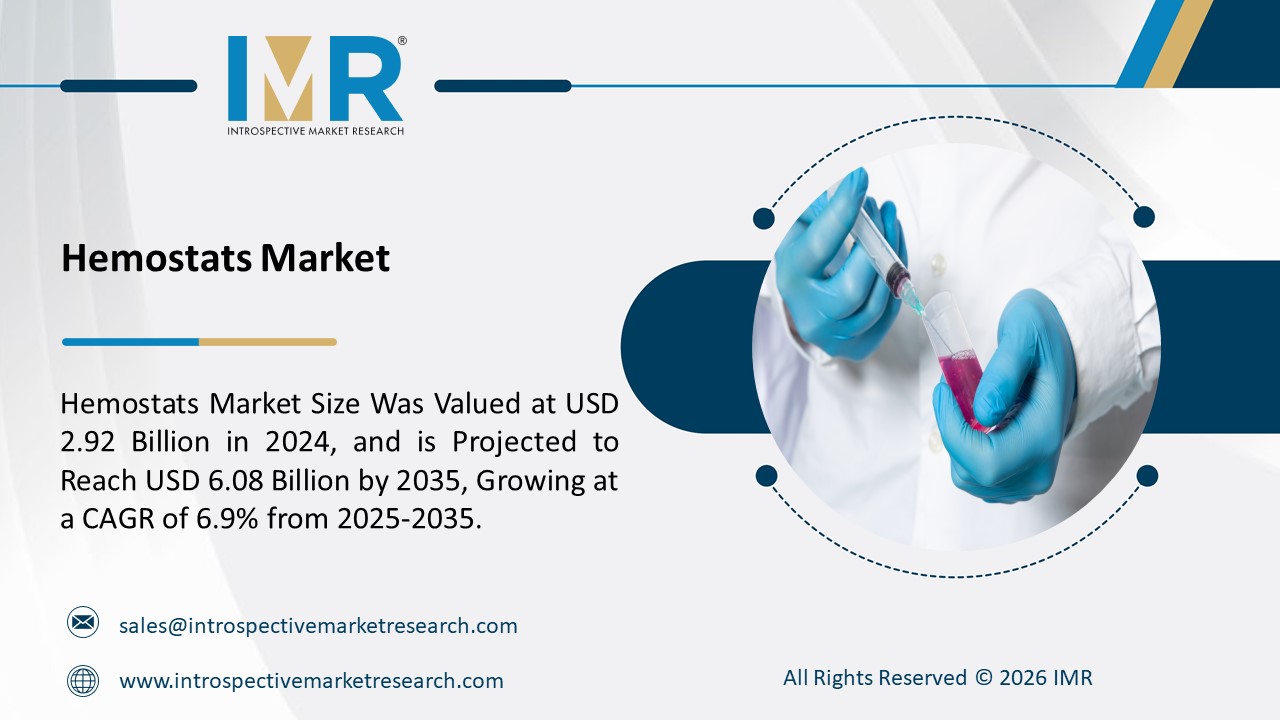
According to a new report published by Introspective Market Research, titled, “Hemostats Market by Product, Application, and End-User,” The Global Hemostats Market Size Was Valued at USD 2.92 Billion in 2024 and is Projected to Reach USD 6.08 Billion by 2035, Growing at a CAGR of 6.9% From 2025–2035.
The Hemostats market comprises a critical class of medical devices and agents designed to control bleeding (achieve hemostasis) during surgical procedures and trauma care. This includes mechanical devices like hemostatic forceps and clips, active agents such as thrombin and gelatin-based sponges, and flowable and fibrin sealants. These products offer a decisive advantage over traditional methods like manual pressure or simple suturing by providing rapid, reliable, and targeted bleeding control, which is essential for maintaining a clear surgical field, reducing blood loss and transfusion needs, and minimizing operative time. The primary use of these products is to enhance patient safety and surgical outcomes across a vast spectrum of medical interventions. They are indispensable in cardiovascular, orthopedic, neurological, and general surgeries, where controlling bleeding from delicate tissues or highly vascularized areas is paramount. Beyond the operating room, advanced hemostats are vital in emergency medicine for trauma cases and are increasingly used in minimally invasive procedures. The market's growth is driven by the rising volume and complexity of surgical procedures globally, the shift towards outpatient and minimally invasive surgery requiring effective internal bleeding control, and the continuous clinical demand for next-generation hemostatic solutions that improve efficacy and ease of use.
The principal growth driver for the hemostats market is the consistent global increase in the volume and complexity of surgical procedures, driven by an aging population and the rising prevalence of chronic diseases. An older demographic experiences a higher incidence of conditions requiring surgical intervention, such as cardiovascular disease, osteoarthritis, and cancer. Simultaneously, advancements in medical technology have made complex surgeries like joint replacements, spinal fusions, and organ transplants more common and survivable. Each of these procedures carries a significant risk of bleeding complications, creating a non-discretionary, procedure-linked demand for advanced hemostatic products to improve patient outcomes, reduce hospital stays, and manage overall healthcare costs effectively.
A significant market opportunity lies in the development and commercialization of next-generation, synthetic and combination hemostatic agents with enhanced properties. There is strong clinical demand for products that offer faster action, greater adhesion in wet surgical fields, and the ability to handle high-pressure bleeding from arterial sources. Innovations such as synthetic polymer-based sealants, combinatorial products that deliver both mechanical barriers and active clotting agents, and hemostats optimized for use in minimally invasive laparoscopic and robotic surgeries represent high-growth avenues. Companies that successfully bring these advanced, differentiated products to market can capture significant share in specialized surgical segments, command premium pricing, and establish strong brand loyalty among surgeons.
Hemostats Market, Segmentation
The Hemostats Market is segmented on the basis of Product, Application, and End-User.
Product
The Product segment is further classified into Mechanical Hemostats, Active Hemostats, Flowable Hemostats, and Fibrin Sealants. Among these, the Active Hemostats sub-segment accounted for the highest market share in 2024. Active hemostats, which include products like thrombin-based gels, powders, and gelatin sponges, dominate because they actively participate in the body's natural clotting cascade to accelerate the formation of a stable clot. They are highly versatile, easy to apply to irregular wound surfaces, and effective for a wide range of bleeding scenarios in both open and minimally invasive surgeries. Their broad applicability and proven efficacy in routine and challenging cases make them a fundamental, high-volume tool in the surgical suite.
End-User
The End-User segment is further classified into Hospitals, Ambulatory Surgical Centers (ASCs), and Specialty Clinics. Among these, the Hospitals sub-segment accounted for the highest market share in 2024. Hospitals remain the dominant end-user as they are the primary center for performing the vast majority of complex, high-risk inpatient surgeries such as cardiovascular, neurological, and major trauma procedures that require the most advanced hemostatic products. Their large surgical volumes, comprehensive emergency departments, and ability to stock a wide range of supplies ensure consistent, high-volume procurement. The growing trend of performing complex surgeries in hospitals further consolidates their leading position in the market.
Some of The Leading/Active Market Players Are-
• Johnson & Johnson (Ethicon) (US)
• Baxter International Inc. (US)
• Becton, Dickinson and Company (BD) (US)
• Integra LifeSciences (US)
• Pfizer Inc. (US)
• CSL Behring (US)
• CryoLife, Inc. (US)
• Teleflex Incorporated (US)
• B. Braun Melsungen AG (Germany)
• Medtronic plc (Ireland)
• Artivion, Inc. (US)
• Gelita Medical GmbH (Germany)
• and other active players.
Key Industry Developments
In January 2025, Ethicon (Johnson & Johnson) received FDA clearance for its novel synthetic hemostatic sealant, HYDROSORB FUSION. The product is designed specifically for laparoscopic surgery, offering easy application through a cannula and strong adherence in wet environments to control bleeding in hard-to-reach areas during minimally invasive procedures.
In April 2024, Baxter International announced a strategic expansion of its manufacturing capacity for its FLOSEAL Hemostatic Matrix in Europe. This investment aims to strengthen the regional supply chain and meet the growing demand for this leading flowable hemostat, which is widely used in cardiac, spinal, and general surgeries across the continent.
Key Findings of the Study
• Active Hemostats and the Hospitals end-user segment held the dominant market shares.
• North America was the largest regional market, supported by high surgical volumes and advanced healthcare infrastructure.
• The rising global volume of surgical procedures is the primary growth driver.
• Key trends include innovation in synthetic and combination agents and optimization for minimally invasive surgery.